


Republicans of Donald Trump argued on Monday that the military strikes against Iran fell within presidential authority as commander in chief, while Democrats insisted the administration had not justified the action and planned a war powers vote this week.
Top officials—including Secretary of State Marco Rubio, Defence Secretary Pete Hegseth, CIA Director John Ratcliffe, and General Dan Caine of the Joint Chiefs of Staff—briefed congressional leaders about the strikes, which began two days after U.S. and Israeli forces launched bombing operations against Iran.
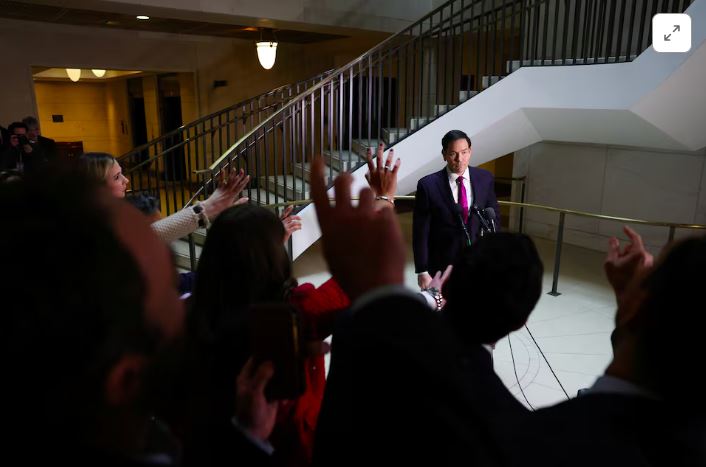
Before the briefing, Rubio told reporters that intelligence indicated an imminent threat to the United States because Israel planned to attack Iran and Tehran was expected to retaliate against U.S. forces. Republicans argued that this constituted the urgent danger justifying action.
House Speaker Mike Johnson defended the operation after the closed briefing, saying it was limited in scope and necessary for defence. “Our commander in chief was facing a very difficult decision,” he said, predicting the operation would conclude quickly.
Democrats countered that the U.S. Constitution grants Congress—not the president—the power to declare war and argued that a potentially prolonged campaign against Iran required legislative approval. They also questioned shifting justifications from the administration, which at different times cited destroying Iran’s nuclear programme, halting ballistic missile development, and even regime change.
Senator Mark Warner, a Democrat, said the administration had not demonstrated an imminent threat to American interests. He acknowledged support for Israel but insisted evidence was needed before placing U.S. troops in harm’s way. “I still don’t think that standard has been met,” he said.
By Monday evening, six U.S. service members had reportedly been killed in the conflict. Administration officials are scheduled to brief lawmakers again, after which Congress may vote on war powers resolutions aimed at limiting further military action without congressional approval.
The U.S. Constitution assigns war-making authority to Congress, though presidents may conduct limited strikes for national security. Republicans hold narrow majorities in both chambers and have so far blocked efforts to require legislative authorisation for the Iran operations.
Republicans of Donald Trump argued on Monday that the military strikes against Iran fell within presidential authority as commander in chief, while Democrats insisted the administration had not justified the action and planned a war powers vote this week.
Top officials—including Secretary of State Marco Rubio, Defence Secretary Pete Hegseth, CIA Director John Ratcliffe, and General Dan Caine of the Joint Chiefs of Staff—briefed congressional leaders about the strikes, which began two days after U.S. and Israeli forces launched bombing operations against Iran.
Before the briefing, Rubio told reporters that intelligence indicated an imminent threat to the United States because Israel planned to attack Iran and Tehran was expected to retaliate against U.S. forces. Republicans argued that this constituted the urgent danger justifying action.
House Speaker Mike Johnson defended the operation after the closed briefing, saying it was limited in scope and necessary for defence. “Our commander in chief was facing a very difficult decision,” he said, predicting the operation would conclude quickly.
Democrats countered that the U.S. Constitution grants Congress—not the president—the power to declare war and argued that a potentially prolonged campaign against Iran required legislative approval. They also questioned shifting justifications from the administration, which at different times cited destroying Iran’s nuclear programme, halting ballistic missile development, and even regime change.
Senator Mark Warner, a Democrat, said the administration had not demonstrated an imminent threat to American interests. He acknowledged support for Israel but insisted evidence was needed before placing U.S. troops in harm’s way. “I still don’t think that standard has been met,” he said.
By Monday evening, six U.S. service members had reportedly been killed in the conflict. Administration officials are scheduled to brief lawmakers again, after which Congress may vote on war powers resolutions aimed at limiting further military action without congressional approval.
The U.S. Constitution assigns war-making authority to Congress, though presidents may conduct limited strikes for national security. Republicans hold narrow majorities in both chambers and have so far blocked efforts to require legislative authorisation for the Iran operations.