
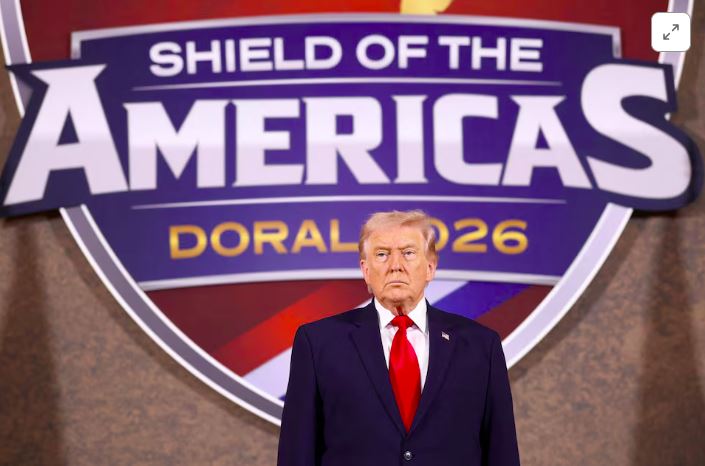

U.S. President Donald Trump welcomed several Latin American leaders to Florida on Saturday to launch a new regional coalition aimed at combating powerful drug cartels.
The initiative, named the “Shield of the Americas,” is intended to strengthen cooperation between the United States and countries across Central America, South America, and the Caribbean in tackling organized crime and drug trafficking. During the summit, Trump signed a proclamation formally establishing the coalition.
Speaking at the event, Trump accused some governments in the region of allowing criminal gangs to gain control of large areas of territory. He warned that the United States would take a tougher approach to confronting transnational cartels.
“Leaders in this region have allowed large parts of the Western Hemisphere to fall under the control of criminal gangs,” Trump said. “We are not going to let that continue.”
Trump described the initiative as part of a more aggressive campaign against organized crime, which he said was a major reason for expanding U.S. involvement in Latin America. He even suggested that the United States could use missiles against cartel leaders if partner countries requested such action.
The U.S. president also pointed to Mexico as a central hub of cartel activity. He predicted political changes in Cuba, saying the country was “very much at the end of the line,” and repeated claims that Cuban officials were in talks with him and U.S. Secretary of State Marco Rubio.
More than a dozen leaders from across the region attended the summit, which also featured discussions on broader global issues. In his more than 30-minute opening speech, Trump touched on topics including Iran, Ukraine, Pakistan, India, and energy markets.
At times, Trump used humor while addressing the mostly Spanish-speaking leaders, joking that he did not have time to learn their languages. Defense Secretary Pete Hegseth also made a light remark during the event, saying he “only speaks American.”
Among the prominent attendees were Argentine President Javier Milei, El Salvador’s President Nayib Bukele, and Chile’s President-elect José Antonio Kast. Bukele’s controversial crackdown on gangs has been widely noted across the region, with some governments viewing it as a model for addressing organized crime.
Other leaders present included Ecuador’s President Daniel Noboa and Honduran President Nasry Asfura. Several of the participating leaders share Trump’s hardline stance on crime and migration, favoring strict enforcement measures and market-oriented economic policies.
The summit also took place amid growing geopolitical competition in Latin America. Although Trump did not mention China directly, he warned that the United States would not allow “hostile foreign influence” to gain a foothold in the Western Hemisphere, including around the strategically important Panama Canal.
China’s economic presence in Latin America has expanded rapidly in recent years. Trade between China and the region reached about $518 billion in 2024, while Beijing has provided more than $120 billion in loans to governments across the Western Hemisphere, according to analysts.
U.S. officials have increasingly expressed concern about China’s investments in strategic sectors such as ports, energy projects, and infrastructure across the region.