
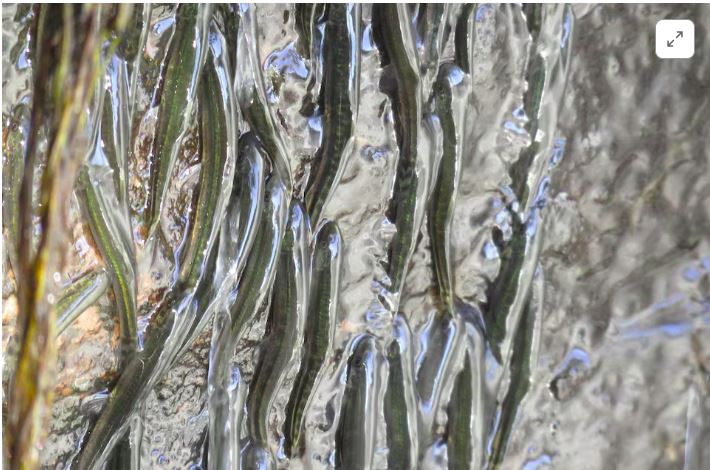


In a remarkable display of nature’s ingenuity, thousands of small fish have been observed climbing a 15-metre (50-foot) vertical waterfall in the Democratic Republic of Congo, demonstrating extraordinary adaptation to extreme environments.
Researchers documented the shellear fish species, Parakneria thysi, scaling the Luvilombo Falls in the upper Congo Basin—a region spanning Central Africa and home to the world’s second-largest rainforest. The fish were seen ascending the vertical rock face during seasonal floods at the end of the rainy season, typically in April and May.
Though the species can grow up to 9.8 centimetres (3.9 inches), only small to medium-sized individuals, measuring 3.7 to 4.8 cm (1.5 to 1.9 inches), were observed making the climb. A single fish may take nearly 10 hours to reach the top, moving in short bursts and pausing frequently. Larger individuals appear too heavy for their fins to support the ascent.
Lead researcher Pacifique Kiwele highlighted the significance of the discovery, saying, “It prompts scientists to be even more vigilant—who would have believed some fish are able to climb waterfalls without photographic and film evidence? There are wonders that surpass our imagination.”
While other fish species can scale waterfalls using various techniques, this is the first documented case in Africa. Observations in 2018 and 2020 showed the fish climbing through the “splash zone,” areas kept wet by spray rather than direct water flow.
The fish use their pectoral fins, supported by pelvic fins and tiny hook-like projections called unculi, to cling to wet rock surfaces, then push upward by wiggling their bodies side to side. Researchers note that the climb is risky: sudden jets of water can knock fish off the rocks, though most falling into water can restart the climb.
Scientists believe the fish ascend upstream to reach habitats with fewer predators and less competition. However, human threats such as illegal fishing with fine-mesh mosquito nets and water extraction for irrigation endanger the species and its habitat.
Kiwele emphasized the broader implications of the discovery: “It is quite possible that other fish species in rapid river habitats are capable of overcoming similar vertical obstacles.” Researchers plan further fieldwork to explore these preliminary observations in other fish families.
This extraordinary behavior sheds light on the little-known world of fish in the Congo Basin and the unexpected ways wildlife adapts to extreme conditions.