
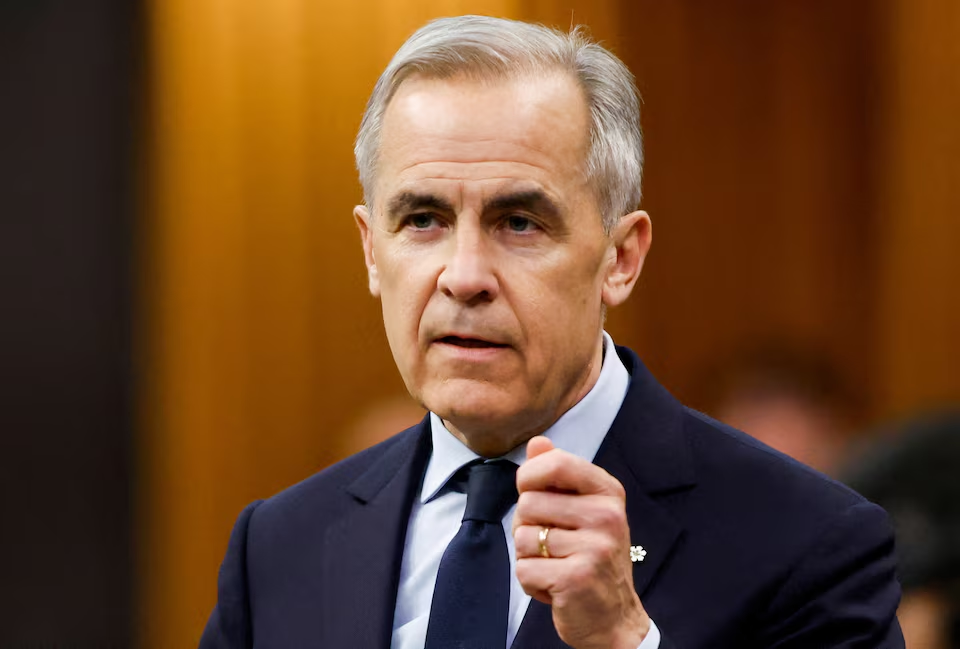


Canadian Prime Minister Mark Carney is on course to secure a parliamentary majority for his Liberal government following Monday’s special elections, a result that would strengthen his ability to advance his legislative agenda amid global uncertainty.
Three by-elections are being held in Ontario and Quebec, including two in long-time Liberal strongholds. Polling suggests the Liberals are likely to win at least two of the three seats, with victory in just one enough to deliver Carney a majority in the 343-seat House of Commons.
Carney’s Liberals currently hold 171 seats and have increasingly positioned themselves to govern more decisively, particularly on economic policy and Canada’s response to trade tensions with the United States under President Donald Trump.
Political analysts say a majority would give Carney significantly greater control over the government’s agenda, removing reliance on opposition support for passing legislation and allowing him to determine the timing of future elections.
“He will be able to pass legislation without having to go to the opposition to secure enough votes,” said Andrew McDougall, assistant professor of Canadian politics at the University of Toronto.
The Liberals have recently benefited from several defections from opposition ranks, further strengthening their position. Most recently, veteran Conservative MP Marilyn Gladu joined the governing party, citing the need for strong leadership in response to economic uncertainty and U.S. tariffs.
Carney welcomed new members into what he described as the Liberal Party’s “large tent,” while emphasizing that core values such as inclusivity, diversity, and protection of Canada’s Charter of Rights and Freedoms remain unchanged.
However, opposition leaders argue the political divide between Canada’s major parties is narrowing. Yves-François Blanchet, leader of the Bloc Québécois, said ideological differences between Liberals and Conservatives are “getting thinner and thinner.”
One of the closely watched races is in Terrebonne, Quebec, where the Bloc is in a tight contest with the Liberals. The seat was previously decided by a single vote before being overturned by the Supreme Court of Canada due to ballot irregularities.
The other two seats are in Ontario, including districts previously held by former Deputy Prime Minister Chrystia Freeland and former Defence Minister Bill Blair. The Liberals are widely expected to retain both.
Political observers say Carney’s leadership marks a shift in Liberal priorities. Laura Stephenson, chair of political science at the University of Western Ontario, said the focus has moved toward economic stability rather than broader social reform agendas seen under former Prime Minister Justin Trudeau.
“He is focused on helping Canada survive the economic turmoil, not remaking society,” she said.
Recent polling from Nanos indicates more than half of Canadians prefer Carney as prime minister, compared with just 23% for Conservative leader Pierre Poilievre, reflecting a significant shift in public sentiment since Carney took over the Liberal Party leadership.
Analysts say Carney’s ability to project economic competence and manage tensions with Washington has strengthened his standing, while opposition alternatives have yet to gain comparable traction.