
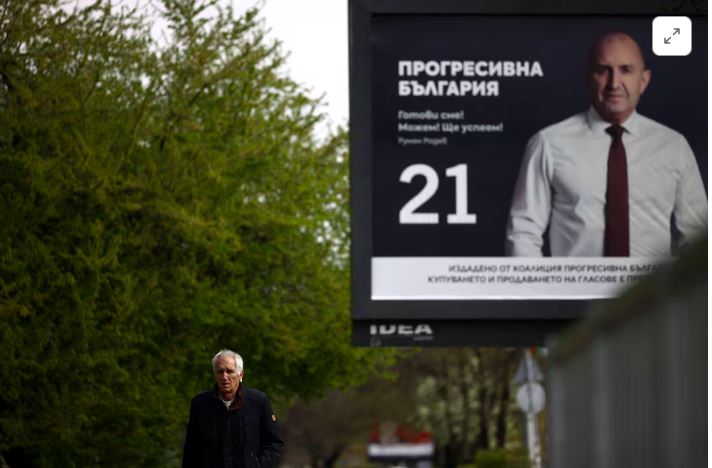


A rural farming community in southern Bulgaria reflects a wider political shift as former president Rumen Radev leads opinion polls ahead of the country’s April 19 parliamentary election, campaigning on a strong anti-corruption message.
In the Haskovo region, farmer Nikolay Vasiliev says years of corruption and political instability have blocked local development and hurt rural livelihoods. Like many voters in the countryside, he now sees Radev as a potential solution.
“I see a leader who can make this drastic change and provide security for people,” Vasiliev said, describing hopes for an end to what Radev calls Bulgaria’s entrenched “oligarchy.”
Bulgaria, a European Union member state, is heading to its eighth election in five years amid prolonged political instability and declining public trust in governance. Despite being a largely ceremonial president since 2016, Radev has remained a dominant political figure and has built support among rural and older voters.
Experts say corruption remains widespread in areas ranging from public procurement to local governance. Bulgaria ranks 84th in Transparency International’s 2025 Corruption Perceptions Index, placing it among the lowest-scoring EU countries.
Radev has promised to dismantle what he describes as “local feudal lords and strongmen” who have stifled regional development.
A potential Radev-led government could significantly shift Bulgaria’s foreign policy orientation. The country joined the eurozone in January and recently signed a security agreement with Ukraine, but Radev has criticized both moves.
He has also signaled openness to improving ties with Russia, positioning himself as one of the few European leaders advocating closer relations with Moscow amid the ongoing war in Ukraine.
“We are the only EU member state that is both Slavic and Eastern Orthodox,” Radev said in a recent interview, suggesting Bulgaria could serve as a bridge in restoring ties with Russia.
Radev’s Progressive Bulgaria (PB) party is polling at around 30%, placing it ahead of the governing GERB party but short of an outright majority. This raises the likelihood of coalition negotiations after the vote.
Possible partners include the pro-European We Continue the Change–Democratic Bulgaria (PP-DB) alliance, though Radev has ruled out cooperation with GERB and the Movement for Rights and Freedoms, whose leader is under Western sanctions.
Analysts say coalition-building will likely determine whether Radev can fully implement his political agenda, particularly his more Russia-friendly stance.
Turnout is expected to exceed 50%, with authorities tightening controls on vote-buying and seeking support from the EU to counter disinformation campaigns.
While Sofia and other urban centers have benefited from economic growth since EU accession in 2007, rural areas like Haskovo continue to struggle with depopulation, underinvestment, and deteriorating infrastructure.
For many voters, however, the priority is not geopolitics but governance and dignity.
“The first word that comes to mind when I think of a leader is ‘dignified,’” said farmer Vasiliev. “To be a dignified leader, you must be a dignified person.”