

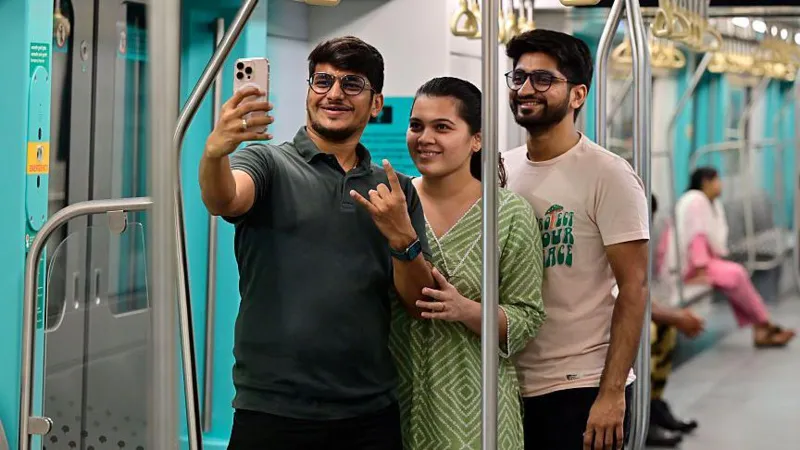

Mumbai – On a recent weekday evening, Mumbai’s newly launched Aqua Line metro appeared strikingly empty. By the time the southbound train reached its final stops, only a handful of passengers remained, and the last station resembled a deserted Soviet-era structure rather than a busy urban terminal in one of India’s most crowded cities.
The Aqua Line, a fully underground 33.5km corridor connecting Cuffe Parade with the Bandra-Kurla Complex (BKC) and airport hubs, was inaugurated last year with expectations of transforming urban mobility in India’s financial capital. Planners had projected daily ridership of nearly 1.5 million passengers. However, current estimates suggest usage is only around a tenth of that figure.
“Not a lot of people are using the line. It’s too expensive,” a ticketing staff member told the BBC at Cuffe Parade station.
The underperformance of Mumbai’s Aqua Line reflects a wider issue across India’s rapidly expanding metro network. Since 2014, the government has invested over $26 billion in metro rail projects across nearly two dozen cities, expanding the network from under 300km to more than 1,000km by 2025. Daily ridership has also increased from around 3 million to over 11 million.
However, experts say these headline figures hide a deeper problem: most systems are significantly underperforming compared to initial projections.
A 2023 study by the Indian Institute of Technology Delhi found actual ridership across many corridors stood at just 25–35% of forecasts. Other research shows even lower figures in some cities—Kanpur as low as 2%, and Chennai around 37% in its first phase. Data from the Institute for Transportation and Development Policy (ITDP) indicates cities like Pune and Nagpur see only 20–50% of expected usage.
Delhi remains a rare exception, with ridership slightly exceeding projections, though experts say this may be due to changes in how trips are counted rather than genuine demand growth.
Transport experts point to several structural issues behind the shortfall.
Aditya Rane of ITDP and Ashish Verma of the Indian Institute of Science say demand projections were often overly optimistic. Verma explains that consultants sometimes inflate estimates to justify project viability, basing forecasts on ideal capacity rather than real-world conditions.
Operational limitations also play a major role. In cities like Bengaluru, peak-hour train intervals can exceed five minutes, while newer routes may see gaps of up to 25 minutes. Many systems operate with only 3–6 coaches per train, far below global metro standards.
Affordability is another key barrier. A single ride on Mumbai’s Aqua Line costs between ₹10 and ₹70, while suburban rail passes remain far cheaper. Experts note that metro travel can consume up to 20% of income for lower-income workers, above global affordability benchmarks.
Fare increases have also affected usage. In Bengaluru, a recent hike led to a 13% drop in ridership, according to Greenpeace data.
Beyond cost and capacity, poor planning and weak integration between transport systems continue to discourage commuters.
Experts highlight a lack of feeder buses, long transfer times between lines, and disjointed operations between metro and bus networks. At some interchange stations in Delhi, transfers can take up to 20 minutes.
“There needs to be better operational integration,” said Nandan Dawda of the Observer Research Foundation.
Safety concerns and poor walkability further limit adoption, particularly for women and elderly passengers. Long distances between stations and final destinations often force reliance on costly taxis or unsafe walking routes.
Despite current challenges, experts believe metro usage will continue to grow gradually as Indian cities face worsening traffic congestion, pollution, and road safety issues.
However, they caution that without better integration, improved last-mile connectivity, and more affordable fares, India’s metro systems may continue to fall short of their intended potential.
“The systems most likely to improve are those that get integration and access right,” said ITDP’s Aditya Rane. “Without that, metros will remain operationally useful but still underperform their original projections.”