

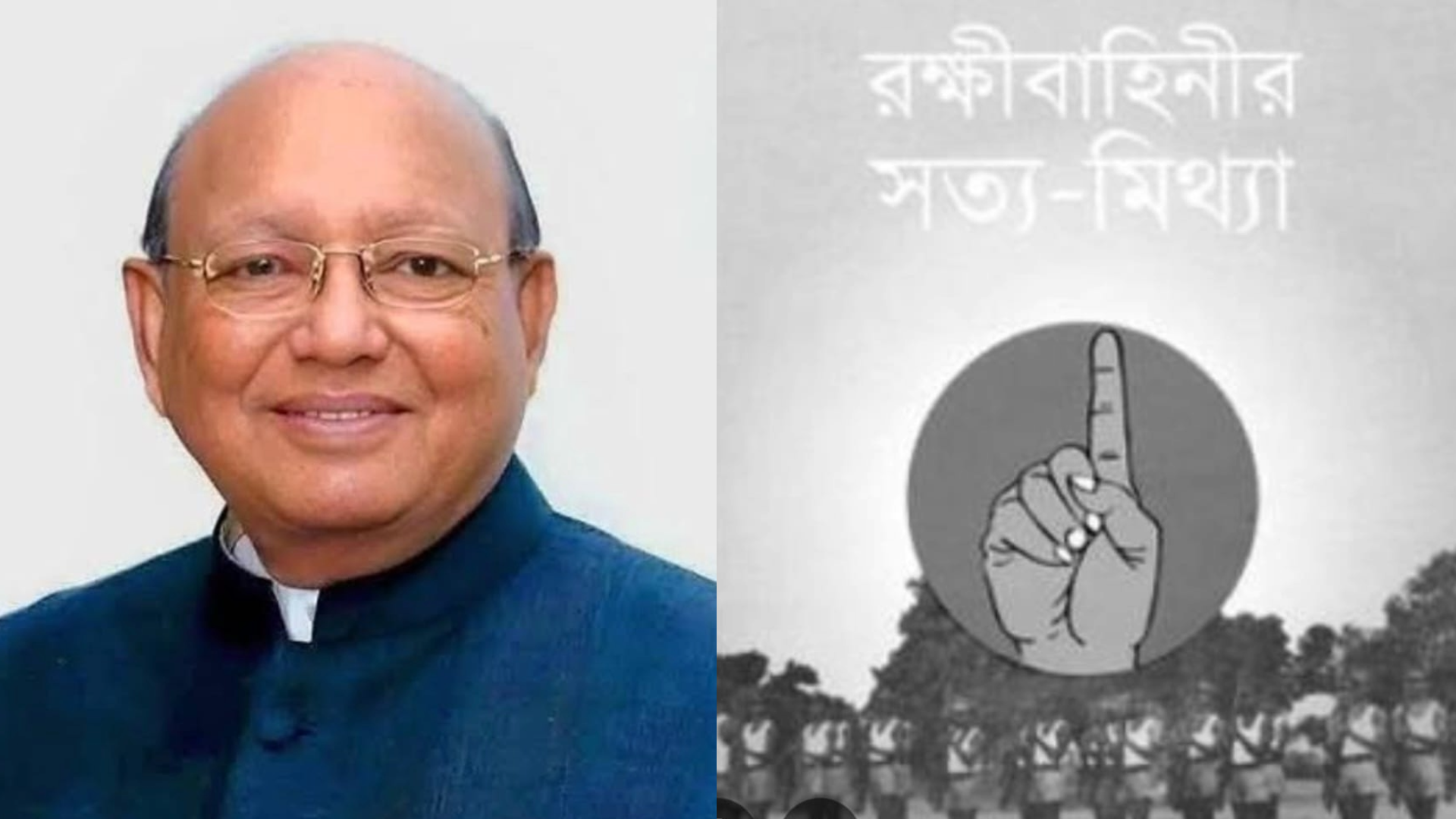

-Md. Kamal Uddin
The history of Bangladesh is a flow where individuals, states, wars, struggles and political ideologies are deeply intertwined. There are some chapters in this history that have become more controversial over time—the Rakshi Bahini is one such chapter. And the recent comments and propaganda being spread around the public leader Tofail Ahmed in the discussion of this history are disrupting the impartial reading of history. The purpose of this article is not to take a position for or against anyone; rather, to try to understand history by placing it in its true context. Tofail Ahmed: The silent organizer of state formation Tofail Ahmed was an important organizer in the political history of Bangladesh. He was a close political companion of Bangabandhu Sheikh Mujibur Rahman and a central coordinator in the initial period of post-independence state governance. His position was the political secretary, whose status is equivalent to a minister in the administrative structure. However, this was not the responsibility of any military or law enforcement agency. His role was limited to state policy formulation, political coordination and administrative communication. There is no reliable historical evidence that he had direct administrative control over the management or operations of a state security structure like the Rakshi Bahini. Rakshi Bahini: Historical Reality of Birth
After the 1971 Liberation War, Bangladesh started its journey with a broken state structure. The country was in deep crisis with a war-torn economy, weak administration, and a collapsed law and order system. The biggest challenge for the state at this time was security and stability. The police force had not yet been fully reorganized, the army had limited capacity, and the emergence of armed groups in various areas further complicated the situation. In this reality, an initiative was taken in early 1972 to form a central security auxiliary force, which later came to be known as the Rakshi Bahini. Its purpose was to assist in maintaining state law and order—especially to act as a supporting force during times of limited police capacity. Structure of the Rakshi Bahini: State or Party? The biggest debate surrounding the Rakshi Bahini is—was it a force of a political party or a state force? According to historical documents, it was a force operating under a state structure. It was managed by a board, which included military and administrative representatives. It was not a private or party militia.
However, in political reality, every state institution cannot remain outside the political debate in the context of time—this is a general fact of history. Training, limitations and post-war reality The members of the Rakshi Bahini were mainly young and newly recruited members who had returned from the liberation war. Their training time was limited, which reflected the practical limitations of the post-war state.
In a war-torn country where the main task was to rebuild the administration, there was little choice but to quickly establish a security structure. In this reality, the activities of the Rakshi Bahini began in a very stressful and critical situation. 1972–1975: The unstable chapter of the state This period was one of the most unstable periods in the history of Bangladesh. Political divisions intensified, armed groups emerged, labor unrest increased in industrial areas, robberies, murders and violence increased in various areas, even police stations were attacked. The state was then forced to handle both reconstruction and security at the same time.
In this context, the Rakshi Bahini was brought into the field, which tried to bring some stability to the law and order situation.
Allegations, numbers and historical controversy The biggest controversy about the Rakshi Bahini is the number of deaths and allegations of human rights violations. But there is a fundamental historical question here – what is the reliable source of these numbers? Any major claim in history requires: impartial research state documents international observations contemporary news documents But many of the various figures that are prevalent about the Rakshi Bahini depend on political statements, assumptions and subsequent interpretations.
Just as exaggeration in history is dangerous, denial also makes history incomplete. Political narratives and rewriting history One reality in the history of Bangladesh is that with every political change, the interpretation of history has also changed. The Rakshi Bahini has sometimes been seen as a “state necessity”, and sometimes as a “political repression tool”. The context has been lost in between these two narratives—which is the most important.
Maulana Bhashani and contemporary understanding It can be seen from various descriptions of the time that many of the members of the Rakshi Bahini were young people who had returned from the Liberation War. There was also confusion in society about their identity and reality. The perception that was created around this force is largely the result of political tension and misinformation. The Army, the Rakshi Bahini and the State Structure At the same time, the army, the police and the Rakshi Bahini—the three structures—were playing different roles. The limitations of the state budget, weapons supply, training and capabilities were a reality. The state was trying to survive within these limitations. Tofail Ahmed: Witness to History, Not a Target Tofail Ahmed is a direct political witness to this entire history. He was an important coordinator in the early stages of state governance, but there is no reliable evidence of his direct involvement in operational decision-making or military management of the Rakhi Bahini. The explanations that are being made around him in recent times tend to simplify the complexity of history to a large extent. The final lesson of history is that history is not a single story—it is a collection of many voices. There is the state, there is politics, there is war, and then there is human life and pain.
Just as one must understand the crisis of the state to understand the Rakshi Bahini, similarly, one must understand the difficult period of state formation to understand Tofail Ahmed. To do justice to history, one must understand the context, go beyond reliance on documents and emotions, and analyze. Ultimately, history teaches us that truth is never linear, but the search for truth is the greatest responsibility of a nation.