

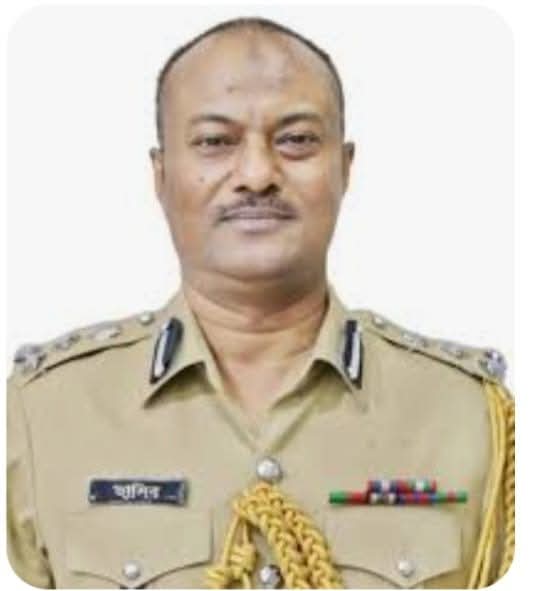

Md. Kamal Uddin: Some people get a place in history because of their rank, and some people get a place in people’s hearts because of their work, honesty and humanity. With the flow of time, positions change, office nameplates change, seats of power change; but people’s love and respect do not change. Because the history written in people’s hearts is not the history of any government gazette, it is the history of feelings, the history of faith. Hasib Aziz is such a name for the people of Chittagong. Today he is not the Commissioner of Chittagong Metropolitan Police. The state has given him even greater responsibility. He is performing important duties as Additional IGP and Head of APBN. But even though he left Chittagong, Chittagong could not leave him. His name still comes up again and again in the alleys of the city, in the chats of businessmen, in the discussions of journalists, in the comments of social media and in the conversations of ordinary people. When people were concerned about some of the recent high-profile crimes, public attacks and law and order situation in the city, I heard one thing from many people – “If Hasib Aziz had been there, perhaps visible initiatives would have been taken to deal with the situation more quickly.” There may be debate about the truth of this statement. But there is no way to deny one thing – the answer to the question of how much people remember an officer is hidden in this memory. Arrival in a time of crisis It was September 2024. The political and administrative situation in the country was going through an uncomfortable reality. As people had expectations on the law and order forces, so too were various questions. At such a time, Hasib Aziz took charge of the Chittagong Metropolitan Police.
Chittagong is not an ordinary city. It is the main seaport of the country. It is the heart of trade. It is one of the driving forces of industry, culture, tourism and economy. The daily lives of millions of people, economic activities worth billions of taka, and the security of numerous important institutions are linked to the law and order of this city. Taking on the responsibility of the security of this city does not just mean taking on an administrative position; it is taking on the responsibility of a huge trust. When the name of Hasib Aziz, the light of inheritance, is mentioned, many remember the name of his father, the late Azizul Haque. He was a respected figure in the history of the Bangladesh Police Force. But inheritance never guarantees success. Inheritance only shows the way. One has to walk that path and create one’s own identity through one’s own honesty, talent and efficiency. Hasib Aziz has walked that path. He has not stayed in the shadow of his father’s identity, but has built his own identity through his own work and leadership. Police means people’s trust Where is the real identity of a police officer? In weapons? In power? In a convoy? Or in the trust of the people? To me, the answer is very clear – the greatest strength of the police is the trust of the people. When a common man goes to the police station, he does not just take a complaint. He takes his pain, his fear, his helplessness and his belief in his last refuge. If that belief is broken, then people’s trust in the law also weakens. Many of those who talk about Hasib Aziz’s leadership mention one thing – he tried to reduce the distance between the police and the people. He believed that the strength of the police is not in fear; in the trust of the people. Field-oriented leadership There are many officers who work inside the files. On the other hand, there are some officers who try to see the reality up close. According to those who have worked with Hasib Aziz, he gave importance to the situation on the field. He wanted to know what was happening, where the problems were, where there was an opportunity for improvement. The greatest quality of a leader is to know the reality. Because problems cannot be solved without knowing the reality. In a busy metropolis like Chittagong, new challenges arise every day. Traffic jams, crime, drugs, juvenile delinquency, social unrest – all of these combine to create a complex environment. An officer has to make decisions within this reality. Efforts to restore morale: The strength of an army lies not only in its equipment; its strength lies in its morale.
If a policeman feels proud of his duty, if he thinks his work has value, then he can work more sincerely. Many believe that Hasib Aziz emphasized on strengthening professionalism, sense of responsibility and public service mentality among policemen. He would praise good work. And if there were mistakes, he would also talk about correcting them. Because leadership does not mean just giving instructions; inspiring people is also part of leadership. Modest yet firm In today’s world, it is easy to show power. But it is difficult to maintain humility even in the midst of power. Those who talk about Hasib Aziz often mention his humble behavior. He was firm, but not harsh. He was confident, but not arrogant. He was administratively strong, but eager to listen to people. These are the characteristics that distinguish an officer from the common man.
In the memory of the people of Chittagong, the success of an officer cannot be measured only in promotions. Real success is measured in the memory of people. Even today, when the people of Chittagong pronounce his name, they do not just remember a former police commissioner. They remember a time, a leadership, a trust, an expectation. People do not always look for someone perfect. People look for someone who sincerely tries to fulfill their duties. This is why some people live in memory. Time will change beyond the boundaries of time. New officials will come. New challenges will come. New history will be written. This is natural. But some names are written deeper than the pages of history. They are written in the hearts of people. Just as the waves of Karnaphuli do not stop, neither does time. But just as people standing on the banks of Karnaphuli remember the memories of the past, a city also remembers its beloved people. Chittagong still remembers many people. It remembers freedom fighters. It remembers cultural workers. It remembers people who worked for the society. And in that list of memories, the name of a police officer is also mentioned – Hasib Aziz. The biggest achievement in life is not a position. The biggest achievement is people’s respect. The biggest achievement is people’s love. The greatest achievement is to leave a memory that time cannot erase. Hasib Aziz may have never considered himself a hero. He may have only tried to do his duty. But he has left a positive presence in people’s memories. Today, he is serving elsewhere. But in the minds of countless people in Chittagong, he is still a symbol of responsible, courageous and humane police leadership. The pages of time will turn. New stories will be written. New people will come. But some names will remain—with respect, with love, in the depths of memory. And one of those names—Hasib Aziz.