

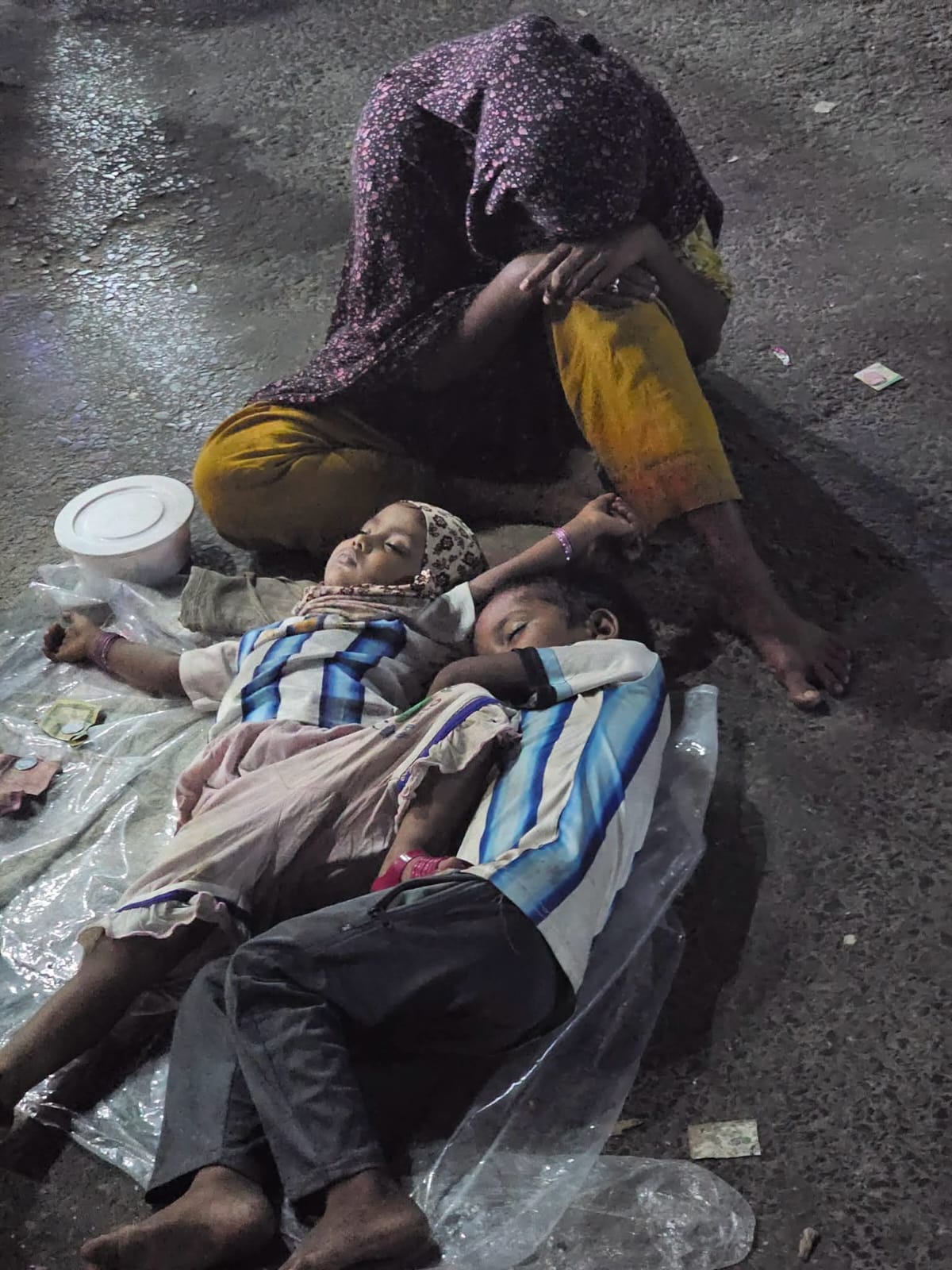

- Md. Kamal Uddin The night is deep. Artificial lights are flashing all around. The hustle and bustle of the city is slowly coming to a halt. People are returning to their safe haven, to their comfortable beds, to the warm presence of their families. But this night is not the same for everyone. Look at this picture. A mother is sitting with her head down. Her face is not visible. Maybe she is trying to hide her tears. Maybe she is ashamed to express her helplessness in front of her children. Or maybe she is looking at the sky and asking the Creator—“Why didn’t you give me the ability to put a handful of food in my children’s mouths?” Two children are sleeping on plastic in front of her. No, this is not a peaceful sleep. This is the sleep of a body defeated by hunger. This is the sleep of a life surrendered to fatigue. The two children may have said for a long time—“Mom, I’m hungry.” The mother may have said—“Wait a little longer, Dad.” But that wait is not over. The food did not come. Only night has come. Finally, hunger and fatigue have closed their eyes together. But can a mother sleep? No, the mother did not sleep. She is sitting. With her head bowed. With a thousand storms in her chest. The biggest pain in the world for a mother is to see her child hungry. It is easy to go hungry herself, but it is impossible to bear the child’s hunger. Yet the cruel reality of the world forces her to see that unbearable scene every day. Today, this picture is not just a family. It is a reflection of thousands of helpless mothers and children in Bangladesh.
We hear stories of development. We see tall buildings. We see the inauguration of new projects. We see accounts worth billions of taka. But where is that development for these children? Why would a child sleep hungry under the open sky? Why would a mother cry in hiding when she can’t feed her child? Why are basic human rights still a dream for many? This question is not only for the state, but for each of us. Because society is not built by the government alone. Society is built by the humanity of people. If we don’t see the hungry child next door, if we don’t hear the cry of a helpless mother, then where is the value of our education, wealth, and civilization? If we don’t see tears in our eyes today after seeing this picture, then perhaps our hearts have dried up. On one hand, a festival of waste, on the other hand, a night of hunger. On one side, luxurious arrangements, on the other, a childhood tormented by hunger.
What kind of society is this?
What kind of civilization is this?
What kind of humanity is this?
Looking at these children, it seems – did they just want a handful of rice? Did they want a safe place to sleep? Did they want a little love? Their request is so small, yet our failure is so huge. Today, the silent cry of this mother is floating in the air. That cry has touched the sky, but has it touched our conscience? Let’s not see this picture as just a picture. It is a mirror. Where the cruel reality of our society is reflected. Some questions for the conscience – in a country where even a child goes hungry, is that development real development? In a society where a mother spends the night without feeding her child, how humane is that society? Will we just sigh after seeing pictures on social media, or will we actually do something? Do we have no responsibility towards the helpless people around us? Who will build the future of these children? Today’s picture shows us with our fingers –
hunger is not just a stomachache, hunger is a test of the conscience of a nation. And have we really been able to pass that test? Or are we being defeated by humanity little by little every day? Each of us has to answer this question. Today or tomorrow, in the court of one’s own conscience.