
UK Parliament Ends Centuries-Old Hereditary Seats in House of Lords
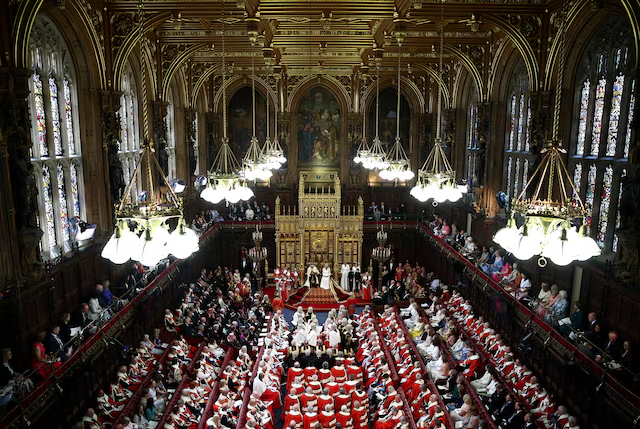
United Kingdom’s parliament has approved new legislation removing the remaining hereditary peers from the House of Lords, effectively ending a centuries-old system that allowed aristocrats to hold seats in the chamber by birth.
The upper house passed the Hereditary Peers Bill on Tuesday evening, completing a reform process that began more than 25 years ago. The move fulfills a major campaign pledge from Prime Minister Keir Starmer and his Labour government to modernize the parliamentary system.
Angela Smith, leader of the House of Lords, said the chamber plays a vital role in the country’s bicameral parliament but argued that membership should not depend on inherited titles. She described the passage of the bill as a significant first step toward broader reforms, which are expected to address issues such as retirement rules and participation requirements for members.
Before the new legislation, 92 hereditary peers were still allowed to sit and vote in the House of Lords. Their presence was part of a temporary compromise introduced in 1999, when more than 600 hereditary members were removed during reforms led by former Labour prime minister Tony Blair, who had criticized the system as outdated.
Under the new arrangements, around 15 Conservative hereditary peers are expected to receive life peerages, although it will be up to the party to decide which members are nominated.
The House of Lords, located in the Palace of Westminster, currently has around 800 members. Most are appointed for life by the prime minister on the recommendation of political parties or an independent commission, alongside bishops from the Church of England.
Critics have long argued that the appointment system needs further reform, saying it encourages political patronage and has created the world’s largest parliamentary upper chamber—larger than the 650 elected members who sit in the House of Commons.
Although the House of Lords can review and amend legislation, it cannot permanently block bills passed by the elected lower chamber, which has the authority to override its changes.
TheDailyTourist © 2026 . All rights reserved.
 প্রিন্ট করুন
 সেভ করুন