


Canadian Prime Minister Mark Carney has drawn international attention for bluntly declaring that the era of a rules-based global order is coming to an end. But at home, he has been far less successful in addressing a more immediate issue for many Canadians: the rapidly rising cost of food.
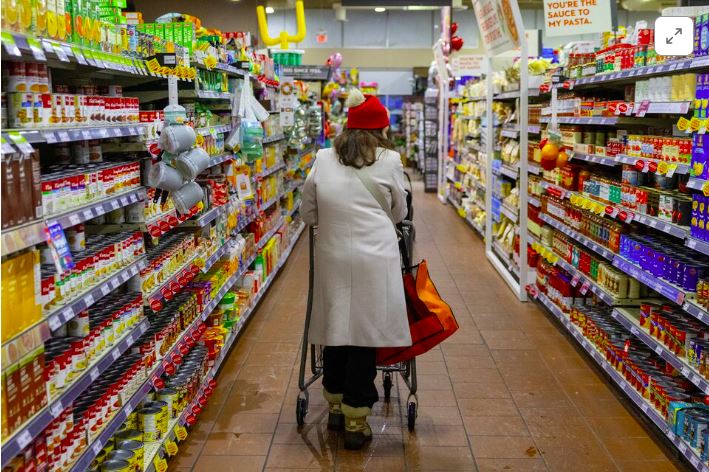
Government data shows Canada recorded the highest food inflation among Group of Seven countries in December. Food prices rose 6.2% year-on-year, about double the pace seen in the United States and more than three times the rates recorded in France and Germany.
Carney leads a minority government and depends on support from other parties to remain in power. While Canadians continue to view him as the strongest leader to handle threats from U.S. President Donald Trump, analysts warn that public sentiment could shift quickly if fears of American aggression ease and cost-of-living concerns become the dominant political issue — as they have in Britain, the U.S. and other countries.
A Bank of Canada statement this week said grocery prices have jumped 22% over the past three years, compared with a 13% increase for other consumer goods. The central bank noted that last year’s food inflation was largely driven by imported products, supply shortages linked to extreme weather, and the sharp fall of the Canadian dollar in 2024.
Last week, Carney announced a five-year tax credit aimed at supporting Canada’s poorest 12 million people, saying it would ensure Canadians receive the help they need immediately. His government has also introduced measures such as allocating C$500 million to assist businesses facing supply chain disruptions and allowing producers to write off certain greenhouse-related costs.
However, economists argue these policies may offer short-term relief without actually reducing grocery prices, which are now one of the biggest drivers of inflation.
Jeremy Kronick of the C.D. Howe Institute said the measures do little to bring down food costs. University of Guelph professor Michael von Massow echoed the concern, saying the tax credit may help families forced to choose between rent and groceries, but it will not lower prices.
A spokesperson for Finance Minister Francois-Philippe Champagne said the initiatives were only the beginning and that the government was targeting deeper structural problems that could reduce grocery prices over the medium and long term.
In late 2024, former Prime Minister Justin Trudeau introduced a two-month suspension of sales tax on selected goods to boost household spending power. The results were mixed, with restaurants reporting higher sales while other businesses saw little change.
Experts say Canada faces unique structural challenges that make food especially expensive, including the dominance of five major grocery companies, a shorter growing season, and heavy dependence on the United States for produce — leaving the country vulnerable to supply chain shocks.
University of Toronto researcher Michael Widener noted that labour and transportation costs are higher in Canada, and the country is geographically distant from many markets. He added that reliance on produce from the U.S. and Mexico makes Canada particularly exposed to disruptions.
Dalhousie University food distribution expert Sylvain Charlebois said the government should focus on reducing transportation barriers between provinces, lowering internal production costs linked to labour laws and carbon taxes, and increasing competition in the grocery sector.
Although Canada is a major producer of canola, wheat, dairy and meat, it depends heavily on imported fresh produce during winter. As a result, fruit and vegetables often cost at least twice as much as they do in Britain and parts of Europe. For example, a two-pound bag of carrots costs about $2.21 in Canada, compared with $0.95 in Britain and $1.18 in Germany, according to online retailers.
Conservative leader Pierre Poilievre has frequently criticized the rising cost of food, but the issue has not significantly boosted his support. Opinion polls still show him trailing Carney by double digits, while Carney’s approval ratings have risen following his widely praised Davos speech, where he accused major powers of using “economic integration as weapons.”
A Nanos poll on January 30 found 54% of Canadians approved of Carney. However, it also showed inflation is becoming a bigger concern, with 11.4% naming it their top issue, up from 9.3% a month earlier.
Conservative co-deputy leader Melissa Lantsman argued that “no amount of tax rebates” will solve food inflation, noting that more than 2 million Canadians — around 5% of the population — now rely on food banks, the highest level ever recorded.
Angus Reid president Shachi Kurl said Trump’s threats to annex Canada have temporarily overshadowed food costs as a voting issue, but warned that could change.
“For now, food prices aren’t deciding elections,” Kurl said. “But if Canadians believe their leader can be held accountable, it may become one.”
Former Conservative aide Ashton Arsenault said soaring food costs should be an opportunity for the Conservatives, but many Canadians have become resigned after years of steady price increases.
“Even when things get really bad, Canadians remain polite and don’t take to the streets,” he said. “This problem is extremely hard to fix, and solving it will take political courage.”