


— Md. Kamal Uddin
Police do not simply mean a person wearing a uniform. Police represent the discipline of the state, the security of citizens, and, in times of danger, the last line of protection for ordinary people. When the night grows deep and the city falls silent, police officers remain awake to ensure public safety. Their duty is to enforce the law without considering the identity of a criminal, political affiliation, or the influence of powerful individuals.
If a police officer faces allegations while carrying out that responsibility, the allegations should certainly be verified through a proper investigation. But branding a responsible police officer as a criminal merely because allegations have been raised is not the path to justice.
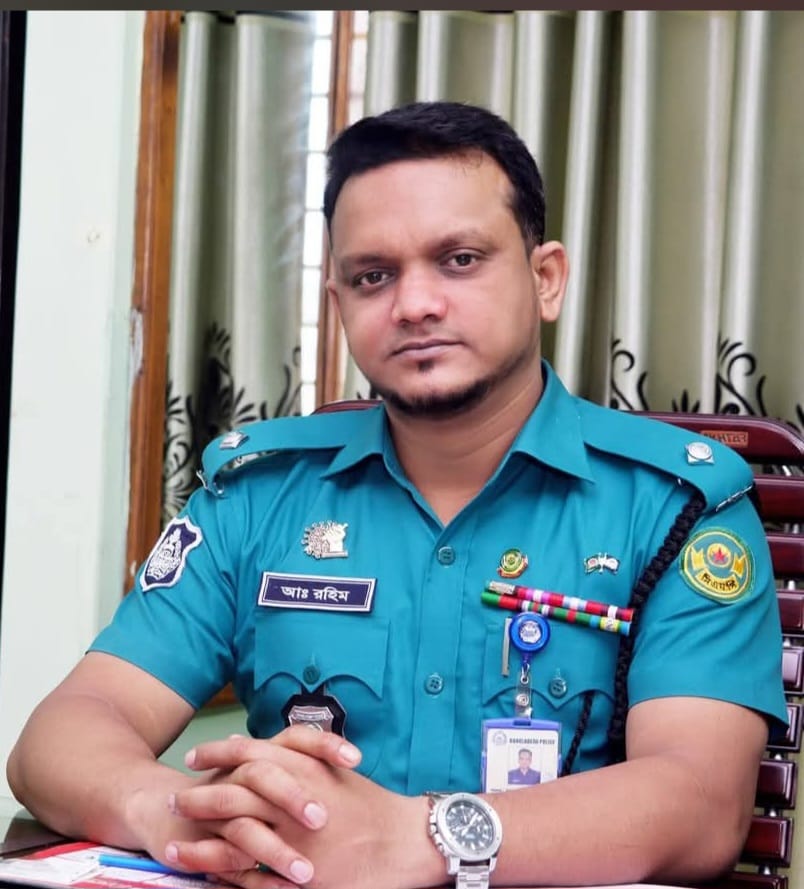
Various allegations and a case have now emerged against Mohammad Abdur Rahim, Officer-in-Charge (OC) of Khulshi Police Station. But before judging him through any political lens, we must remember that he is serving the state as a professional police officer. Governments change and political leadership changes, but the police force remains responsible for ensuring the security of the people.
The police do not belong to any political party, nor should individual officers be defined by a political identity. Their identity is simple: they are members of the state’s law-enforcement agency. Therefore, in the Khulshi Police Station incident as well, emotion should not determine the outcome. Truth, evidence and an impartial investigation should have the final say.
If any wrongdoing by the police is proven, punishment must follow. But performing a lawful duty should never itself be treated as a crime.
If any citizen alleges wrongdoing, abuse, misuse of authority or unlawful conduct by the police, the allegation should be investigated seriously. This is a citizen’s right to justice.
At the same time, we must remember that an allegation is not a crime. Filing a case does not mean someone has been found guilty. And being accused does not make someone a criminal.
The truth of an allegation must be established through testimony, evidence, investigation and the judicial process. If we forget this fundamental principle, we risk weakening the very structure of justice.
Mohammad Abdur Rahim is serving as the Officer-in-Charge of Khulshi Police Station. The responsibility of a police station OC is not to satisfy any political side. His duty is to operate the police station according to law and maintain law and order in the area.
If he conducts an operation, its legality can be questioned. If a decision appears wrong, an explanation can be sought. If a citizen is harmed, a complaint can be filed.
But labeling a professional police officer with a political identity without evidence cannot be considered responsible conduct. The first identity of a police officer is his profession.
This is something that needs to be remembered particularly at this moment.
The police do not belong to any political party. They are a state institution responsible for maintaining law and order.
The government in power today may not remain in power tomorrow. Political leadership will change, power will change hands and administrative structures may undergo changes. But the need to maintain law and order will never disappear.
The police therefore cannot be politically colored every time the government changes. Governments will come and go, but the police must continue to serve the people and protect their safety. This is the continuity expected of a state institution.
When a police officer conducts an operation at night, he does not always work in a normal environment. While attempting to apprehend criminals, he may face resistance, confront an agitated crowd or even put his own safety at risk.
There are situations where immediate decisions are necessary to control law-and-order conditions. However, those decisions must remain within the law.
That is where the balance lies.
Police must have the authority necessary to enforce the law, but there must also be accountability against any misuse of that authority. The state must ensure both: that the police have the legal authority to act and that such authority is not abused.
This is a question we often overlook.
If a police officer becomes afraid of facing complaints or cases every time he attempts to apprehend a criminal; if he hesitates to conduct a lawful operation; or if he becomes fearful of making necessary decisions during a crisis, ordinary citizens will ultimately suffer the most.
Criminals will not hesitate to exploit weakness within law enforcement.
If the police at a particular station lose the confidence and morale necessary to perform their duties, crime control will weaken. Public safety will be threatened, and ordinary citizens may lose confidence in the police station.
Therefore, police accountability is necessary. But their ability and morale to perform lawful duties must also be protected.
Wearing a police uniform does not place anyone above the law.
If a police officer genuinely violates the law, abuses authority, commits torture, uses unlawful force or becomes involved in a crime, action must certainly be taken against that officer.
A departmental inquiry may be conducted where necessary. Legal proceedings may follow. If guilt is proven, punishment must be imposed. If the law provides for dismissal from service in such circumstances, that provision should also be applied.
But declaring a police officer guilty before an investigation has been completed is not only contrary to justice; it may also undermine the investigation of genuine wrongdoing.
There is no scope to take the allegations surrounding Khulshi Police Station lightly. Every aspect of the allegations should be properly examined.
Why did the police go to the location at the time of the incident? Was there a legal basis for their presence or action? What instructions or information did the police have? What was the actual situation during the operation? Was excessive force used? Is the allegation of damage to anyone’s property true? What do medical records say regarding claims of injuries? What can be seen in video or CCTV footage?
Finding answers to these questions is the responsibility of an investigation.
Let evidence speak, not rumors.
An important principle of justice is that a decision cannot be reached simply by hearing one side.
The complainant’s statement is important, but so is the statement of the accused police officers. To establish the complete picture, investigators should examine eyewitness accounts, video footage, medical records, police documents and other relevant information.
The truth is rarely contained completely in the words of one side. It must be established through a careful search for facts.
Placing a newly appointed Officer-in-Charge at the center of a political controversy from the very beginning is not a sign of a healthy administrative environment.
His performance should be evaluated on the basis of his professional responsibilities.
Has he been successful in maintaining law and order? Is he taking lawful action against criminals? Is he listening to ordinary citizens? Is he managing police personnel professionally? Is he following the law and regulations?
The answers to these questions should form the basis of his professional assessment.
Personal allegations should not become the standard. Performance should.
We do not want a police force that commits injustice against citizens.
At the same time, we do not want a police force that becomes afraid to act against criminals.
We want police officers who know the law, follow the law, respect citizens, act firmly against criminals, do not abuse their authority and accept accountability when they make mistakes.
That is the police the people deserve.
That is the police of the state.
Responsible journalism is particularly important when reporting on the Khulshi Police Station incident.
If there are allegations against the police, they should be reported. If there is evidence of wrongdoing, it should be investigated.
But simply because allegations have been raised against the police does not mean those allegations should be presented as established facts. Likewise, publishing a report solely on the basis of allegations without seeking the police version cannot be considered complete journalism.
Evidence alongside allegations, information alongside statements, and conscience alongside public emotion—these are what make journalism responsible.
The allegations brought against Mohammad Abdur Rahim, OC of Khulshi Police Station, and others should be investigated impartially.
If the allegations are proven true, legal action should follow. If the allegations are found to be false, the accused should also have the opportunity to seek legal remedy.
But one thing must never be forgotten: the police cannot be placed above the law, nor can they be made so fearful of the law that they become incapable of performing their duties.
Citizens have the right to make complaints. The accused have the right to defend themselves. The relevant authorities are responsible for conducting investigations. And the final determination of guilt or innocence belongs to the court.
Therefore, the controversy surrounding OC Abdur Rahim of Khulshi Police Station should be viewed within the framework of law and evidence, rather than through a political lens.
If a police officer has genuinely committed a crime, there is no reason to protect him. But if an officer has performed his lawful duties in the interest of public safety, there is equally no reason to unnecessarily turn him into a subject of controversy.
The police do not belong to any political party. The police do not belong to any individual. The police are a state institution responsible for maintaining law and order.
Governments will come and go. Political realities will change. Power will change hands. But the police officer who responds to crime in the darkness of night, stands beside people in times of danger and controls situations when law and order breaks down will continue to have a responsibility to the public.
Therefore, let allegations be investigated—but let duty not become a punishable act. Let action be taken when wrongdoing is proven—but let there be no condemnation before proof.
The police should be strengthened within the law, not weakened by fear of it.
For OC Abdur Rahim and every police officer, the same principle should apply: accountability before the law, firmness in performing lawful duties, and a commitment to public safety.
That should be the policing philosophy of a civilized, democratic and law-based state.