

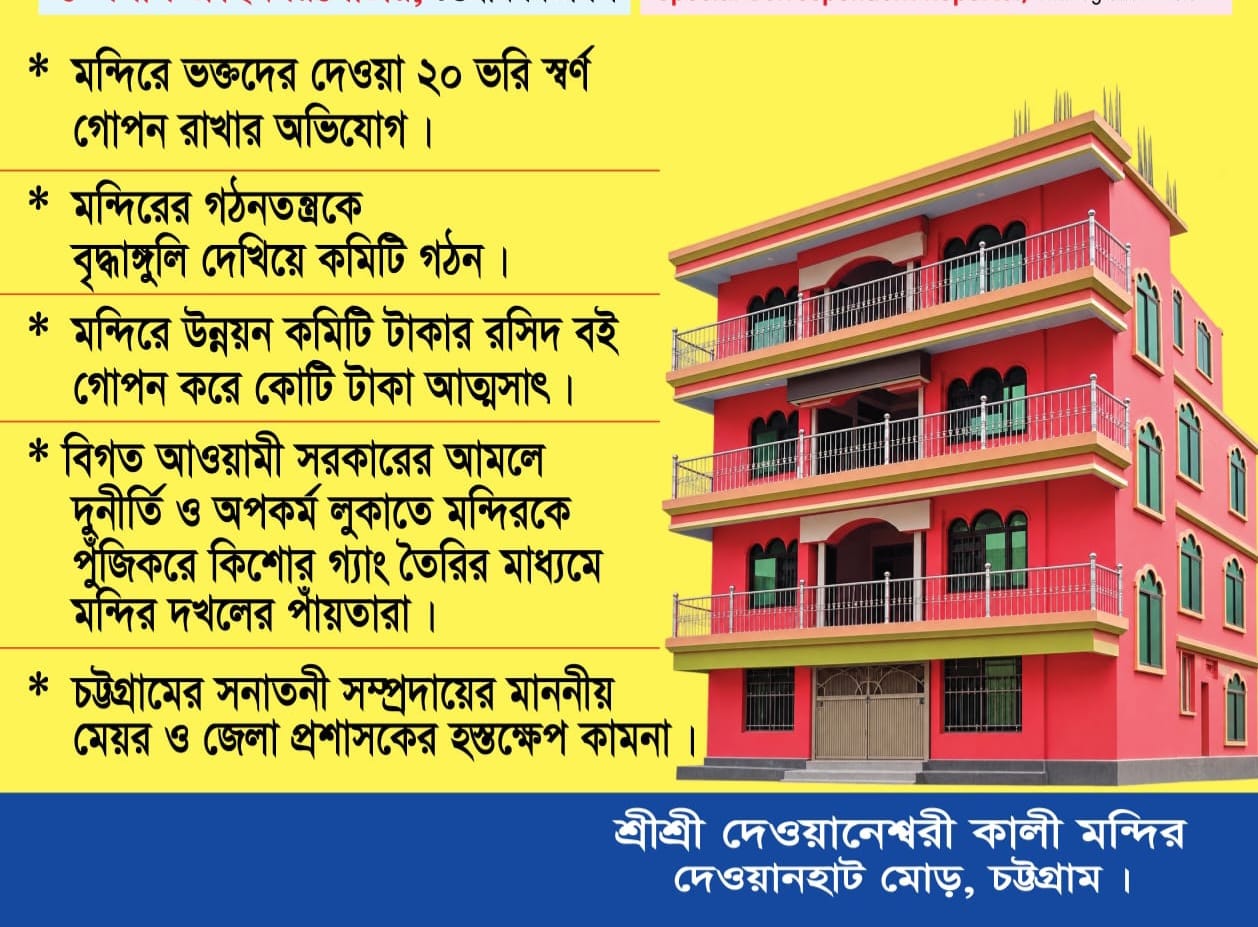

By Arup Chandra, Chattogram:
The historic Shree Shree Dewaneshwari Sarbojanin Kali Temple in Dewanhat, Chattogram, widely known as Dewaneshwari Kalibari, has long been closely associated with the religious beliefs, culture and heritage of the Hindu community in Chattogram.
Devotees gather at the temple every year on the occasions of Kali Puja, Shyama Puja, Diwali and various other religious events. However, several serious questions have recently emerged regarding the management of the temple, formation of its committee, donations and contributions, valuable gold ornaments, and its income and expenditure accounts.
A section of local Hindu devotees alleges that the current management committee was formed without properly following the temple’s constitution.
They also allege that there is a lack of transparency regarding nearly 20 bhori of gold ornaments donated by devotees. Questions have also been raised over receipt books used to collect donations for development and other activities, as well as the related financial records.
Some complainants have expressed concern over possible financial irregularities involving a substantial amount of money. However, none of these allegations can be considered established facts without an investigation.
Local devotees therefore demand an impartial investigation, an audit of the accounts, and the publication of relevant documents so that the truth can be established.
One of the most sensitive issues concerns the temple’s gold ornaments.
Local devotees claim that approximately 20 bhori of gold ornaments have been donated to the temple over the years. However, they allege that no clear and comprehensive record has been presented to ordinary devotees showing the list of ornaments, their weight, information about donors, place of storage, history of use, and current whereabouts.
When contacted by phone regarding the matter, temple management committee President Dhirendra Das Gupta said that he could not show the temple’s gold ornaments without permission from senior officials.
Regarding accountability, the essence of his statement was that the management committee oversees the matter and does not need to answer to anyone.
The accuracy and full context of this statement, however, need to be verified against relevant documents and the temple’s constitution.
Following the statement, questions among local devotees have become more pronounced: Should records of valuable assets belonging to a public temple remain confined only to the management committee?
When contacted, temple management committee General Secretary Amal Karmakar said he knew nothing about the matter and advised speaking to the president.
The apparent lack of clarity in the statements of the president and general secretary regarding important valuable assets of the temple has further increased concerns among local devotees.
A review of the temple’s written accounts, asset register and minutes of committee meetings could, however, clarify the actual situation.
When media workers contacted temple management committee Joint General Secretary Bishnu Dey Abhi, he told them not to concern themselves with these issues.
He also described the matters as their “personal affairs.”
This statement has also raised questions among local residents. The extent to which donations, contributions and financial management of a public religious institution can be considered personal matters should be determined on the basis of the constitution, applicable laws and relevant documents.
Important allegations have also been raised regarding the structure of the temple’s management.
Local devotees claim that the current committee was formed without following the constitution amended in 2019.
They allege that several fundamental provisions of the constitution have been violated, including Clauses 6(g), 11(a), 12(f), 17(j), 25(b), 26(e), 27(c), the second part of 28(chha), 29(c), 31(b), and 33(a) and (b).
In particular, they have questioned the structure of the executive committee under Clause 11(a).
According to the allegations, the constitution provides for a 35-member executive committee, whereas the current committee consists of 41 members.
Questions have therefore arisen as to whether the constitution was amended, and if so, when and how. Was such an amendment approved at a general meeting? What is the legal basis for the 41-member committee?
Local devotees have demanded publication of the constitution, minutes of general meetings, approval documents and other relevant records concerning the formation of the committee so that these questions can be answered.
Locals further allege that long-serving, dedicated and respected devotees were not properly recognized and that attempts were made to form the committee based on personal preferences and dislikes.
They claim this has damaged long-standing mutual trust in the management of the temple and created divisions among the devotee community.
However, this allegation also requires impartial verification. The actual facts could be established by examining who was excluded, how the committee was formed, and what the constitution stipulates.
Various allegations have also been raised regarding the temple’s financial management.
According to several local sources, money has been collected in the name of development and other activities, but proper accounts of all the funds have not been made public.
Questions have also been raised about the use and preservation of receipt books and whether the collected funds have been properly reconciled with the accounts.
Some people have expressed concern over possible financial irregularities amounting to as much as Tk 1 crore. However, there is currently no independently verified evidence publicly available to establish such allegations of embezzlement.
To determine the truth, it is necessary to examine the receipt books, bank accounts, details of cash transactions, expenditure vouchers, donor lists, development project costs and previous audit reports.
An independent audit of these documents could clarify whether any irregularities have occurred in the management of the temple’s finances.
One of the most concerning allegations involves attempts to use teenagers in connection with control and influence over the temple.
Some locals allege that, in the past, an influence network was created around the temple and attempts were made to use juvenile groups to maintain political influence and conceal various irregularities.
However, as this is a serious allegation, it would not be appropriate to hold anyone responsible without evidence.
Local residents are demanding an investigation by law enforcement agencies.
They want investigators to determine whether any organized group of youths or teenagers was used in connection with the temple, who may have been behind them, and whether there were any attempts to take control of the temple or exert undue influence over it.
The position of members of the local Hindu community is clear.
Dewaneshwari Kali Temple is not the personal property of any individual, family, group or political force. It is a public religious institution.
If devotees’ donations, endowed properties, gold ornaments, land and other assets are held by the temple, transparency and accountability in their management are essential.
If any irregularities have occurred, they must be investigated. If any allegations are false, that should also be established through an investigation.
No one should be declared guilty prematurely through the media. What is needed are documents, evidence and an impartial investigation.
Local devotees have raised the following demands to resolve the ongoing controversy surrounding Dewaneshwari Kali Temple:
- Publication of complete income and expenditure accounts for the past several years.
- Verification of the list, weight, source and current whereabouts of the approximately 20 bhori of gold ornaments.
- Arrangement for an independent and impartial audit.
- Verification of the legality of the committee formation in accordance with the constitution amended in 2019.
- Investigation into allegations of attempts to take control of the temple, extortion, intimidation or the use of juvenile gangs in connection with the temple’s property, donations and religious environment.
- Ensuring effective administrative monitoring to protect the temple’s security and religious environment.
In the wake of the situation, members of the local Hindu community have sought urgent intervention from the Deputy Commissioner of Chattogram, the Mayor of Chattogram City Corporation and the relevant law enforcement authorities.
They expect the administration to verify the temple’s documents, assets, financial records and committee formation process—not in favor of any particular side, but in the interest of uncovering the truth.
Whether the allegations are found to be true or false, they believe an independent investigation is necessary. If the allegations are substantiated, legal action should follow; if they are proven false, those accused should be cleared of responsibility.
The questions raised by local devotees regarding Dewaneshwari Kali Temple may ultimately be resolved through an investigation.
But one thing is clear.
Allegations should not be answered with counter-allegations; they should be answered with documents.
If there is an account of the 20 bhori of gold, it should be verified.
If there are records of income and expenditure, they should be audited.
If the committee formation is valid, evidence of its legality should be available in the constitution and relevant documents.
And if any allegation is baseless, that too should be established through an investigation.
Because the sanctity of a temple is upheld not only by the lamps lit during worship, but also by transparency and accountability.
The dispute surrounding Dewaneshwari Kali Temple must not, under any circumstances, become a cause for communal division, conflict or people taking the law into their own hands.
This is the expectation of concerned members of the local community.
Their demand is simple:
“Let Dewaneshwari Kalibari remain transparent, safe and for everyone—not the property of any individual or group.”