

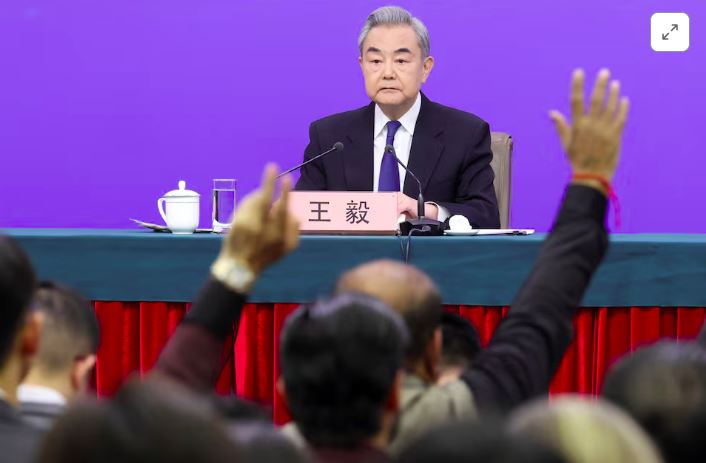

China’s top diplomat said on Sunday that dialogue between the United States and China is essential to prevent global misunderstandings and possible confrontation, ahead of an anticipated summit between Chinese President Xi Jinping and U.S. President Donald Trump later this month.
Chinese Foreign Minister Wang Yi warned that a lack of engagement between the world’s two largest economies could lead to miscalculations with serious global consequences.
“Failure to engage between the two nations would only lead to misunderstandings and misjudgements, escalating toward confrontation and harming the world,” Wang said at a press conference on the sidelines of China’s annual parliamentary meeting in Beijing.
Wang said preparations for high-level exchanges between the two countries are ongoing, but both sides must work to create a constructive environment and carefully manage their differences.
The comments come as global tensions rise following the war launched by the United States and Israel against Iran. The conflict has reportedly killed more than 1,300 people in Iran, including Supreme Leader Ayatollah Ali Khamenei, according to Iranian authorities.
Trump has also taken strong action against governments seen as close to Beijing, including authorising the capture of Venezuelan President Nicolas Maduro earlier this year.
On the Iran conflict, Wang called for an immediate halt to military operations, saying the war should never have happened and that force cannot resolve disputes. However, he stopped short of announcing new measures beyond Beijing’s earlier expressions of concern.
Analysts say Trump’s push for what he calls the “Donroe Doctrine”—a modern version of the historic U.S. policy asserting influence in the Americas—has increasingly clashed with China’s global initiatives such as the Belt and Road Initiative and the Global Security Initiative.
Trump has also warned of possible military action against countries including Colombia and Mexico, while suggesting Cuba’s communist government may soon collapse. These developments have raised concerns in Latin America about whether their economic and strategic ties with China could offer protection if tensions with Washington escalate.
Experts say China’s foreign policy is facing its most intense scrutiny since the Cold War, particularly as Beijing balances economic partnerships with its reluctance to directly confront U.S. power.
In his remarks, Wang appeared to criticise Washington’s approach without naming the United States directly.
“If China, like some traditional major powers, sought to carve out spheres of influence or shift problems onto its neighbours, would Asia still be as stable as it is today?” he said.
Despite advocating dialogue, China has taken a more assertive stance in its region over the past year, holding large-scale military exercises around Taiwan and confronting vessels from the Philippines in disputed areas of the South China Sea.
Still, Wang emphasised that China aims to act as a stabilising force in global affairs.
“A hard fist is not the same as a hard reason,” he said. “The world cannot return to the law of the jungle. Resorting to force at every turn does not prove one’s strength.”