

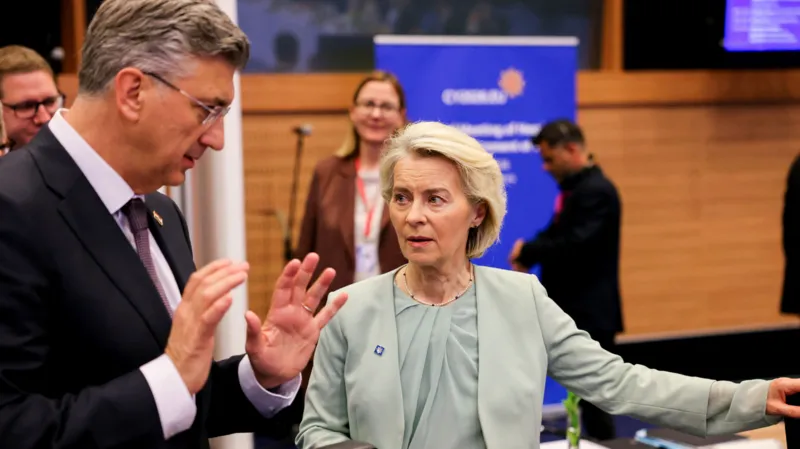

CYPRUS — European leaders have rallied in support of Spain following reports that the United States considered punitive measures — including a possible suspension from NATO — over Madrid’s stance on the US-Israel military campaign against Iran.
The controversy emerged after a leaked Pentagon email, first reported by Reuters, suggested Washington was exploring ways to penalize allies it believed had not sufficiently supported its operations. The email reportedly referenced Spain and raised the possibility of limiting its role within NATO structures.
Spain’s Prime Minister Pedro Sánchez sought to downplay the issue, telling reporters his country was “fulfilling its obligations” to NATO and would respond only to official communications from Washington.
“There is no provision to expel a member from NATO,” Sánchez noted indirectly, reflecting a broader sentiment among European leaders that the reported threat lacks legal basis.
Leaders across Europe quickly dismissed the idea of any punitive action against Spain. Dutch Prime Minister Rob Jetten said it was “crystal clear” that Spain remains a full NATO member, emphasizing that European nations are actively strengthening the alliance — a goal aligned with US interests.
German officials echoed that position, while Italian Prime Minister Giorgia Meloni described the tensions as “not at all positive,” signaling growing unease in Europe over deteriorating transatlantic relations.
Meloni, once considered a close ally of former US President Donald Trump, has recently taken a more critical stance. She denied US requests to use Italian bases for operations against Iran and condemned remarks by Trump about the Pope as “unacceptable,” highlighting widening political rifts.
At the heart of the dispute is Spain’s refusal to support US-led strikes on Iran. Sánchez has described the attacks as violations of international law and denied US forces access to joint military bases on Spanish territory.
Spain has also resisted US pressure to increase defense spending to 5% of GDP — a demand that has strained relations with Washington.
The leaked email also hinted at broader tensions, including a possible review of US support for the Falkland Islands — a sensitive issue involving the United Kingdom and Argentina.
Experts warn the dispute risks undermining NATO unity at a critical time. Former NATO official Camille Grande said the reported US approach reflects a “fundamental misunderstanding” of how the alliance operates.
“NATO is based on consensus, not unilateral decisions,” he said, rejecting comparisons that treat the alliance like a hierarchy led solely by Washington.
French President Emmanuel Macron has gone further, accusing Trump of “hollowing out” NATO through repeated public criticism. Trump has previously described the alliance as a “one-way street” and questioned its value to the US.
The tensions come as Europe faces growing security threats, particularly from Russia, whose ongoing war in Ukraine has heightened fears across the continent.
Polish Prime Minister Donald Tusk recently questioned whether the US would honor NATO’s collective defense commitments in a crisis. Intelligence assessments in Europe suggest Russia could be capable of challenging NATO within a few years.
Meanwhile, smaller NATO members such as Estonia have expressed concern after delays in US weapons deliveries, further fueling doubts about reliability.
Amid uncertainty, European Union leaders are exploring alternative defense mechanisms, including Article 42.7 of the EU treaty — a mutual defense clause. However, Ursula von der Leyen acknowledged the provision lacks clear operational guidelines.
European powers are also preparing post-conflict maritime security plans in the Strait of Hormuz, aiming to protect global trade routes and potentially ease tensions with Washington.
Former NATO Secretary General Jens Stoltenberg warned that continued divisions could threaten the alliance’s long-term survival, even as he stressed its strategic importance.
“The United States is stronger with allies,” Stoltenberg said, noting that NATO collectively represents half of global economic and military power.
Despite disagreements over Iran, most European nations insist NATO remains a defensive alliance and should not be used to justify unilateral military actions.
As tensions persist, the dispute over Spain underscores a broader question facing the alliance: whether it can maintain unity amid diverging strategic priorities between Europe and the United States.