
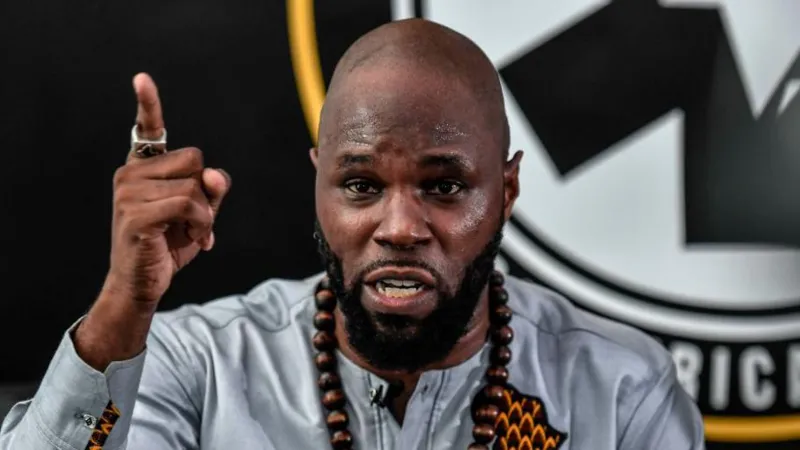

A controversial pan-African activist, Kemi Seba, has once again captured international attention following his recent detention in South Africa. The 45-year-old activist was arrested in Pretoria last week alongside his 18-year-old son, Khonsou Seba Capo Chichi, reportedly during an operation targeting immigration violations.
Authorities allege that Seba, whose real name is Stellio Gilles Robert Capo Chichi, had overstayed his visa after residing in the country for several months. His arrest has triggered renewed scrutiny of his long and controversial political activism across Africa and Europe.
Seba is currently wanted in Benin on charges including “inciting rebellion” and alleged involvement in a failed coup attempt in December 2025. He also faces accusations of money laundering, which his associates strongly deny. Benin’s authorities are reportedly preparing an extradition request, while officials in South Africa have confirmed that legal proceedings are under way, though it remains unclear which country will ultimately seek his transfer.
South African police further claim that Seba is considered a fugitive in both Benin and France, where he has had multiple run-ins with the law over the years.
Born in Strasbourg, France, to Beninese parents, Seba first rose to prominence as a radical activist in Europe. Influenced by the Nation of Islam during his youth in the United States—an organization once associated with Malcolm X—he later returned to France and became involved in black nationalist movements.
In 2004, he founded “Tribu Ka,” a controversial group promoting black separatism and widely criticized for antisemitic rhetoric. The organization was banned by French authorities, and Seba served prison time for related offenses. Continued legal pressure eventually led him to leave France and relocate to Africa.
In recent years, Seba has rebranded himself as a leading anti-colonial voice in West Africa. As founder of the NGO Pan-Africanist Emergency, he has campaigned against what he describes as ongoing French influence in the region—particularly targeting the CFA franc, a currency used by several former French colonies.
In a widely publicized protest in 2017, Seba burned a CFA banknote in Senegal to denounce “Françafrique,” a term used to describe France’s continued political and economic ties to its former colonies. Although arrested, he was later acquitted on technical grounds.
His outspoken criticism has earned him both strong support and fierce opposition. According to analysts, Seba has built a significant following among younger West Africans, particularly through social media platforms.
Seba’s growing prominence has coincided with a wave of military coups in countries such as Niger, Mali, and Burkina Faso—all of which have distanced themselves from France and strengthened ties with Russia.
In 2024, France revoked Seba’s citizenship, prompting him to publicly burn his French passport. Shortly afterward, Niger granted him a diplomatic passport and appointed him as an adviser to junta leader Abdourahmane Tchiani.
French officials have accused Seba of promoting pro-Russian narratives and acting as a conduit for foreign influence—allegations he has not directly addressed.
Seba’s latest detention adds another chapter to his long history of legal battles. His supporters insist that the charges against him are politically motivated, while critics argue that his activism has contributed to instability in the region.
As extradition proceedings unfold in South Africa, the case is likely to further intensify debates around sovereignty, foreign influence, and political activism in West Africa.
Meanwhile, Pan-Africanist Emergency has urged supporters to remain calm, dismissing what it calls misinformation and reaffirming Seba’s commitment to “social justice, sovereignty, and African dignity.”