

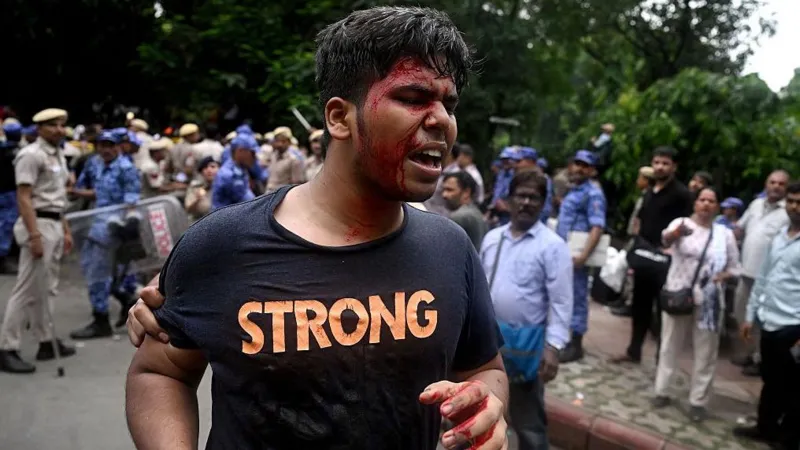

Thousands of supporters of India’s satirical youth-led Cockroach Janta Party (CJP) movement returned to the streets of Delhi on Tuesday, a day after a major police crackdown on protesters demanding education reforms and the resignation of Education Minister Dharmendra Pradhan.
The renewed demonstrations came after violent clashes in central Delhi on Monday, when tens of thousands of young protesters attempted to march towards parliament despite a police ban.
At least 60 protesters were injured after police used batons and tear gas to disperse the crowd. Police also dismantled the main protest stage and temporary shelters at the demonstration site in Jantar Mantar.
Authorities said 118 police personnel were injured during the unrest and that 70 protesters were detained. Police and Prime Minister Narendra Modi’s government have not commented on allegations of excessive use of force. Opposition parties have strongly criticised the police response.
Opposition leader Rahul Gandhi said the students’ demands were “legitimate” and accused Prime Minister Modi of being “the most anti-youth prime minister India has ever had.”
On Tuesday, Gandhi led members of his Congress party, including several lawmakers, in a march towards Modi’s residence, demanding answers over what he described as “brutalities against young students.”
“The government does not want to take accountability or allow a debate in parliament,” Gandhi said in a post on social media. He called for Prime Minister Modi and Home Minister Amit Shah to resign, accusing them of damaging the future of India’s youth.
The CJP began as a satirical political movement inspired by remarks made earlier this year by India’s chief justice, who used the term “cockroach” while referring to unemployed young people entering journalism and activism.
The comments sparked public anger, though the judge later clarified that he was referring only to people with “fake and bogus degrees.”
Although the CJP is not a registered political party, Monday’s massive turnout showed its growing ability to mobilise tens of thousands of young people across the country.
The movement has been based for the past month at Jantar Mantar, a historic protest site in Delhi. It gained national attention after activist and education reform campaigner Sonam Wangchuk joined the protest on 28 June and began an indefinite hunger strike.
Police removed Wangchuk from the protest site on Saturday and took him to hospital, where he has continued his fast.
The campaign has since become one of the most visible public challenges to the Modi government in recent years. CJP founder Abhijeet Dipke and Wangchuk have received support from opposition parties, farmer organisations, activists and several Bollywood figures.
The government had not directly engaged with protesters until Monday, when Health Minister J. P. Nadda met with CJP representatives.
The meeting took place as thousands of protesters from across India gathered for a planned march to parliament during the opening day of the monsoon session.
Nadda, a senior leader of the ruling Bharatiya Janata Party (BJP), said the discussions were held in a “cordial atmosphere” and urged protesters to end their sit-in demonstration.
CJP spokesperson Saurav Das said the 10-minute meeting ended with a promise that the government would examine their concerns but provided no specific commitments.
Another CJP leader, Ashutosh Ranka, criticised the lengthy wait before the meeting, calling it “a waste of time.”
During Monday’s clashes, witnesses reported seeing injured protesters being brought to Jantar Mantar for medical assistance. Some suffered serious injuries, including head wounds and broken bones.
Later that evening, police and paramilitary forces moved to clear the protest area. Several protesters alleged that plainclothes officers joined uniformed police in beating demonstrators with sticks.
Videos shared online after internet restrictions were lifted showed security forces using force against protesters, including women. The footage triggered further criticism of the police response.
Police officials rejected accusations of excessive force, saying protesters had behaved violently, ignored warnings and violated restrictions.
In a statement, Delhi Police alleged that demonstrators attacked officers with stones, attempted to break through barricades, damaged government vehicles and destroyed public property.
The CJP rejected the police version of events, accusing authorities of initiating the violence.
Dipke later apologised to supporters, particularly women protesters, saying the group could have done more to protect them from what he called “inhumane actions” by Delhi Police.
The movement said one injured supporter was in critical condition in hospital.
The main demand of the CJP is a major overhaul of India’s education system, including stronger accountability over alleged examination paper leaks.
The resignation of Education Minister Dharmendra Pradhan became the group’s central demand following controversy surrounding the National Eligibility cum Entrance Test (NEET) for medical admissions.
Around 2.28 million students appeared for the exam on 3 May. It was cancelled after allegations that the question paper had been leaked, and a re-test was later conducted.
More than 20 students have reportedly died by suicide since the controversy emerged, with families blaming the examination crisis for their distress.
Protesters argue that Pradhan should accept moral responsibility and resign. The minister has rejected the demand and accused the CJP and its supporters of being a “B-team of disruptive elements.”
Despite the government’s response, the large turnout, violent clashes and the protesters’ decision to remain at Jantar Mantar suggest that the CJP movement is likely to remain a major political issue in India in the coming weeks.