

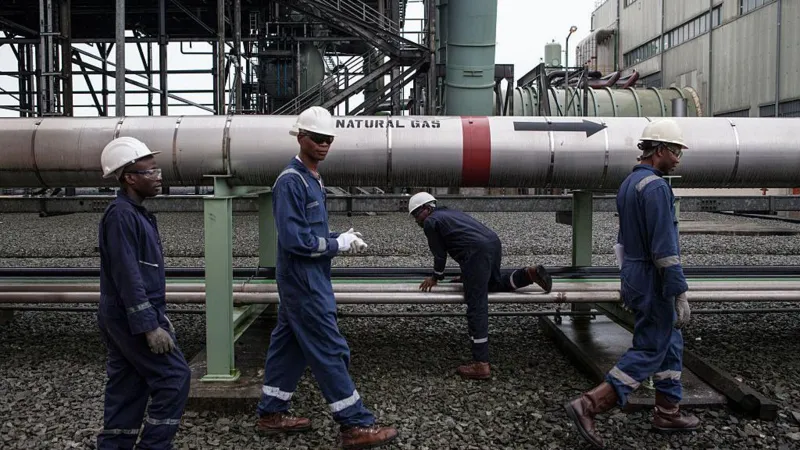

Following a signing ceremony in Freetown on Sunday, Sierra Leone President Julius Maada Bio, who currently chairs the Economic Community of West African States (ECOWAS), welcomed the agreement with a light-hearted remark: “Don’t be surprised when the gas comes your way.”
The massive 6,000-kilometre (3,700-mile) pipeline will run along the Atlantic coast, passing through 14 African countries. It will transport Nigerian natural gas northwards to Morocco, where it will eventually connect with Europe’s existing gas network through Spain.
Construction is expected to begin in 2028, with the total cost estimated at around $25 billion.
Energy experts say the project represents a major shift away from Africa’s traditional energy model, where raw resources are often exported, processed overseas and then sold back to African countries at much higher prices.
Charles Majomi, an energy expert and former Nigerian government adviser, said the current system has resulted in the “complete devaluation” of Africa’s natural resources.
According to Majomi, the new pipeline could help African countries develop local industries, improve energy access and increase their influence in international negotiations.
“Beyond energy security, it will open up Africa as a corridor to international markets,” said Professor Ganiyat Adejoke Adesina-Uthman of Nigeria’s National Open University.
She added that the project represents a symbol of what Africa can achieve through cooperation and regional integration.
If completed as planned, the pipeline will transport around 30 billion cubic metres of gas annually, supplying energy to approximately 400 million consumers. It would become one of the world’s longest offshore gas pipeline networks and could reshape West Africa’s energy future.
The latest agreement follows nearly a decade of negotiations involving more than a dozen countries. It establishes the legal and governance framework needed for the project and removes one of the biggest political obstacles standing in the way of financing and construction.
The pipeline was first proposed in 2016, but it has now entered a more advanced technical and political stage.
The project is expected to be developed in phases rather than built all at once. Analysts say construction is unlikely to begin in Nigeria, which was previously considered a possible challenge.
Majomi explained that the first phase could focus on the Morocco-Mauritania-Senegal corridor, followed by sections involving Ghana and Côte d’Ivoire, before the final connection to Nigeria.
Unlike the proposed Trans-Saharan Gas Pipeline through Niger and Algeria, the Atlantic route avoids some of the Sahel region’s most unstable areas. However, offshore construction will significantly increase costs and technical complexity.
Feasibility studies and front-end engineering design (FEED) studies have reportedly been completed, while much of the pipeline route has already been agreed.
Despite the political support, major challenges remain.
The estimated $25 billion cost could rise due to inflation and rising construction expenses. Ensuring security along thousands of kilometres of pipeline will also be critical.
Experts warn that participating countries will need strong security measures and cooperation with local communities to protect the infrastructure from possible attacks.
Majomi suggested that advanced technology, including drones and aerial monitoring systems, could play an important role in safeguarding the pipeline.
The project is being jointly led by Nigeria’s state-owned oil company and Morocco’s national mining organisation. It has received support from regional and international institutions, including ECOWAS, the Islamic Development Bank and the OPEC Fund for International Development.
Beyond supplying gas to Europe, the pipeline aims to provide affordable natural gas to African countries currently dependent on expensive imported fuels.
Supporters say it could encourage the development of electricity generation, fertiliser production, petrochemical industries and manufacturing along the Atlantic coast.
For Nigeria, the project offers a chance to monetise its huge natural gas reserves while deepening economic ties with both West and North Africa.
However, analysts point out that challenges remain, including political stability, financing, offshore engineering difficulties and competition from alternative energy export projects such as liquefied natural gas (LNG) developments and the Nigeria-Algeria Trans-Saharan Gas Pipeline.
There are also questions about Europe’s future demand for natural gas as the continent accelerates its transition towards renewable energy.
Despite these concerns, supporters remain optimistic.
Professor Adesina-Uthman said the pipeline is not simply an energy project but a platform for wider economic growth.
The Nigeria-Morocco Atlantic Gas Pipeline is expected to become a landmark example of African cooperation, linking energy resources, industrial development and international markets across the continent.