


By Md. Kamal Uddin
Joint Editor, Daily Bhorer Awaj
Deputy Editor, The Tourist
Some writings do not grow old with time. Rather, one day, time returns and gives new meaning to every word of those writings.
Today is such a day.
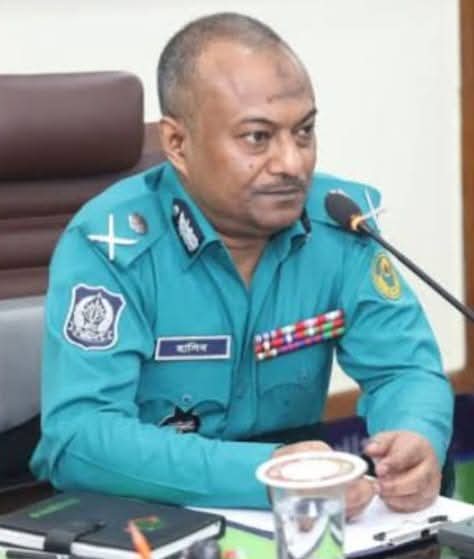
Exactly one year ago, I wrote an article about the newly appointed Commissioner of Chattogram Metropolitan Police, Hasib Aziz. To be honest, amid the busyness of time, I had almost forgotten about that article myself. But today, that old piece suddenly resurfaced in the memories section of social media.
As I read the old article again, I paused for a few moments.
Because the man I had written about a year ago, sitting in the chair of Commissioner of Chattogram Metropolitan Police, is today an Additional Inspector General of Police (Additional IGP) and the chief of the Armed Police Battalion (APBn).
One year is not a very long time. Yet, in a person’s professional life, a single year can sometimes witness enormous change.
That is exactly what has happened in the case of Hasib Aziz.
But more than the news of his promotion, what makes me happy is this: the light of potential that I saw through a journalist’s eyes a year ago has, after being tested by time, grown even brighter today.
Throughout my long journey in journalism, I have had the opportunity to meet many police officers across the country. Some were highly intelligent, some strict, some administratively skilled, while others were popular among the people.
But my first encounter with Hasib Aziz was somewhat different.
At the time, he had just taken charge as Commissioner of Chattogram Metropolitan Police. I went to meet him as a courtesy visit.
Usually, such meetings are brief and formal. But my conversation with him quickly moved beyond the boundaries of formality.
We discussed various issues, including police responsibilities, crime prevention, law and order, public safety and journalism.
What attracted me most about his way of thinking was this—
He did not want to see the police merely as an institution of power; he wanted to see the police as an institution that earns the trust of the people.
I still remember the essence of one of his remarks that day:
“The police are for the people.”
It is easy to hear such words from a police officer. But turning those words into reality is difficult.
Because the police possess the power to enforce the law. And with power comes responsibility.
The greatest test of that responsibility is how well the rights and dignity of the people can be protected while exercising that power.
I believe the greatest success of a police officer is not simply arresting criminals.
The greatest success is when an ordinary person, walking through the doors of a police station in times of trouble, feels:
“Here, someone will listen to me.”
Building that trust is not easy.
The good behavior of a single police officer can strengthen people’s confidence in the entire force. Likewise, the misconduct of one officer can damage that trust.
Therefore, people-friendly policing is not a slogan. It is the sum of everyday behavior, decisions, accountability and responsibility.
During my first meeting with Hasib Aziz, this was precisely where I saw a positive aspect of his thinking.
When talking about Hasib Aziz, his strictness must certainly be mentioned.
The responsibilities of the police are not always easy. Sometimes circumstances demand quick decisions. Protests, political programs, conflicts, crime, terrorism or sudden law-and-order situations—these are all difficult tests of a police officer’s experience and decision-making ability.
Throughout his long professional career, Hasib Aziz has faced and dealt with such challenging situations.
He can be strict—that is one aspect of his professional capability.
But to me, something else is even more important:
Knowing when to be strict and when to be humane.
Because unnecessary harshness in the name of maintaining law and order can be harmful, just as excessive leniency toward criminals can be dangerous for society.
A capable police leader must find the path of law between these two extremes.
That day, we also talked about journalism.
He was aware of several of my reports. We discussed some of my reports published in Somoyer Alo, Daily Bhorer Awaj and The Daily Banner.
I also presented him with copies of my book Adommo Monowar and several newspapers.
I have my own belief about how the relationship between a police officer and a journalist should be.
A journalist’s job is not simply to praise; it is to ask questions.
And the responsibility of the administration is not to treat those questions as hostility, but, when necessary, to accept them as an opportunity for self-reflection.
At least in my conversation with Hasib Aziz, I saw such a mindset.
He understood that courageous journalism may sometimes make the administration uncomfortable, but that discomfort can often open the door to correction and improvement.
No matter how much we talk about people-friendly policing, public trust will never be fully restored if there is corruption, bribery, abuse of power or negligence within the police itself.
One of the most difficult responsibilities for a police officer is to stand against wrongdoing within his own organization.
Bringing an external criminal under the law is a duty.
But when someone within the institution commits wrongdoing, having the courage to take action against that person is a true test of leadership.
I believe that strengthening internal discipline and accountability is just as important as making the police force stronger.
Because the dignity of the police uniform is not protected by weapons alone—
It is protected by integrity.
Chattogram is one of Bangladesh’s most important centers of economy, ports, industry, commerce and tourism.
Therefore, serving as the Police Commissioner of this metropolitan city is not merely an administrative position.
Law and order here means more than crime control. It is connected with port security, industrial security, the business environment, public safety and the overall stability of the city.
After passing through that Chattogram chapter, Hasib Aziz is now entrusted with an even greater responsibility.
Additional IGP.
Chief of APBn.
The greater the responsibility, the greater the expectations.
Leading APBn is a special kind of responsibility.
Administrative efficiency alone is not enough here. It requires operational experience, discipline, quick decision-making, leadership ability and the mental strength to remain calm in difficult situations.
Hasib Aziz’s professional experience has given him a strong foundation for this responsibility.
Now he faces a new test—
How can a large and important force be made more efficient, disciplined, professional and worthy of public trust?
There has been various discussion about Hasib Aziz’s political leanings. He is also described in some circles as being close to the BNP.
But my consideration regarding state responsibility is different.
The primary criteria for evaluating a police officer should not be his political identity. Rather, it should be his professional competence, integrity, commitment to obeying the law, decision-making ability and dedication to public safety.
The police of the state belong to no political party.
The police belong to the state, and the ultimate owners of the state are its people.
Therefore, an officer who can rise above changes in political power and prioritize the rule of law and public safety is, in the truest sense, a successful police officer.
This question may now arise in many people’s minds.
Could Hasib Aziz one day become the Inspector General of Police of Bangladesh?
No one can answer that today.
The appointment of an IGP is a decision made at the highest level of the state. Time, seniority, qualifications, administrative requirements and the government’s decision—all play a role.
Yet, based on my long observation as a journalist, I can say that the possibility certainly exists before Hasib Aziz.
He has extensive experience.
He has experience handling difficult situations.
He has the ability to make decisions.
He has experience in establishing discipline.
And now he has the opportunity to lead a large force.
One of the most important qualities required of a police chief is the ability to remain firm during moments of crisis—and that quality has also been evident throughout his career.
However, the greatest test on the road to becoming an IGP will lie elsewhere—
Restraint in exercising power, fairness in applying the law, and accountability to the people.
Reading that article from a year ago today, I felt that sometimes a journalist’s pen draws a small picture of the future.
Back then, I saw a Commissioner.
Today, I see an Additional IGP.
I do not know what tomorrow will bring.
But I believe this much: when an officer treats his responsibility not merely as a job, but as a duty and a trust, a greater path opens before him.
That greater path now lies ahead of Hasib Aziz.
My expectations of him are very simple.
I want him to become an even greater person as he takes on greater responsibilities.
As his position grows, I hope he moves closer to the people—not farther away.
As his power increases, may his sense of responsibility grow rather than his ego.
As his firmness increases, may his humanity grow as well.
And while leading the police force, may he always remember—
The greatest identity of a police officer is not his rank, but the trust of the people.
One year ago, I met the Commissioner of Chattogram Metropolitan Police.
Today, he is an Additional IGP and the chief of APBn.
Looking at this journey, it seems that sometimes a single year can change the course of a person’s professional life.
Whether greater responsibilities await him in the future is something only time can tell.
But if he has the courage,
if his integrity remains unwavering,
if his wisdom continues to mature,
if he maintains a balance between firmness and humanity,
and if earning the trust of the people remains at the heart of his leadership—
then I would not be surprised to see his name one day at the highest position in Bangladesh Police.
Rather, perhaps I will remember that article I wrote a year ago.
And I will quietly say to myself—
“The light of potential I once saw in a man in Chattogram has, with time, carried that light into an even wider sky.”
My heartfelt congratulations, best wishes and prayers for Hasib Aziz.
May the police be not a display of power, but the strength of the law.
May the police be not a symbol of fear, but a shelter of security.
May the police belong neither to any group nor any party, but to the state and its people.
And may leadership be such that it earns not only the respect of those under its command, but also the trust of ordinary citizens.