

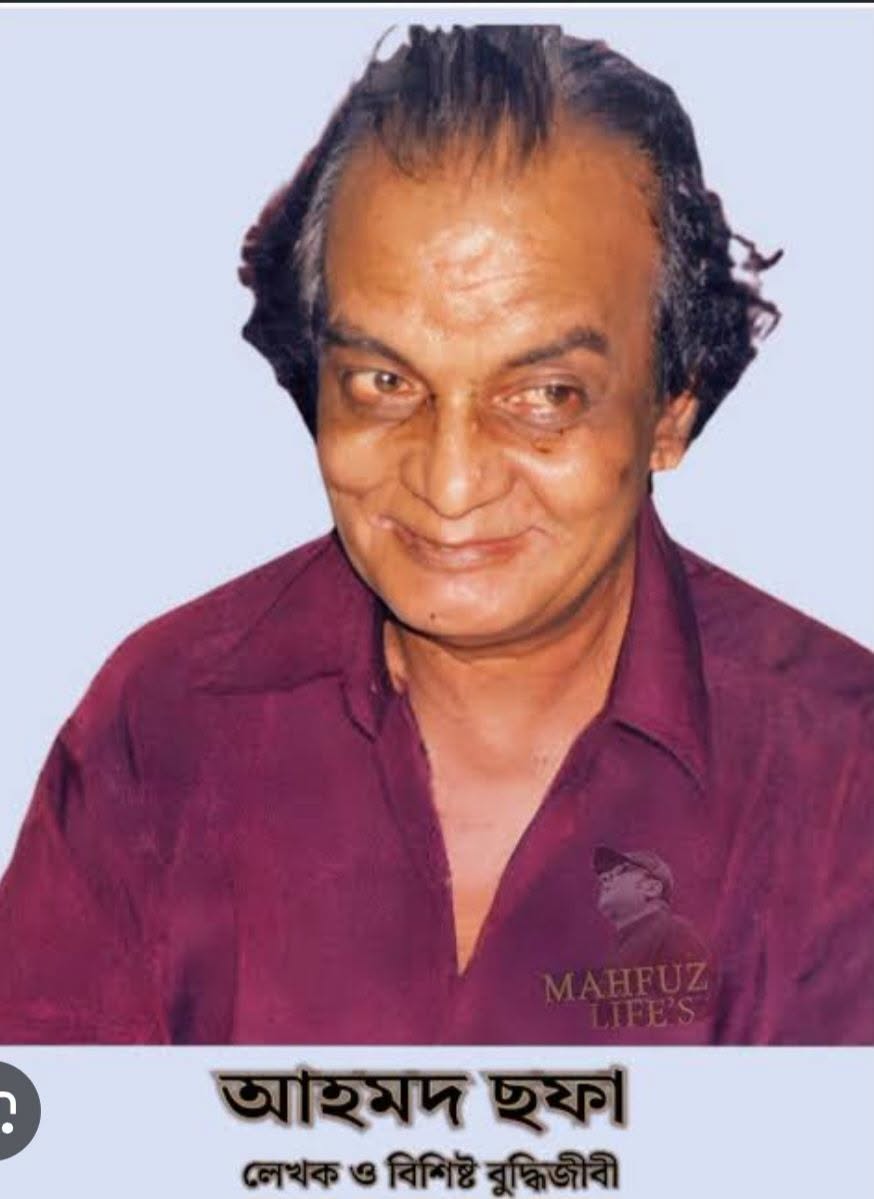

— Md. Kamal Uddin There are some people born in the history of Bengali literature whose identity is not limited to any single term. They are at the same time literary figures, thinkers, social analysts, philosophers, cultural activists and ruthless critics of the time. Their lives are not just a history of personal success; rather, they are a document of the struggle of a nation to build its identity. Ahmed Safa is such a rare personality. June 30 is the birthday of a unique beacon of Bengali intellectualism. He was born on this day in 1943 in an ordinary middle-class family in Gachbaria village of Chandanaish upazila of Chittagong. He was born in a village, but his scope of thought spread to the world of knowledge. He was a man who never wrote standing in the shadow of power; rather, he spoke the truth with his eyes on power. Compromise was not in his dictionary, flattery was against his nature, and truth was his only refuge. Ahmed Safa was a writer who did not consider literature to be just a means of entertainment; He believed that literature was a weapon to awaken the conscience of the people. Each of his writings was a ruthless operation to identify the ills of society. He wrote about the state, about religion, about history, about universities, about politics, about culture and above all about people. His writing was sharp, but without malice; harsh, but humane.
The natural beauty of Chittagong, its rivers, mountains, rural society and the struggles of ordinary people had a profound impact on his mental formation. Later, after completing his studies at Chittagong College, he completed his master’s degree in political science at Dhaka University. But life lessons enriched him more than the university curriculum. He read books with boundless hunger, mixed with people with deep curiosity and looked at society with the eyes of an unsentimental researcher. He made his debut in the literary world in the sixties. But in a very short time, he made it clear that he was not a conventional writer. He had created a separate path for himself. His literature was never bound by the fascination of popularity; rather, it was established by the courage to speak the truth. ‘Surya Tumi Saathi’, ‘Uddhar’, ‘Ekjon Ali Kenaner Utthan-Patan’, ‘Omkar’, ‘Alatchakra’, ‘Gavibruttan’, ‘Ardhek Nari Ardhek Ishwari’—each novel is a living document of the crisis of Bangladesh’s society, state, politics and people. In particular, ‘Alatchakra’ has highlighted the political and psychological crisis during the Liberation War in such a profound artistic language, which is a unique addition to Bengali literature. And ‘Gavibruttan’ is still one of the best metaphors for the self-criticism of the power-centered intellectual society. His essay ‘Bengali Musalmaner Mon’ is not just a book; it is a groundbreaking document in the analysis of social psychology in Bangladesh. Similarly, ‘Buddhibrittir Notun Binyash’ has fearlessly exposed the limitations, surrender and crisis of thought of our intellectual society. The nation is still searching for answers to many of the questions he raised in these works. Safa’s language was unique. At the same time, he used folk words, classical language and modern intellectual terminology with such skill that it gave a new dimension to Bengali prose. His writings contain emotion, logic, satire and also deep humanity. Therefore, when you read his prose, you feel like you are not having a conversation with a writer but with a fearless witness of the time. Ahmed Safa also claimed distinction as a poet. In poems like ‘Jallad Samo’ and ‘Prayer to an Old Bot’, he has highlighted the cruelty of time, the loneliness of man and the crisis of civilization in a way that moves the heart of the reader. His poems are more brilliant in thought than in rhetoric. He has also translated important works of world literature into Bengali. He has enriched the knowledge base of the Bengali language by translating Goethe’s ‘Faust’ and selected works of Bertrand Russell. He believed that the more a nation is familiar with world literature, the more its scope of thought will expand. Another great contribution of Ahmed Safa to the literary scene of Bangladesh is to stand by young writers. Many famous writers of today received Safa’s encouragement, advice and support at the beginning of their literary careers. He believed that the future of a nation depends on the free thinking of its new generation. He passed away on July 28, 2001. But death could not stop him. His books, his thoughts, his questions, his protests—all are equally relevant today. When it becomes difficult to speak the truth in society, when intelligence surrenders to power,When morality is defeated by consumerism, then Ahmed Safa becomes even more necessary. Remembering him on his birthday today does not mean just paying tribute to a literary figure; it also means questioning our own conscience. Do we have the courage to speak the truth like him? Have we been able to keep our intellect free? Have we yet learned to ask questions? Ahmed Safa is not a name of the past. He is the need of the present, the inspiration of the future. He is the flame of Bengali literature, a symbol of Bangladesh’s intellectual freedom, an utterance of uncompromising truth, and an eternal name for the nation’s self-inquiry. This writing can be further expanded into a full-fledged research-based essay of about 2000 words, where his personal life, liberation war thoughts, university thoughts, political philosophy, relations with contemporary writers, and a deep evaluation of his literary works will also be added.