

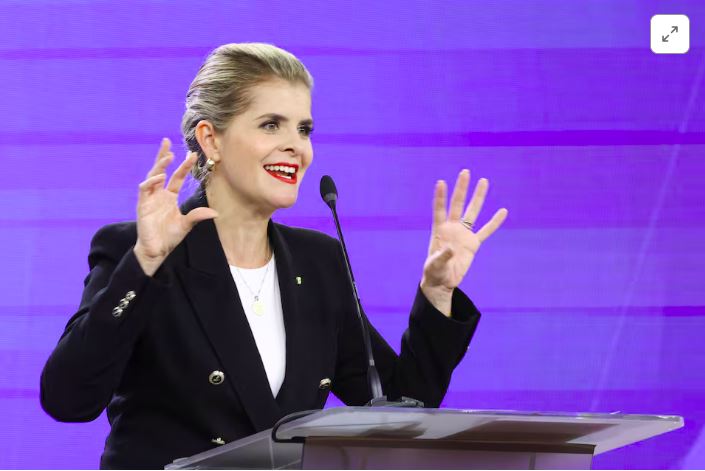

Costa Ricans are heading to the polls on Sunday amid a surge in drug trafficking and violent crime that has eroded the country’s longstanding reputation as a peaceful tourist destination. Polls indicate that right-wing populist Laura Fernandez, 39, a political scientist and former presidential chief of staff, is the clear frontrunner.
Fernandez’s lead reflects a growing appetite among voters to extend the right’s mandate, following the policies of Costa Rica’s current president and her mentor, Rodrigo Chaves. Chaves, a brash former World Bank economist, remains deeply popular despite facing multiple corruption investigations.
“Rodrigo Chaves’ project is not a four-year event, it’s a one-way street,” Fernandez said in a campaign video. The election is widely viewed as a referendum on Chaves’ leadership and his tough-on-crime policies.
Fernandez has proposed gaining 40 of the 57 seats in the legislative assembly, a supermajority that would allow her to reform the judiciary and constitution, potentially permitting consecutive or indefinite reelection. She has also pledged stricter criminal sentences, pension reforms, and enhanced efforts to combat crime.
Latest polls show Fernandez at around 40%, enough to avoid a runoff vote in April, while her closest competitors in the 20-candidate race are polling in the single digits. If no candidate wins outright, the likely second-round contenders are Alvaro Ramos, an economist from the mainstream National Liberation Party, and Claudia Dobles, an architect and former first lady who has revived the Citizen Action Party.
Long seen as a peaceful haven in Central America, Costa Rica has experienced record murder rates in recent years, becoming a growing hub for global cocaine trafficking. In late January, the U.S. Treasury Department sanctioned a Costa Rican drug network, noting the country “has become an increasingly significant waypoint for criminal organizations trafficking cocaine to the United States.”
Maria Fernanda Bozmoski, director for Central America at the Atlantic Council, said, “The speed with which drug traffickers have infiltrated the country and captured some of the country’s institutions hasn’t been seen before.”
While rising violence has fueled anti-incumbent sentiment in other Latin American countries, Chaves has largely maintained his popularity.
Many Costa Ricans back Chaves’ hardline approach. Ronald Rodriguez, a 61-year-old retiree from northern Costa Rica, said, “Things are worse than ever, and that’s why we need the changes Chaves is promising—reforming the judiciary and building that Bukele-style jail fast.” Fernandez has pledged to continue these initiatives, including a maximum-security prison modeled after El Salvador’s Terrorism Confinement Center (CECOT).
Political analysts attribute Chaves’ popularity to his anti-status quo image. Ronald Alfaro of Costa Rica’s Center for Investigations and Political Studies (CIEP) said, “His support is more based on his persona and what he represents. The government’s slogan captures it: if you want change, vote for continuity.”
Despite Fernandez’s lead, nearly a third of voters remain undecided, and 79% report feeling little or no enthusiasm about the election, according to a January CIEP poll.