

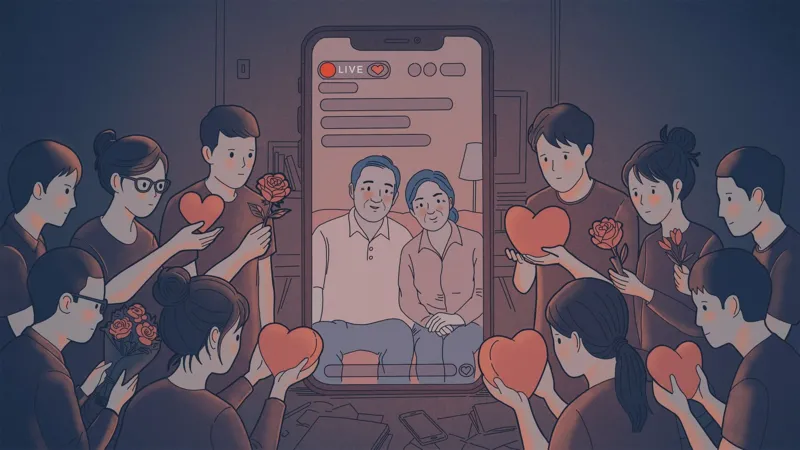

Shanghai, China — A growing number of young Chinese adults are turning to social media “virtual parents” for comfort and encouragement, reflecting rising generational tensions and the emotional pressures facing China’s youth. Among them is 33-year-old Shanghai tech worker Vincent Zhang, who regularly watches videos from a middle-aged couple on Douyin, China’s version of TikTok. In their videos, the pair offer words of reassurance and affection, speaking directly to viewers as if they were their own children. “Are you tired from work and study lately? Don’t push yourself too hard. Mum and Dad know that you have endured a lot,” the couple says in one of their most popular clips. The creators, Pan Huqian and Zhang Xiuping, have attracted nearly two million followers and are among a growing group of influencers known as “virtual parents.” Their content resonates with young people who feel overwhelmed by career pressures, economic uncertainty, and high expectations from their families. “My parents are never the ones who tell me not to drive myself too hard or that I am already good enough,” Vincent said. “But virtual parents will ask me whether I am happy today.” Pan has said that his own difficult upbringing inspired the content. In a 2024 interview, he recalled leaving home at age 14 to support his family after his mother became paralysed. Despite years of sacrifice, he said he never received words of encouragement from his parents. Determined to create a different environment for his own daughter, Pan said he makes a point of expressing love and support—values that now form the foundation of the couple’s online persona. Their message has struck a chord with many young Chinese adults who grew up during China’s economic rise but now face intense competition in education and employment. Youth unemployment has remained a concern in recent years, while many young people report feeling burned out and disillusioned with the relentless pressure to succeed. Vincent says conversations with his own parents often leave him feeling criticized. They disapprove of his career choices, believing a government position would provide greater stability, and frequently question him about marriage and family plans. “From the moment the phone call begins, all my actions and choices are wrong and something to be corrected by them,” he said.The trend has emerged alongside broader online discussions about parenting, family expectations, and mental health. Many young people have embraced viral memes and humorous content to cope with frustrations over what they see as controlling or overly critical parenting styles. One popular online phenomenon, known as “gourd soup literature,” satirizes situations where parents dismiss their children’s preferences while insisting they are acting in their best interests. The meme has become a symbol of generational misunderstandings and family conflicts. For 28-year-old Zhao Xuan, the humor offers a way to deal with ongoing family tensions. After years of trying to understand her parents’ behavior, she says she now approaches the situation with greater emotional distance. “My mom wouldn’t change, so I could only change my own mindset,” Zhao explained. “I treat it as if it were a joke.” Despite recognizing that many virtual-parent creators operate as commercial influencers, Vincent says their content still provides genuine comfort. He recently watched a video showing the couple shopping at a supermarket and was reminded of childhood trips with his own parents before the Lunar New Year. “We have not had this kind of conversation, which comes with no social pressure, for a long, long time,” he said. As China’s younger generations navigate economic challenges, changing social expectations, and evolving family relationships, the popularity of virtual parents highlights a growing demand for empathy, reassurance, and emotional connection. “I believe that a little bit of warmth is better than nothing,” Vincent said.