


A sharp سقوط in milk prices across the United Kingdom is pushing dairy farmers to the brink, with many warning that production is no longer profitable and could force widespread closures in the sector.
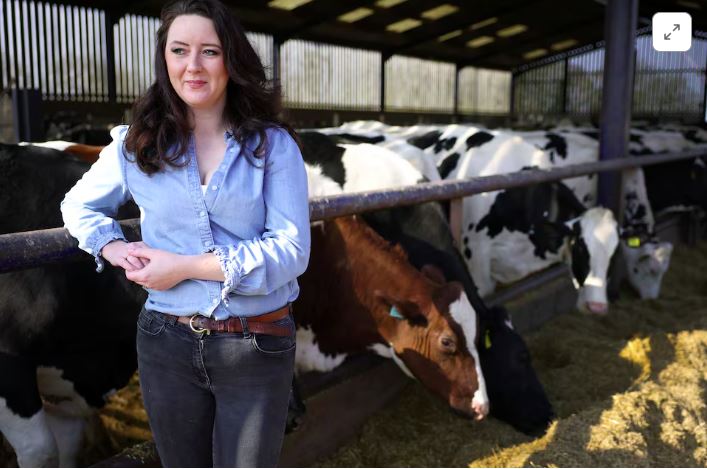
Farmers Kelly and Ed Seaton, who rear 200 pedigree Holstein cows in northwest England, say they expect to make a loss this year as prices paid for milk have plunged. The couple’s farm, located on the Shropshire–Cheshire border, has been in the family for over a century.
Across Britain, the number of dairy producers has already fallen by around 20% since 2019, dropping to about 7,000, according to the Agriculture and Horticulture Development Board.
Industry figures show that the price paid by processors to many UK farmers has dropped by as much as 15 pence per litre—around 40%—since October 2025. The decline is being driven by a surge in both domestic and global milk production, which has outpaced demand and overwhelmed processing capacity for products such as cheese and yoghurt.
“It’s simply a matter of too much milk in the market,” said Kelly Seaton, highlighting the growing imbalance between supply and consumption.
Despite the UK’s milking herd falling to around 1.6 million cows—the lowest level in a decade—output has increased due to higher yields. Last year’s drought led farmers to rely more on concentrated feed instead of grazing, boosting milk production per cow.
Globally, milk output has rebounded in both the United States and Europe after a weaker 2025, further intensifying the supply glut. The head of the French dairy association National Interprofessional Dairy Economy Centre described the situation as a “tsunami of milk supply worldwide.”
For many farmers, the financial strain is severe. Seaton estimates it costs around 40 pence to produce a litre of milk, yet she is currently being paid just 30.5 pence—well below cost price. Her monthly income has dropped significantly, leaving her operation firmly in the red.
The UK dairy processing market is dominated by major players such as Müller, Arla Foods, and First Milk, whose pricing structures heavily influence farmgate returns. Arla has warned that the global surplus is likely to continue putting downward pressure on prices.
Farmers across the country are reporting similar struggles. Gwyndaf Thomas, who runs a 300-cow operation in Wales, described the cuts as “savage,” while Paul Tompkins, a dairy farmer in northern England and deputy president of the National Farmers’ Union, said he expects to lose around £600,000 this year.
The crisis could deepen in the coming months, as milk production typically rises during the spring calving season, potentially increasing the surplus and pushing prices even lower.
The UK dairy sector, worth over £6 billion annually and accounting for about 20% of agricultural output, is also grappling with rising costs linked to energy, fuel, fertiliser, and labour.
Despite the bleak outlook, long-term demand for dairy products is expected to grow. Rising global incomes and shifting dietary habits are projected to increase per capita consumption of fresh dairy by 11% by 2033, according to international forecasts.
However, industry leaders warn that without urgent measures to improve resilience and profitability, the UK risks losing more farmers, increasing reliance on imports, and undermining national food security.
“We’re going through a very difficult period,” Seaton said, “but we just have to hope the good times will eventually return.”