


U.S. and Israeli military strikes on Iran are likely to reinforce the nuclear ambitions of Kim Jong Un and could increase the chances of renewed nuclear negotiations with Donald Trump, according to experts and former officials.
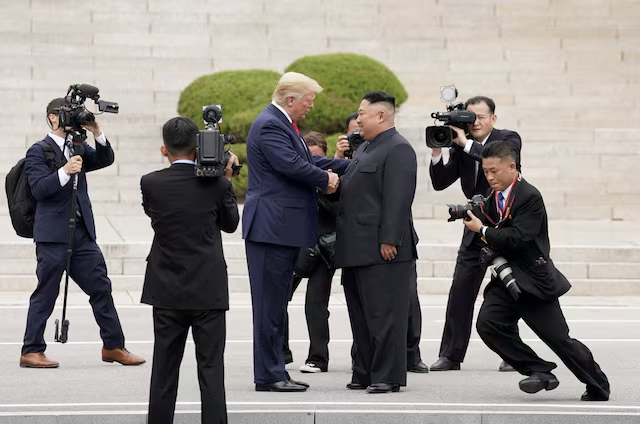
Diplomatic talks aimed at dismantling Pyongyang’s nuclear and ballistic missile programs collapsed after high-profile summits between Trump and Kim in 2018 and 2019. However, analysts say the recent military action against Iran may push North Korea to reconsider negotiations.
The strikes on Iran, which resulted in the death of Supreme Leader Ali Khamenei, come just months after the capture of Venezuelan President Nicolas Maduro in a U.S. special forces operation authorized by Trump. Observers argue that these events may strengthen North Korea’s belief that nuclear deterrence is essential for regime security.
“Kim must have thought Iran was attacked like that because it didn’t have nuclear weapons,” said Song Seong-jong, a former South Korean defense official, suggesting the strikes could validate Pyongyang’s nuclear strategy.
A spokesperson for North Korea’s foreign ministry condemned the military operations, describing the United States as “hegemonic and rogue,” according to state media reports.
Just days before the Iran strikes, Kim pledged to expand North Korea’s nuclear arsenal at a ruling party congress but left room for potential dialogue depending on Washington’s stance. State media quoted him as saying that improved relations with the U.S. were possible if Washington abandoned its policy of confrontation.
Trump has repeatedly expressed interest in restarting negotiations with North Korea, fueling speculation about a potential meeting when he visits China later this month.
Experts note that North Korea is far more advanced than Iran in nuclear capabilities, possessing intercontinental ballistic missiles and an estimated 50 nuclear warheads, with sufficient material to produce additional weapons.
North Korea formally enshrined the right to preemptive nuclear strikes in a 2022 law, declaring its nuclear status “irreversible.” While renewed talks remain a low priority for Kim, some analysts believe heightened security concerns could drive him back to the negotiating table.
Unlike Iran, complete denuclearization of North Korea is considered highly unlikely due to the dispersion of nuclear facilities across the isolated state.
Despite strong ties with China and Russia, Kim may seek to manage relations with the United States more carefully. Analysts suggest he could attempt to leverage personal rapport with Trump while advancing North Korea’s nuclear program.
Diplomats and defectors believe Kim may consider reassuring Washington that North Korea does not intend to use nuclear weapons against the U.S., provided relations improve.
“The incident in Iran must have made him think he should manage relations with the United States better,” said Ko Young-hwan, a former North Korean diplomat.
As tensions continue to shape global security dynamics, the question remains whether the Iran strikes will ultimately prompt North Korea to re-engage in diplomatic negotiations or further entrench its nuclear ambitions.