

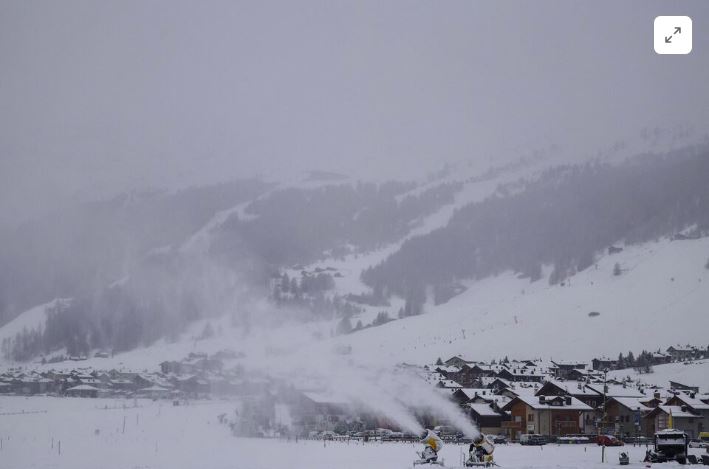

Italy’s reputation in winter sports has long been shaped by Alpine skiing, but the northern resort town of Livigno is aiming to use the Milano Cortina 2026 Winter Olympics as a once-in-a-generation opportunity to reshape that image.
Livigno is positioning the home Games as a springboard to cement its status as a global hub for freestyle skiing and snowboarding — disciplines that have evolved from countercultural roots into fast-growing, youth-driven mainstream sports.
Around €300 million ($360 million) in public and private investment has flowed into the town ahead of the Olympics, with local officials and business leaders betting on world-class facilities to attract higher-spending visitors and expand into new markets such as China, Japan and the United States, without necessarily increasing overall visitor numbers.
“The strategy is to arrive at this unique event at our very best,” said Marco Rocca, chief executive of Livigno’s Mottolino ski area.
Livigno, one of several mountain venues for the Games, is already well established as a freestyle and snowboard destination, thanks to terrain, infrastructure and a culture that attracts riders from around the world.
More than €50 million has been invested over the past four years to upgrade Mottolino, which is now equipped to host halfpipe, big air, slopestyle, ski and snowboard cross, and parallel giant slalom, all feeding into a single finish area designed to improve the spectator experience.
Lift capacity is also being expanded with a new high-speed cable car and an eight-seat chairlift, investments intended to serve both the Olympics and the long-term future of the resort.
“With snowboarding and freestyle we can guarantee a consistently young clientele — not just athletes, but also people who want to stay connected to this scene. It’s about identity as much as sport,” Rocca said.
Luca Moretti, head of Livigno’s tourism promotion agency, said the Games would reshape the resort “more in qualitative than quantitative terms.”
Livigno’s high-altitude location, long winters and isolation — earning it the nickname “Little Tibet” — remain among its biggest strengths.
Sitting at 1,816 metres above sea level, the resort enjoys regular snowfall, supported by an expanded snow-making system fed by a reservoir with capacity exceeding 200,000 cubic metres. This is complemented by “snowfarming,” a technique that collects and stores snow for later use.
The system allows organisers to protect training schedules and event windows, extend an already long season and reduce the risk of weather-related disruptions.
“Livigno is known for its guarantee of snow and cold conditions,” Moretti said, noting that the infrastructure will remain in place long after the Olympics, helping the resort adapt to increasingly volatile winters.
U.S. freestyle skier Jaelin Kauf said a recent World Cup event offered a glimpse of what the Olympic venue could deliver.
“It’s a great course — long, steep, with excellent jumps — and it runs right down into the village. I think it’s going to be a fantastic Olympic venue,” she said.
Livigno’s Olympic push comes as freestyle skiing and snowboarding continue their rapid rise from niche pursuits to mainstream global attractions, drawing younger audiences with their blend of style, risk and constant innovation.
Snowboarding’s inclusion in the Olympics in 1998 helped cement its global appeal, transforming it from an outsider sport into a major driver of participation and viewership.
Organisers are also pinning hopes on Italian athletes, including freestyle-skiing siblings Flora and Miro Tabanelli, as well as snowboarders Lucia Dalmasso and Maurizio Bormolini, to chase medals that could further raise Livigno’s profile.
“Livigno has always been a mecca for snowboard and freestyle,” said Bormolini, who trains and is based in the resort. “The terrain, facilities and atmosphere make it an internationally sought-after destination.”
He said recent upgrades have ensured consistently high-quality snow and slopes, helping athletes perform at the highest level.
The Milano Cortina 2026 Games, he added, will help secure Livigno’s status as a global winter sports capital and inspire future generations.
“It will leave a lasting mark on our community and our region,” Bormolini said.
($1 = €0.8378)