


— Md. Kamal Uddin
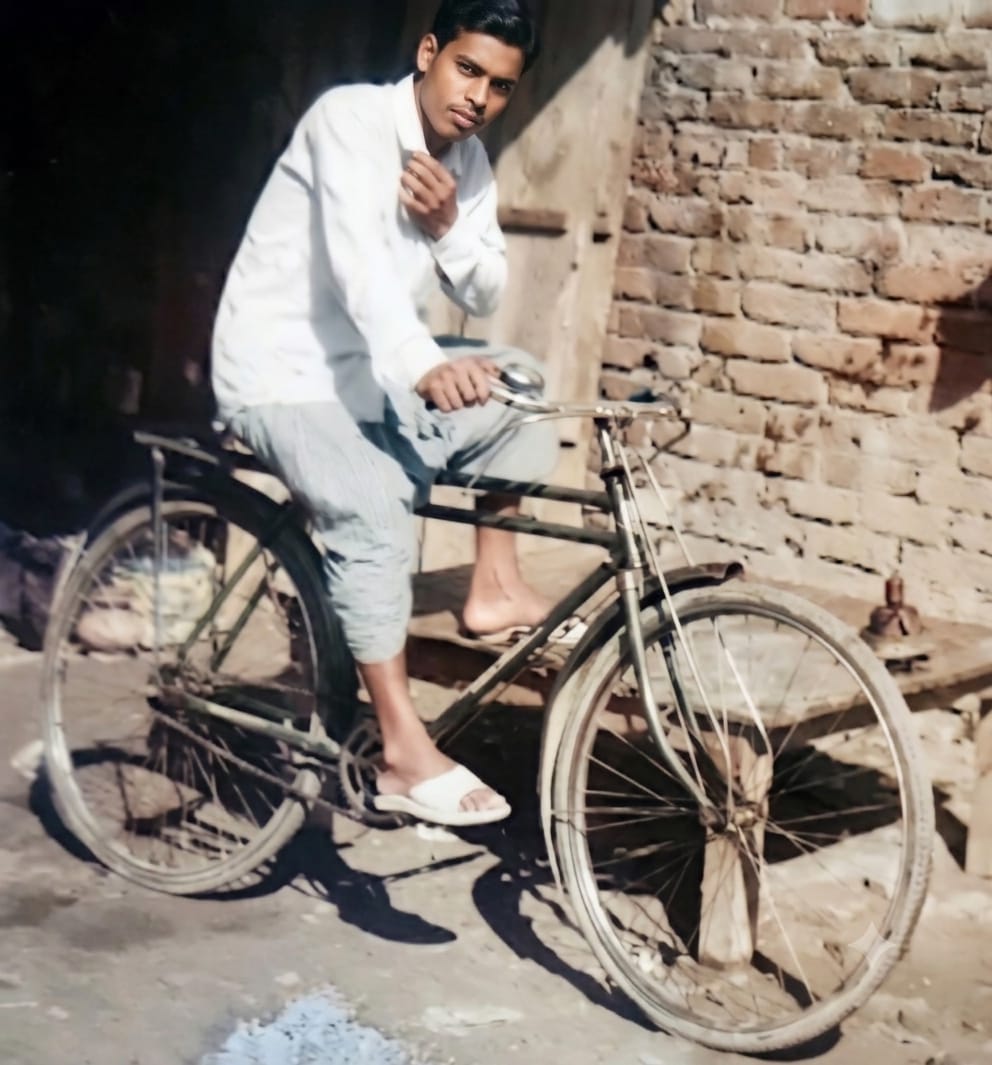
Some pictures stop time. Some memories never get old. Every time I look at this picture, I feel like I have gone back many years, to my beloved village, Charandwip. That teenager is still standing with his hands on the bicycle handle with a heart full of dreams, yet how much the world around him has changed! That bicycle was not just a two-wheeled vehicle; it was the wings of my adolescence, the first taste of freedom, the first lesson of courage, and the first companion in recognizing life. My childhood, my dreams, and my boundless joy revolved around the rotation of its wheels. Our traditional Charandwip house, Nazar Mohammad Bari, was the center of my world. I grew up in the courtyard of that house, sat in the shade of a century-old tree and dreamed, and welcomed the dawn light by listening to the birds’ calls. Every brick, every door, every courtyard of that house is still as precious to me as history. Not only my family, but also my roots, my identity, and the deepest sense of my existence are hidden there. I would set out on my bicycle as soon as the dawn broke. The winding paths of the village, the green paddy fields, the swaying of the cashew trees, the rows of palm trees and the Karnaphuli River flowing in the distance under the blue sky—all together, it was as if nature itself had composed an epic poem. The wind blowing from the chest of the Karnaphuli would hit our faces, and it seemed that there was no purer happiness in the world than this.
How many times have I rushed to Boalkhali on that bicycle! Sometimes laughing with friends, sometimes talking to myself on a lonely afternoon. And the Kalurghat Bridge—that was the wonder of our teenage years. Standing on the bridge and looking at the Karnaphuli flowing down, it seemed that the river not only carries water, but also carries the history, love and stories of people. I still remember clearly that one day, a few of us friends decided to cycle to the shrine of Hazrat Mohsin Aulia in Anwara. That long journey was a unique adventure of our lives. It was tiring, but the joy was much greater than the fatigue. The dust of the road stuck to our clothes, but the color of indelible memories stuck to our hearts. That journey taught us that friendship means walking together, and life means the courage to move forward.
Later, I cycled on the busy roads of the city for many years. The needs of life were met, the pace of work increased; but on the concrete roads of the city, I never found the smell of the soil of Charandwip, the touch of the wind of Karnaphuli, or the indescribable freedom felt standing on the chest of the Kalurghat Bridge.
Today’s children know the world on the screen of their mobile phones, and we knew it by riding on the wheels of bicycles. Our map was the village path, our university was nature, our teachers were the river, the field, the sky, and the lives of people. Time has taken away many things. Many faces have been lost, many paths have changed, many memories have become history. But deep in the heart, the sound of that old bicycle bell still remains indelible. It seems like if I could go back to that Charandwip, that Nazar Mohammad’s backyard, that bank of the Karnaphuli, that Kalurghat bridge, then maybe I would hear the laughter of my youth again, and feel the purest joy of life.
There are some treasures in human life, the value of which cannot be measured in any way. For me, those priceless treasures are—an old bicycle, a river, a village, a traditional house, and a golden childhood that is evergreen in the light of memories. As long as I live, these memories will shine like the North Star in the sky of my heart.