

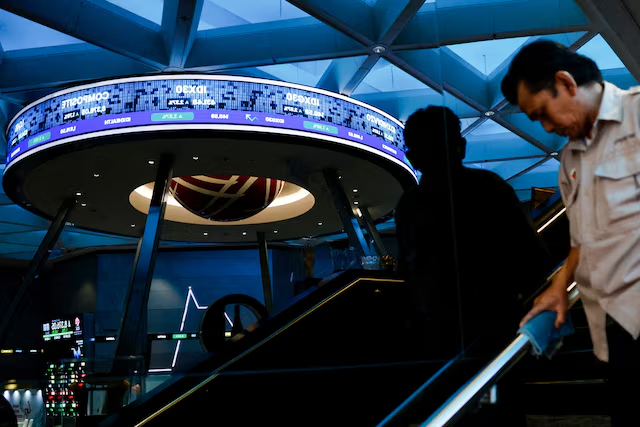

Asian share markets traded firmly higher on Wednesday, tracking a rebound on Wall Street as investors adjusted to sharp mood swings around artificial intelligence stocks.
Markets appear to be accepting that volatility in AI-related equities is here to stay. The U.S. dollar edged slightly lower, Treasury yields ticked higher, and oil prices rose around 0.6%.
South Korea, Taiwan and Japan — key suppliers of AI hardware and semiconductor equipment — continued to benefit from surging capital expenditure tied to AI development.
South Korea’s Kospi index has climbed nearly 5% this week to a fresh record high, bringing its gains for 2026 to around 44%. Taiwan’s benchmark index has risen about 5% this week and nearly 22% for the year. Japan’s Nikkei is up 15% so far in 2026, bolstered by improved corporate earnings and governance reforms.
Analysts at Deutsche Bank noted that Japanese investors hold approximately $2.25 trillion in foreign equities. Even a modest reallocation toward domestic shares could provide a significant boost to the Nikkei and support the yen.
The spotlight now turns to Nvidia, which reports earnings later in the day. Markets are watching closely to see how far the AI chip giant can exceed expectations.
According to LSEG data, forecasts point to a 62% rise in quarterly profit for the period ending in January, with revenue expected to jump 68%. First-quarter revenue guidance is projected to show a 64% increase to roughly $72 billion.
Nvidia has beaten sales forecasts for 13 consecutive quarters, making the size of any earnings surprise critical. Analysts suggest that exceeding forecasts by at least $2 billion on both fourth-quarter results and first-quarter guidance may be the minimum needed to sustain investor enthusiasm.
Options markets imply a potential share price swing of about ±4.8% following the results. Given Nvidia’s massive $4.7 trillion market capitalization, such a move would represent a shift of roughly $226 billion in market value — larger than the annual GDP of Japan or India.
Artificial intelligence received only brief mention in President Donald Trump’s State of the Union address. Trump announced a “rate-payer protection pledge,” suggesting major technology firms would need to build their own power plants to supply energy for data centers. However, details on implementation or enforcement were not provided.
Oil prices dipped slightly when Trump said his preference was to resolve nuclear tensions with Iran through diplomacy, though markets remained cautious given a continued U.S. military build-up in the region.
Investors will be watching several developments on Wednesday that could shape market direction:
Nvidia earnings results
German and French consumer confidence data
Final euro zone CPI figures
Public remarks from central bank officials, including Sweden’s Riksbank Governor Erik Thedéen, Norway’s central bank chief Ida Wolden, ECB board member Pedro Machado, and Federal Reserve presidents Thomas Barkin, Jeffrey Schmid and Alberto Musalem
With AI enthusiasm still driving global equity markets, much hinges on whether Nvidia can once again justify sky-high expectations — or whether volatility will intensify further.