

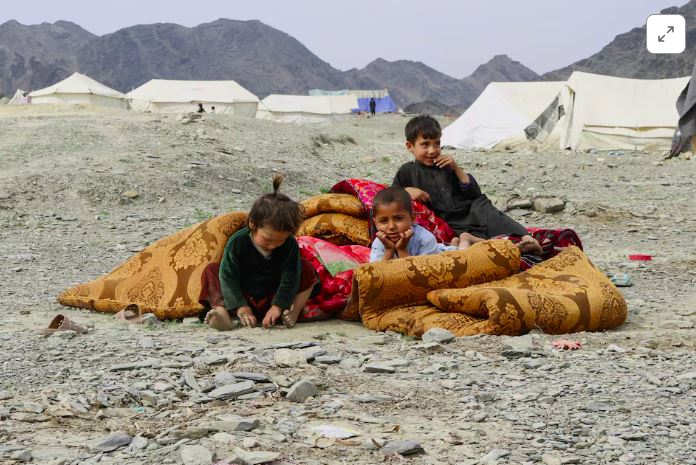

Pakistani and Afghan troops exchanged fire at dozens of locations along their border on Friday, while the United Nations reported that the week-long conflict has forced more than 100,000 people to flee their homes.
The fighting between the South Asian neighbors shows no signs of de-escalation and represents the worst violence in years, further destabilizing a region already affected by U.S. and Israeli strikes on Iran—another country that borders both Afghanistan and Pakistan.
The clashes have included Pakistani airstrikes on Taliban government installations, including the Bagram air base north of Kabul.
Afghanistan’s Ministry of Defense said Taliban forces attacked Pakistani military positions at more than two dozen points along the 2,600-kilometer border, destroying 14 outposts and shooting down a drone.
The ministry reported that seven Afghan civilians and three Taliban fighters were killed in overnight fighting.
Pakistani security officials said they conducted ground and air operations targeting military sites, including positions near Kandahar—home to much of the Taliban’s leadership—and destroyed several Afghan border posts.
Protests erupted in Kabul on Friday, where demonstrators condemned Pakistan’s airstrikes and chanted anti-Pakistan slogans, according to witnesses. Afghanistan’s Bakhtar news agency also reported a large protest in Laghman Province against Pakistan’s actions.
Residents in border towns told Reuters that heavy shelling often begins after sunset, placing homes in danger just as families gather to break their fast during the holy month of Ramadan.
Haji Shah Iran, a Pakistani laborer living in the border town of Torkham, said he had evacuated with his family and was staying with friends.
“When we leave our homes in the morning, shells start falling,” he said. “Our house has been damaged, and our belongings are still inside.”
The town remained quiet on Friday, with only limited traffic on the roads. Some buildings showed signs of damage, and smoke could be seen rising on the Afghan side of the border.
The United Nations refugee agency said the situation remains extremely tense, estimating that about 115,000 people in Afghanistan and 3,000 in Pakistan have been displaced by the fighting.
Several countries have offered to mediate a ceasefire, with Turkey being the most recent to propose negotiations. However, the Iran conflict has drawn attention away from diplomatic efforts by Gulf states that previously signaled willingness to help mediate.
Pakistani government spokesperson Mosharraf Zaidi said there are no current talks aimed at ending the hostilities.
“There is nothing to discuss. There will be no dialogue and no negotiations,” he said. “Terrorism originating from Afghanistan must end—this is Afghanistan’s problem. Pakistan’s responsibility is to protect its citizens.”
The conflict began last week when Pakistan launched airstrikes inside Afghanistan, claiming they targeted militant strongholds. Afghanistan condemned the strikes as a violation of its sovereignty and launched retaliatory operations.
Islamabad argues that Afghanistan provides safe havens for militants who carry out attacks inside Pakistan. The Taliban denies supporting such groups and maintains that militancy in Pakistan is an internal security issue.
On Friday, Afghanistan’s defense ministry claimed it also struck a Pakistani military base in Balochistan province. Reuters could not independently verify the claim, and Pakistan’s military has not reported any damage in the area.
Both sides have repeatedly asserted that they inflicted heavy casualties on the other, claiming hundreds of enemy fighters were killed. However, they have provided no evidence, and Reuters has been unable to confirm the figures.
The United Nations Assistance Mission in Afghanistan reported that at least 56 civilians have been killed and 128 injured since the fighting began. The Taliban government has stated that 110 civilians have died.
Pakistan has rejected both sets of figures, insisting that its forces target only militants and related infrastructure.