

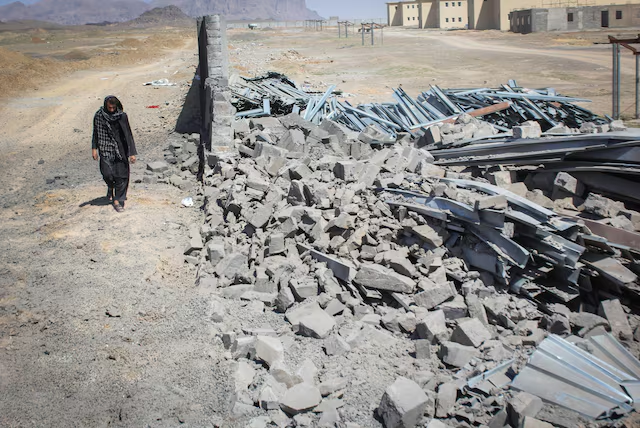

Troops from Pakistan and Afghanistan engaged in heavy clashes at multiple points along their shared border on Tuesday, while the United Nations Assistance Mission in Afghanistan reported that 42 civilians had been killed during six days of fighting.
The neighbouring countries—long-time partners now locked in conflict—have seen their worst hostilities in years after Pakistani airstrikes on Afghan territory last week. The escalation has raised fears of a broader and prolonged conflict in a region already affected by hostilities involving strikes on Iran.
Pakistan has launched air-to-ground missile strikes on sites linked to the Taliban, accusing the group of harbouring militants responsible for attacks inside Pakistan. The Taliban government has denied providing support to militant organisations.
Pakistan’s Information Minister Attaullah Tarar confirmed that strikes targeted the Bagram air base north of Kabul, alleging it stored ammunition and equipment used by militants operating against Pakistani forces and Afghan Taliban troops.
Afghan authorities reported that the Bagram attack was repelled by anti-aircraft fire. A senior Pakistani security official stated that strikes would continue until Afghanistan takes concrete action against militants using its territory. The official warned that further action, including potential targeting of Taliban leadership, could follow if no progress is made.
Fighting along the 2,600-kilometre border has fluctuated over the past six days. Afghanistan’s defence ministry claimed Taliban forces captured a Pakistani military post in the Kandahar region, while Pakistan reported clashes at more than two dozen locations.
Both sides asserted they inflicted heavy losses on the other, though neither provided verifiable evidence. Reuters was unable to independently confirm the claims.
The UN mission reported preliminary figures indicating 42 civilian deaths and 104 injuries from indirect fire between February 26 and March 2. Pakistan dismissed the figures, arguing that militants often dress as civilians and that UN information relies on Taliban sources.
Pakistan insisted its strikes were precise and targeted only militant positions.
Asif Ali Zardari told parliament that Pakistan “will not allow any entity—domestic or foreign—to use neighbouring territory to destabilise our peace.” His remarks underscored Islamabad’s position that cross-border militancy must be addressed.
The UN mission urged an immediate halt to hostilities, warning that the conflict has displaced an estimated 16,400 households and worsened conditions for Afghanistan’s population, which is still recovering from devastating earthquakes in 2023 that killed more than 1,400 people.
Humanitarian operations have also been disrupted by movement restrictions in border areas, limiting aid delivery to communities most affected by the violence.