

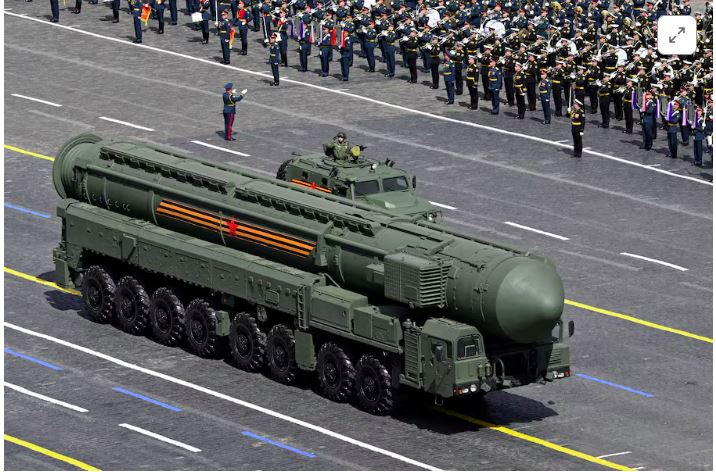

Russia said on Thursday it regretted the expiration of its last remaining nuclear arms treaty with the United States but remained willing to hold talks, raising the possibility of a last-minute arrangement to preserve limits on the world’s most powerful weapons.
Axios reported that negotiations had taken place over the past 24 hours in Abu Dhabi, and that both sides were close to an understanding to continue observing key provisions of the New START treaty. The agreement sets limits on the number of missiles, launchers and deployed strategic nuclear warheads held by each country.
U.S. President Donald Trump has not formally responded to a proposal by Russian President Vladimir Putin to continue following the treaty’s core restrictions for another year, even though there is no legal mechanism to extend the full treaty.
Kremlin spokesman Dmitry Peskov said Russia was ready to engage in dialogue if Washington responded constructively.
“If there are any constructive replies, of course we will conduct a dialogue,” Peskov told reporters.
New START was the final agreement in a series of arms control treaties between Moscow and Washington dating back to the Cold War. Beyond setting numerical limits, the treaties also established inspection systems that experts say helped build trust and reduced the risk of confrontation.
Analysts warn that if no new framework replaces New START, the global security environment could become more dangerous, increasing the chances of miscalculation. Without limits, both countries may feel pressure to expand their arsenals, particularly as China continues its own rapid nuclear buildup.
Trump has said he wants a broader and “better” agreement that includes China. Beijing has repeatedly rejected such negotiations, noting that it has far fewer warheads — an estimated 600 — compared with roughly 4,000 each for Russia and the United States.
China reiterated on Thursday that the treaty’s expiration was regrettable and urged the United States to resume dialogue with Russia on “strategic stability.”
There was some uncertainty over the exact time the treaty would expire, but Peskov said it would lapse at the end of Thursday.
Former Russian President Dmitry Medvedev, who signed the treaty with then-U.S. President Barack Obama in 2010, said on Wednesday that New START and earlier agreements were now “all in the past.”
Russia’s Foreign Ministry said it considered the treaty no longer in force and that both countries were free to determine their next steps. It added that Russia was prepared to take “decisive military-technical countermeasures” if new threats emerged, but said it remained open to diplomacy.
Ukraine said the treaty’s collapse reflected Russia’s efforts to weaken global security structures and described it as “another tool for nuclear blackmail.”
Strategic nuclear weapons are long-range systems designed to strike major military, industrial and political targets. Experts say that without any agreement, Russia and the U.S. could each deploy hundreds more warheads within a few years beyond the New START cap of 1,550.
Karim Haggag, director of the Stockholm International Peace Research Institute, said arms control provides vital transparency and predictability that supports deterrence and stability.
U.N. Secretary-General Antonio Guterres warned that the dismantling of decades of arms control progress “could not come at a worse time,” adding that the risk of nuclear weapons being used is now the highest in decades.
He urged both sides to resume negotiations quickly to create a successor framework that restores verifiable limits.