

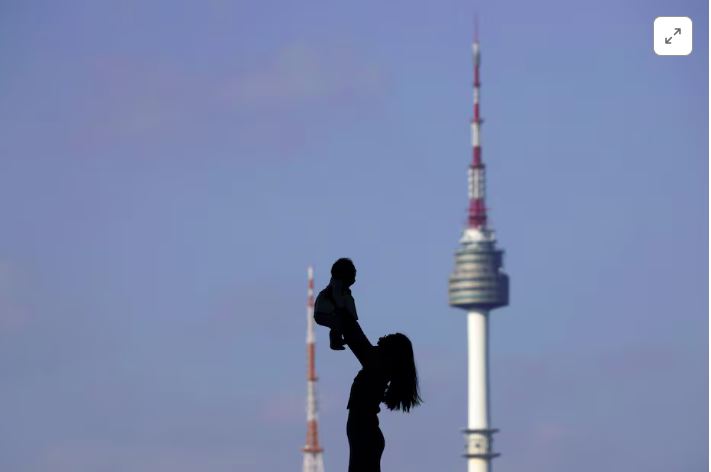

South Korea’s birthrate rose for a second consecutive year in 2025, according to government data released signaling cautious optimism that the country may be starting to ease a demographic crisis that has persisted for nearly a decade.
Preliminary figures from the Ministry of Data and Statistics showed that the country’s total fertility rate — the average number of children a woman is expected to have in her lifetime — increased to 0.80 in 2025 from 0.75 in 2024. The rebound follows eight straight years of decline, when the rate fell to a record low of 0.72 in 2023, the lowest in the world.
There were 5.0 births per 1,000 people in 2025, up from 4.7 a year earlier. By comparison, China recorded 5.6 births per 1,000 people last year, Taiwan 4.6, and Japan 5.7 in 2024, where the downward trend has continued.
The pace of recovery has exceeded the government’s earlier projections, which had forecast a fertility rate of 0.75 in 2025 and 0.80 in 2026. Officials now anticipate the rate could rise above 1.0 by 2031 if the trend continues.
Marriages — often viewed as a leading indicator for future births — climbed 8.1% in 2025, following a record 14.8% surge in 2024. Park Hyun-jung, a ministry official, said the cumulative increase in marriages, along with a growing population in their 30s and shifting social attitudes toward family life, contributed to the rise in births.
The sharpest increase in births was recorded in the capital, Seoul, where the fertility rate rose 8.9% to 0.63, up from 0.58 in 2024. Despite the improvement, Seoul still has the lowest fertility rate nationwide.
Experts urged caution in interpreting the data. Shin Kyung-ah, a sociology professor at Hallym University, said statistical factors such as population composition changes may have influenced the figures. However, she described the trend as a meaningful sign that could help foster more positive attitudes toward having children.
A 2024 government survey showed 52.5% of South Koreans held positive views about marriage, up from 50.1% in 2022. Respondents said they ideally wanted an average of 1.89 children.
Last year, births rose 6.8% to 254,457 — the biggest percentage increase since 2007 — while deaths climbed 1.3% to 363,389. As a result, the population continued to shrink naturally for a sixth consecutive year.
The administration of President Lee Jae Myung is preparing a five-year policy roadmap to address demographic shifts and mitigate the economic impact of a rapidly ageing population.
The government plans to expand childbirth support programs and introduce measures to attract skilled foreign workers to offset a shrinking labor force.
South Korea’s potential economic growth rate, currently estimated at about 2% annually, has declined sharply over the past three decades and could fall to 0.6% by 2045–2049, according to the central bank. Credit rating agencies have warned of mounting pressure on public finances due to rising welfare costs. The country’s public pension fund — the world’s third-largest, with assets of about $1 trillion — is projected to be depleted by 2071.
President Lee has also pushed for regional cooperation on demographic challenges. At last year’s Asia-Pacific Economic Cooperation summit, he proposed hosting the grouping’s first population policy forum in South Korea this year. During visits to China and Japan in January, he reached separate agreements with Xi Jinping and Sanae Takaichi to collaborate on ageing population issues.
South Korea’s population, currently 51.8 million, is projected to decline by nearly one-third to 36.2 million by 2072, according to government estimates — underscoring that while the recent rise in births offers hope, significant demographic challenges remain.