

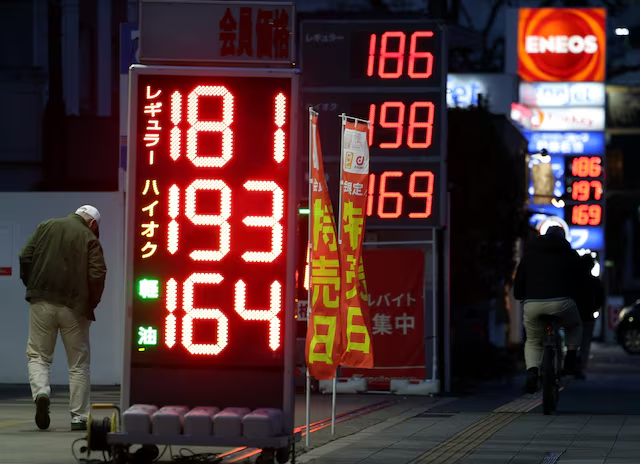

Japan has announced plans to release oil from its national stockpiles starting Monday in an effort to ease supply disruptions caused by the ongoing conflict between the United States and Israel against Iran. The move comes as rising tensions in the Middle East threaten global energy supplies and push fuel prices higher.
The Japanese government said it will release a record 80 million barrels of oil, equivalent to about 45 days of supply for the resource-dependent country. Officials hope the measure will help stabilize domestic fuel markets as gasoline prices begin to rise due to disruptions around the Strait of Hormuz, one of the world’s most critical oil transit routes.
Tokyo has instructed Japanese refiners to use the released crude to ensure stable domestic fuel supplies. The move will reduce Japan’s national oil reserves by approximately 17 percent. However, it remains unclear how much of the oil will contribute to a broader 400-million-barrel global release coordinated by the International Energy Agency to address supply shortages and market volatility.
Energy experts say the release can provide short-term relief but cannot fully offset prolonged disruptions in the region. Yuriy Humber, CEO of the Tokyo-based consultancy Yuri Group, said the reserves can help stabilize prices temporarily but mainly serve to buy time if the conflict continues.
In addition to the 80 million barrels, another 12 million barrels stored in Japan by Saudi Arabia, the United Arab Emirates, and Kuwait could also be released if needed, according to Japan’s Ministry of Economy, Trade and Industry.
Japan established its national oil reserve system in 1978, following the global energy crisis triggered by the Arab oil embargo. Today, the country maintains reserves equivalent to about 254 days of consumption, reflecting its heavy reliance on imported energy. Nearly 90 percent of Japan’s oil imports come from the Middle East.
Officials said the country will initially release 15 days’ worth of privately held oil reserves, followed by about one month’s supply from state reserves later this month.
At the same time, Japan is exploring alternative sources of crude oil from the United States, Central Asia, South America, and Gulf countries that can bypass the Strait of Hormuz. Japan currently imports around 4 percent of its oil from the United States, a share that increased after Tokyo reduced purchases from Russia following the 2022 invasion of Ukraine.
U.S. Environmental Protection Agency Administrator Lee Zeldin noted that the conflict highlights the importance of diversified energy supplies. He said countries in the Indo-Pacific region can look to the United States as a reliable energy partner with abundant resources.
The situation underscores growing global concerns about energy security as geopolitical tensions continue to affect vital oil supply routes.