

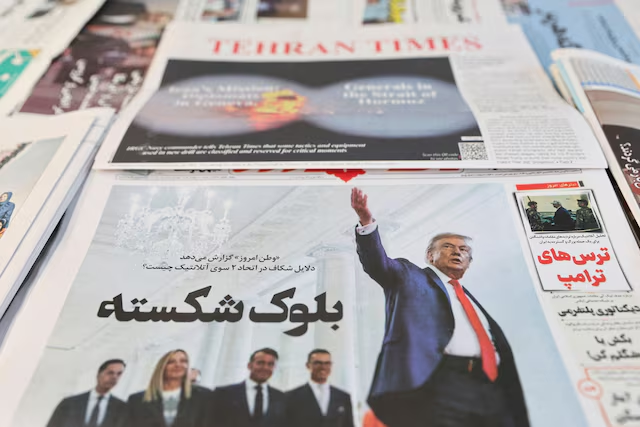

Donald Trump has pushed the United States closer to potential military conflict with Iran, even as some of his advisers urge him to concentrate on voters’ economic concerns ahead of this year’s midterm elections.
According to administration officials, Trump has ordered a significant buildup of U.S. forces in the Middle East and directed preparations for a possible multi-week air campaign targeting Iran. However, he has yet to publicly outline in detail the strategic rationale for what could become the most aggressive U.S. action against the Islamic Republic since its 1979 revolution.
The president’s sharpened focus on Iran underscores how foreign policy — including an expanded reliance on military power — has dominated the first 13 months of his second term. That emphasis has at times overshadowed domestic priorities such as inflation and the cost of living, which opinion polls consistently show rank higher among American voters.
A senior White House official said that despite Trump’s forceful rhetoric, there is still no “unified support” within the administration for launching an attack on Iran. Advisers are also wary of sending what one official described as a “distracted message” to undecided voters who are more concerned about economic stability.
Republican campaign strategists have urged the president to focus on economic achievements, including individual tax cuts passed last year and initiatives aimed at reducing housing and prescription drug costs. November’s elections will determine whether Republicans retain control of both chambers of Congress, with the potential loss of either chamber to Democrats posing significant challenges to Trump’s agenda.
Rob Godfrey, a Republican strategist, warned that a prolonged conflict with Iran could present serious political risks. He noted that Trump’s political base — energized by his “America First” doctrine — has long been skeptical of foreign entanglements, especially after campaign promises to end so-called “forever wars.”
Although many supporters of the “Make America Great Again” movement backed last month’s swift operation that removed Venezuelan President Nicolas Maduro, analysts say Iran would represent a far more formidable adversary.
Trump has repeatedly warned Tehran that it must reach a new agreement over its nuclear program or face military consequences. The U.S. carried out strikes on Iranian nuclear facilities in June, and Iranian leaders have threatened retaliation if further attacks occur.
The president won reelection in 2024 largely on promises to curb inflation and avoid costly foreign conflicts. However, public opinion surveys indicate he has struggled to convince voters that prices are falling significantly.
Republican strategist Lauren Cooley said Trump’s base could support limited and decisive military action if it is clearly tied to protecting U.S. national security and economic stability. Still, with little public appetite for another prolonged overseas war, any escalation with Iran could prove politically risky.
Historically, foreign policy has not been the decisive issue in most midterm elections. Yet Trump’s deployment of aircraft carriers, warships, and warplanes to the region may narrow his options. Without major concessions from Tehran — which so far appears reluctant — stepping back could risk projecting weakness abroad.
While the White House insists Trump prefers diplomacy and wants Iran to negotiate before it is “too late,” critics argue that the administration has not clearly articulated how potential air strikes would achieve long-term objectives, including preventing Iran from developing nuclear weapons.
Independent voters, who often determine close electoral outcomes, are expected to closely watch how Trump manages tensions with Iran in the months ahead.