
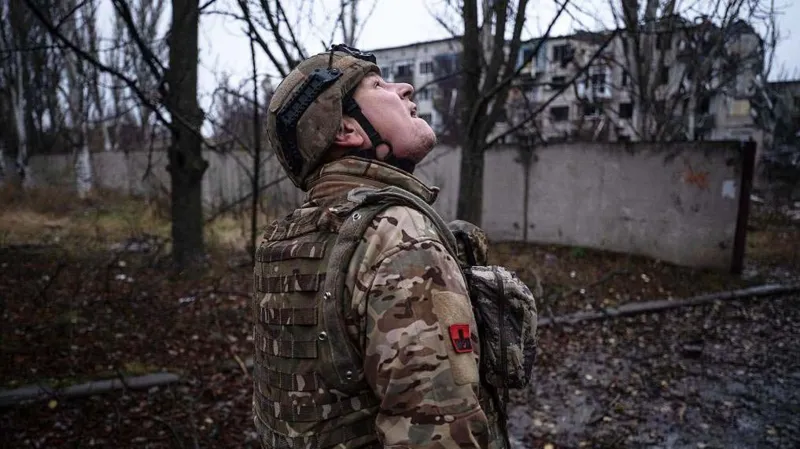


Near the embattled city of Kostyantynivka in the Donbas region, Ukrainian infantryman known by the call sign “Kenya” recently emerged after spending 225 days trapped in a front-line foxhole. His muscles had weakened so severely that he could barely walk after finally escaping the position.
According to Ukraine’s 93rd Brigade, repeated attempts to rotate him out of the front line failed because drones constantly monitored the area, making movement nearly impossible.
Kenya spent two days walking 11 kilometres back to his brigade, hiding from drones and avoiding mines along the way.
The region around Kostyantynivka has become one of the fiercest battlegrounds in eastern Ukraine. Ukrainian officials acknowledge that Russian troops have already reached the outskirts of the strategically important city.
If Russia captures Kostyantynivka, Moscow could intensify pressure on the remaining Ukrainian strongholds in Donbas, including Kramatorsk and Sloviansk.
Russian President Vladimir Putin has repeatedly described control of the Donbas region as a key military objective, while Ukrainian President Volodymyr Zelensky believes the Kremlin may launch another major offensive during the summer.
Despite continued attacks, Russia’s recent territorial gains in Donbas have slowed significantly, according to Ukrainian monitoring groups.
Soldiers on the front line say warfare has changed dramatically as drones now dominate combat operations. Large tank assaults and mass infantry attacks have largely disappeared, replaced by small groups of soldiers moving quickly across open terrain using motorcycles, bicycles and even horses.
“Most fighting was done by drones,” Kenya said.
Troops describe the “kill-zone” as a desolate grey area along the front where remotely piloted drones from both sides hunt anything that moves. Speed and concealment have become more important than heavy armour.
“Every time we left our positions, we prayed we would come back alive,” Kenya recalled.
At night, soldiers wear special anti-drone cloaks designed to hide them from thermal cameras, though troops say the protection only lasts for short periods.
Another soldier, Khani, who spent 122 days at the front, described how Russian drones and artillery destroyed the basement position where he and fellow troops had been sheltering.
After Russian forces discovered their location, drones dropped explosives into the building while kamikaze drones targeted the entrance.
Khani said one drone connected by fibre-optic cable managed to enter the basement before becoming tangled, allowing him to shoot the cable reel and sever its connection.
Russian soldiers later detonated anti-tank mines outside the shelter, believing everyone inside had been killed. However, the Ukrainian troops survived by escaping through a hidden emergency exit they had previously dug.
Another fighter, known as Granata, said Russian forces recently used explosives containing gas in an attempt to force Ukrainian troops from their positions.
Supplying front-line soldiers has also become increasingly dangerous. Many supply routes inside the Donbas kill-zone are cut off, forcing Ukraine to rely on aerial drones to deliver food, ammunition and water.
But these deliveries are often disrupted by electronic jamming or enemy fire.
Kenya said food was constantly threatened by rats and mice living in the trenches.
“They gnaw everything except metal,” he said.
However, soldiers say the greatest shortage at the front remains clean water.
“The most memorable moment for me was when it rained,” Kenya said. “I went outside just to wash myself.”
Winter conditions have also taken a heavy toll, with temperatures dropping to minus 25 degrees Celsius. Soldiers often sleep on frozen ground using worn-out sleeping bags with little protection from the cold.
Khani said one of his comrades died from hypothermia after becoming seriously ill at the front.
Ukraine’s military says Russian forces are regrouping for a possible summer offensive, while Ukrainian troops continue targeting Russian supply lines and logistics in an effort to slow the advance.
Military analysts say the fighting increasingly highlights a new reality of modern warfare: although drones now dominate the battlefield, control of territory still depends on soldiers holding the ground.
Without infantry defending positions inside the kill-zone, Ukrainian troops warn the front line could quickly collapse.