
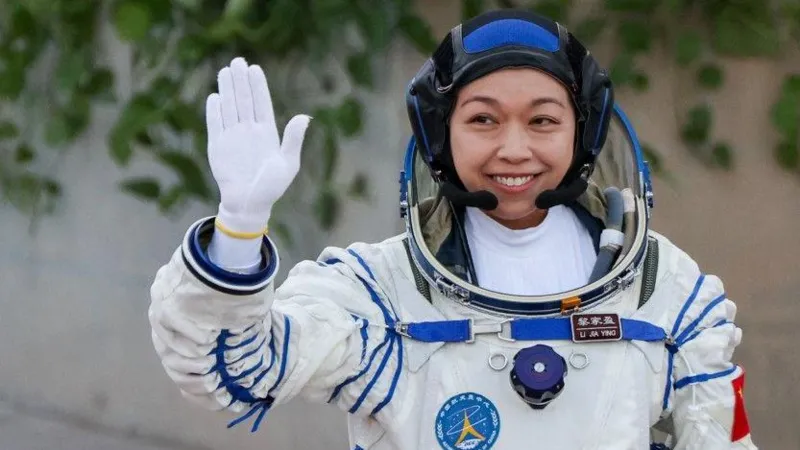


China has launched its first astronaut from Hong Kong into space aboard the Shenzhou-23 mission, marking a historic milestone in the country’s rapidly expanding space programme.
Among the astronauts is Li Jiaying, a 43-year-old police officer and mother of three, who is serving as the mission’s payload scientist. She became the first person from Hong Kong to travel into space.
The Shenzhou-23 spacecraft successfully docked with the Tiangong space station several hours after launch.
Li was joined on the mission by Zhu Yangzhu and Zhang Zhiyuan, both aged 39.
Chinese authorities confirmed that at least one astronaut from the crew will remain in orbit for a full year as part of a major long-duration space experiment. Officials said the astronaut selected for the extended mission would be announced later.
The Shenzhou-23 mission will focus on studying the effects of microgravity on the human body, alongside a range of scientific experiments designed to support China’s long-term ambitions in deep space exploration.
Crowds waving Chinese flags gathered to witness the launch, which took place at 11:08pm local time on Sunday.
Hong Kong Chief Executive John Lee described Li’s participation as a “historic” achievement for Hong Kong.
Li said she was inspired by Yang Liwei, the first astronaut sent into space by China.
“This is a rare chance. Why not try?” Li said before the launch, according to Chinese state media.
As she headed to the launch site, Li told state broadcaster CCTV: “How high our Chinese spacecraft flies, that’s how high we can hold our heads high.”
Analysts say stories of successful Hong Kong figures like Li could help Beijing strengthen patriotic sentiment among younger generations in the city.
China has steadily expanded its space programme in recent years, sending crews to the Tiangong station since 2021 on regular six-month missions.
The planned year-long stay aboard the station would rank among the longest human space missions ever conducted, approaching the 14-month record set by Russian cosmonaut Valery Polyakov in 1995.
Experts say the mission demonstrates China’s growing expertise in long-duration spaceflight and preparations for future lunar exploration.
Last year, China’s Chang’e-6 mission became the first spacecraft to return rock samples from the far side of the Moon.
Later this year, China is also expected to test its new Mengzhou spacecraft, which is being developed to transport astronauts to the Moon as Beijing pushes toward its goal of landing humans on the lunar surface by 2030.