

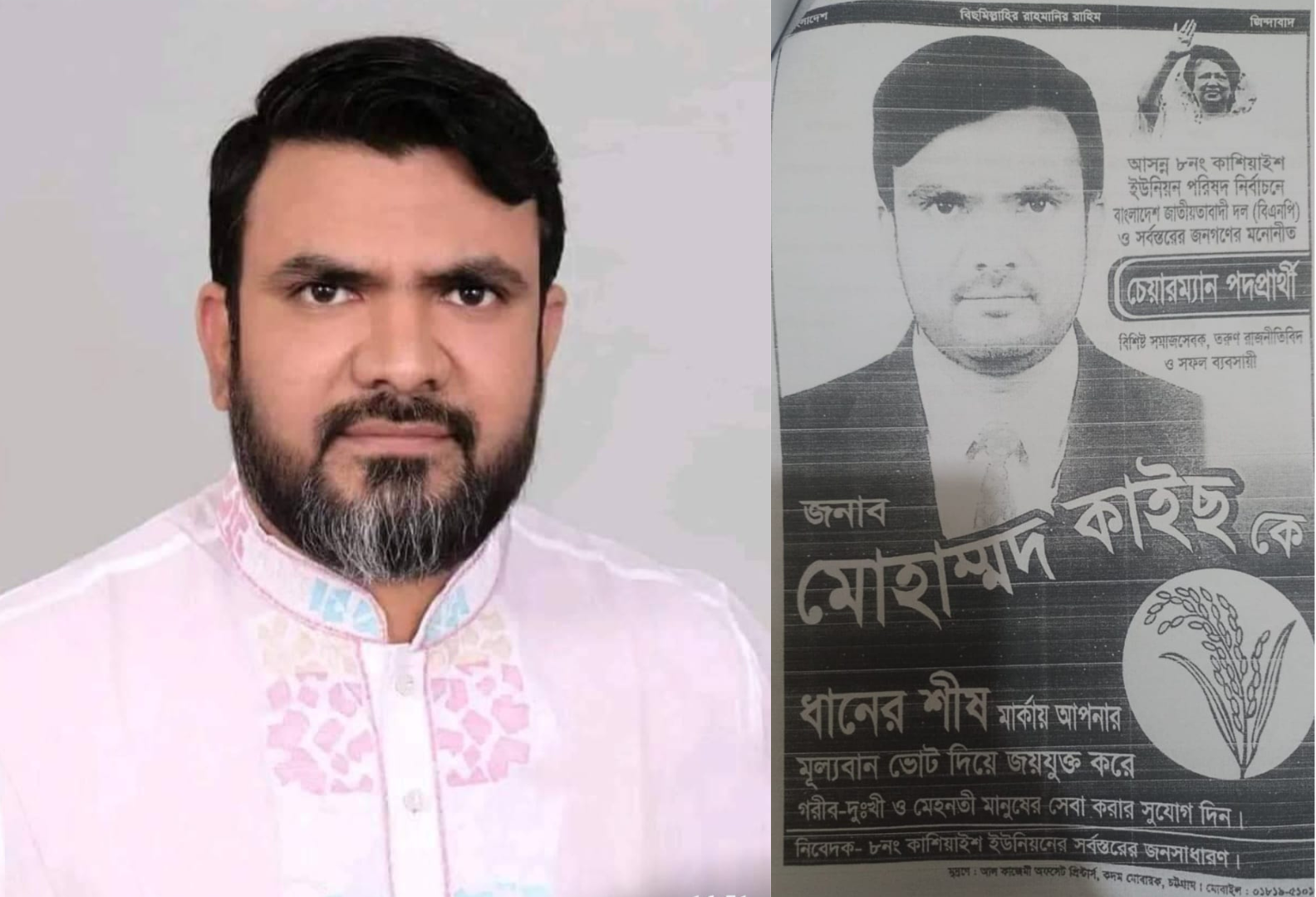

By Mohammad Kamal Uddin The history of political rivalry, persecution, and retaliation in Bangladesh is not new. Since independence, leaders and activists of different political parties have often faced harassment, criminal cases, arrests, and political repression whenever power changed hands. Yet some incidents transcend the boundaries of ordinary legal disputes and raise profound questions about the state, society, politics, and the justice system itself. The case of Md. Kaiych, a businessman, expatriate from Dubai, and political activist from Budhpura village in Kashiais Union of Patiya, Chattogram, appears to be one such case. Political participation is a constitutional right. Every citizen has the freedom to support or join any political party—whether the BNP, Awami League, Jamaat-e-Islami, Jatiya Party, or any other organization. Differences in political ideology are natural in a democratic society. However, when an individual is repeatedly subjected to legal harassment because of political affiliation, when years of imprisonment follow, and when even his political identity is allegedly altered in official records, legitimate questions arise: Is this justice, or is it political vengeance? According to local sources, Kaiych has long been involved in BNP politics. A significant portion of his hard-earned income from abroad was reportedly spent on party activities, assisting persecuted activists, and supporting social welfare initiatives. He was known not only as a political worker but also as a generous and helpful figure within his community. In the 2016 Union Parishad election, he contested for chairman under the BNP’s “Sheaf of Paddy” symbol. At the time, standing as a BNP candidate required considerable courage amid the prevailing political environment. Although defeated, he remained politically active. Later, in the 2021 Union Parishad election, he ran as an independent candidate and reportedly gained substantial public support. His supporters, however, claim that political and administrative influence deprived him of a fair outcome. What followed was a new chapter of political conflict, legal battles, and controversy. A murder case was filed in which Kaiych was named as the principal accused. His family maintains that he had no direct involvement in the incident and was implicated for political reasons. On November 16, 2022, he was arrested and began a prolonged period of incarceration. His imprisonment lasted not for days or months, but for years. During this time, his family suffered severe hardship, his business deteriorated, and his children were deprived of their father’s presence. One of the most painful moments came when his father passed away while he remained behind bars. For any son, attending a father’s funeral and bidding a final farewell is an invaluable human experience. Yet Kaiych was denied even that opportunity. Confined within prison walls, he received the heartbreaking news of his father’s death from afar. Such pain rarely appears in court documents or charge sheets, but it leaves permanent scars on a human heart.
Subsequently, the case was investigated by the Police Bureau of Investigation (PBI). According to sources familiar with the matter, after extensive inquiry, witness interviews, and evidence analysis, the PBI reportedly recommended exoneration for Kaiych and several others. This development raised hopes that justice might finally prevail and that an innocent man might regain his freedom. However, legal complications and procedural delays prevented that expectation from becoming reality. Then emerged an even more astonishing development. During the anti-discrimination student movement of 2024, Kaiych was named as an accused in the murder case of student Jahiduzzaman Tanvin filed with Uttara East Police Station in Dhaka. Even more surprisingly, court documents allegedly identified him as an assistant secretary of the Awami League’s volunteer wing, the Swechchhasebak League, and accused him of participating in shootings against protesters.
This is where the most significant questions arise. How could a man known locally as a BNP activist, who had previously contested elections as a BNP candidate and who was reportedly imprisoned since November 2022, become an accused in a 2024 shooting incident in Dhaka? His family insists that at the time of the alleged incident, he was confined in Chattogram Central Jail. Local BNP leaders have echoed the same claim. If prison records confirm this assertion, the issue extends far beyond a simple procedural error. It raises serious concerns regarding investigative standards, information verification, and the integrity of the legal process. The fundamental principle of the rule of law is that while the guilty must be punished, the innocent must be protected. Justice loses its meaning if an innocent person suffers punishment for a crime he could not possibly have committed. When an individual allegedly becomes an accused in an incident that occurred elsewhere while he was already in prison, public confidence in the justice system is inevitably shaken. Today, Kaiych’s family is not merely seeking his release. They are demanding truth, impartial investigation, and a transparent examination of all available evidence. They have appealed to BNP Acting Chairman Tarique Rahman to look into the matter, believing that a long-time political worker deserves both humanitarian and political consideration. For them, this case is not only about one man. It represents the fate of countless political activists who have, at various times, become victims of political conflict and legal controversy. Bangladesh today speaks increasingly about democracy, human rights, accountability, and the rule of law. In that context, the Kaiych case presents an important test. The strength of a state lies not only in punishing offenders but also in safeguarding innocent citizens from wrongful prosecution. Ultimately, only a court of law can determine guilt or innocence. Yet as citizens, we expect that truth will not be suppressed, political identity will not influence justice, and no individual will lose years of life under questionable or disputed accusations. Kaiych’s family continues to wait. They wait for the day when the courts, investigative agencies, and responsible state institutions will bring the full truth to light. They remain convinced that while truth may be delayed, it cannot be buried forever. As a journalist reflecting public concerns, I ask: How can a man allegedly imprisoned in Chattogram become an accused in a shooting incident in Dhaka?
Is the Kaiych case merely the story of one individual, or does it reveal deeper questions about politics, justice, accountability, and the protection of citizens’ rights in Bangladesh?
Only a transparent and impartial pursuit of truth can answer that question. Suggested English Headlines: Accused of Murder While Behind Bars: The Unanswered Questions in the Kaiych Case From BNP Activist to Awami League Leader on Paper? The Curious Case of Md. Kaiych Prison Walls, Political Identity, and the Search for Justice How Can a Jailed Man Be Accused of a Dhaka Shooting? The Kaiych Case: Politics, Imprisonment, and a Long Wait for Justice Can Truth Prevail? The Controversial Case Surrounding Patiya’s Kaiych
A Prisoner, A Murder Case, and a Nation’s Questions About Justice Behind Bars Yet Charged Elsewhere: A Story That Demands Answers