

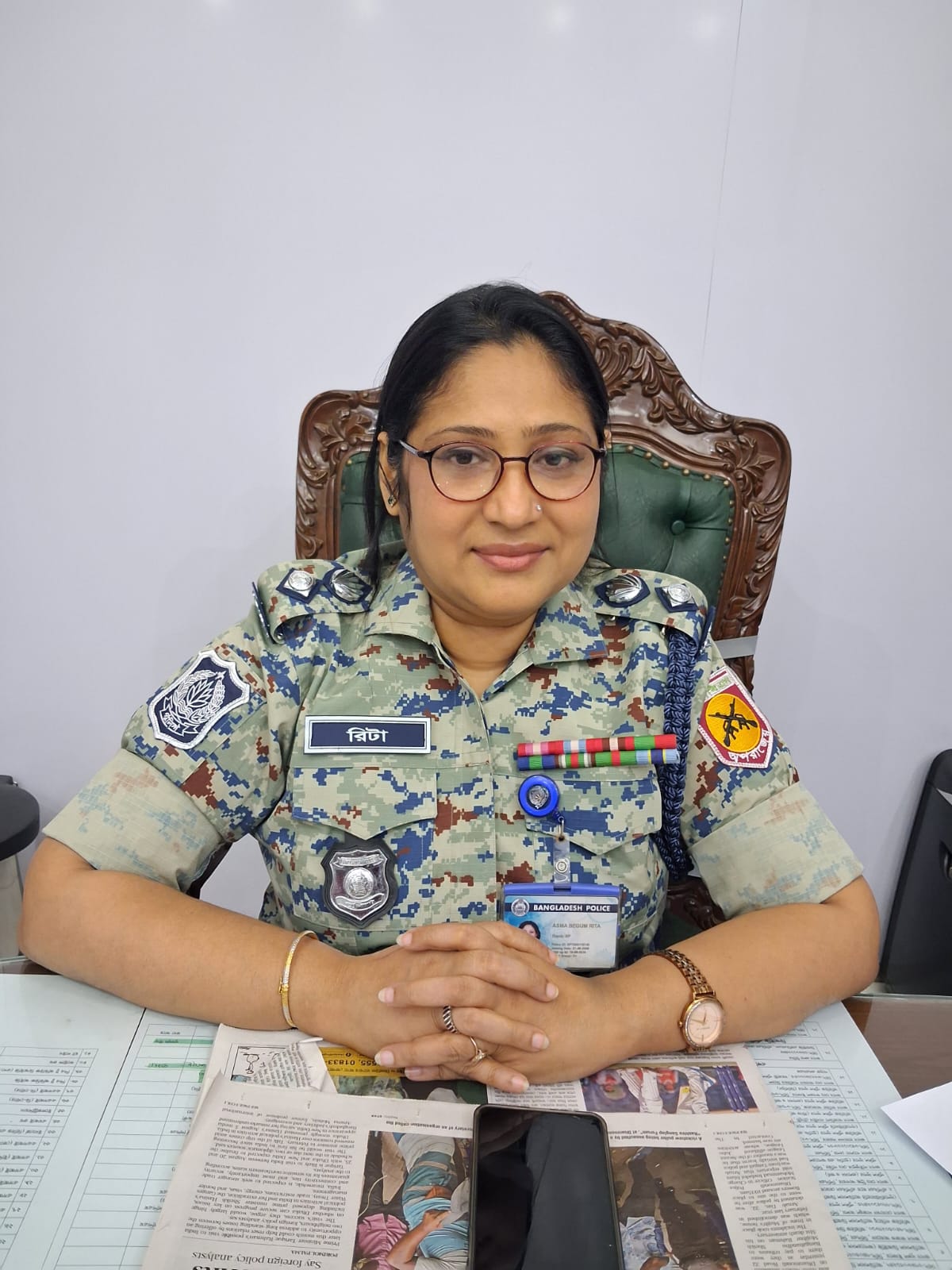

Some meetings take place within the boundaries of a scheduled time, while others stay in the mind long after the clock has moved on. Some people make you feel at the very first meeting that this introduction may one day become part of a story. And some workplaces are more than buildings made of brick and concrete; they hold within them history, responsibility, courage, human suffering, relief and countless invisible stories. My recent visit to the Armed Police Battalion, APBn, Headquarters in Dhaka was one such afternoon. It was exactly 3 p.m. I have spoken with numerous institutions, officials and people throughout my long journey in journalism. I have written about the police, investigated their activities, written about APBn and even produced documentaries on the force. As a result, APBn is not merely the name of a law-enforcement agency to me; it is connected to a long-standing professional interest, research and a distinct chapter of my experience. That day, I stepped into a new chapter of that familiar institution, and waiting for me was a woman police officer—Superintendent of Police Asma Begum Rita. It was our first meeting, yet from the very beginning, it felt as though she did not allow the ice of formality to settle between us. A uniform identifies a person with responsibility, but it is behavior that makes a person truly distinctive. My first impression of Rita was that behind the firmness of her uniform was a very natural, amiable and sensitive human being. Wearing glasses, with a neat personality, a restrained smile and clarity in her words, she carried a distinctly modern presence. Her tone was gentle, but her words reflected confidence. She spoke as if she was not delivering a formal briefing to a journalist, but simply explaining matters in her own way. Her sincerity in maintaining communication through her mobile phone on several occasions was also an expression of that courtesy. The speed, sincerity and mutual trust necessary when dealing with members of the media were clearly visible in her conduct. To me, this was her first and most important identity—she is a Superintendent of Police, but before that, she is a human being. She is new to the responsibility of APBn’s Media Wing, and the responsibility is not an easy one. While much of police work is visible in the field, presenting an institution’s actual performance, operations, recoveries, crime-prevention activities, public services and humanitarian initiatives to the people is no less important. In today’s world, information is power. And in an age of misinformation, rumors and incomplete information, accurately presenting the real work of a law-enforcement agency to the public is itself a responsibility. Rita is working in that area in a new capacity. She understands that a journalist is not merely a messenger of news; journalists ask questions, seek information, verify facts and create opportunities for society to evaluate the work of an institution. That journalist-friendly mindset was one of the things that stood out most during our conversation. As we spoke, her educational background also came up. As a student of Political Science at the University of Dhaka, she has an academic foundation in the relationship between the state, administration, law and society. But her interests are not limited to political science; she is also interested in history. That increased my curiosity further, because to understand the present of an institution, one must also know its past. And the history of APBn is closely intertwined with the history of law enforcement in Bangladesh. Various kinds of information about APBn circulate in society, but when it comes to history, documents—not emotion—should have the final word. According to official information from Bangladesh Police, APBn began its journey in 1975, while its legal framework was consolidated through the Armed Police Battalions Ordinance of 1979. The force developed from the need for a specialized armed police unit in the changing security realities of Bangladesh after independence. Over time, its responsibilities have changed and expanded. Today, APBn is not merely an armed specialized force. Its activities extend across areas including combating terrorism and armed crime, controlling narcotics, preventing smuggling, providing special security, maintaining law and order in Rohingya camp areas, combating cybercrime and recovering lost property belonging to ordinary citizens. The evolution of a force is, in many ways, also a story of the evolution of a state’s security needs. When Rita described APBn’s activities during July, it felt less like an official report and more like the story of hundreds of people whose lives were touched during a month of work. In various operations during July, APBn recovered 844 mobile phones. It also recovered Tk 958,148 that had been taken through bKash and Nagad fraud. Authorities recovered 13 SIM cards, one Facebook account, three WhatsApp accounts and one email account used in fraudulent activities. Four complaints related to Facebook accounts were resolved, while two cyberbullying incidents were also addressed. Through the National Emergency Service 999, APBn provided assistance to 508 people during July. These figures are not merely numbers. Behind 844 recovered mobile phones may have been the anxiety of 844 families. Behind Tk 958,148 may have been someone’s savings, business capital or money needed for a household. Recovering a lost phone can sometimes mean far more to a person than the monetary value of the device itself, because along with the phone may disappear personal photographs, contacts, important documents, memories and countless invisible connections. Therefore, this work by the police is not only about crime prevention; it is also about the humanitarian act of restoring a sense of relief. Drugs destroy society from within. During various APBn operations in July, authorities recovered 12,421 yaba tablets, 1.18 kilograms of cannabis, 32 liters of liquor, 285 cartons of cigarettes of various brands, 72 foreign cigarettes and 72 cans of beer. Ten cases were filed in these incidents, and 11 people were arrested. Anti-drug operations should not be viewed merely as police operations. They are essentially a battle to protect a generation. A drug dealer does not simply sell drugs; he puts the future of a family at risk, destroys the dreams of a young person and sometimes takes away the peace of an entire household. That is why every anti-drug operation is also socially significant. July also brought success in arms recovery. Authorities recovered two one-shooter guns, 16 rounds of ammunition and other locally made sharp weapons and related items. One person was arrested in the case. In anti-smuggling operations, 1,744 grams of gold were recovered. Eleven cases were filed in these incidents, and five people were arrested. In addition, authorities recovered 910 kilograms of cosmetics, 187 sarees and various other products, two mobile phones/laptops, 322 kilograms of marine crabs, two FDMN cards and large quantities of food products and other goods. Smuggling routes do not merely harm the economy; they can sometimes be connected with drugs, arms, human trafficking and organized crime. APBn’s role in blocking those dark routes is therefore significant. Among July’s successes, several incidents deserve special mention. In operations conducted by 12 APBn, 185 lost mobile phones were recovered based on general diary records from different batches. A total of Tk 73,198 mistakenly transferred through bKash and Nagad was also recovered and later handed over to the rightful owners. In an operation by 13 APBn, 300.7 grams of gold worth approximately Tk 4,720,990 at market value were recovered, and one person was arrested. In an operation by 8 APBn, nine people, including the prime accused in a sensational murder case, were arrested. In an operation by 14 APBn, one person was arrested with 5,800 yaba tablets. Meanwhile, in an operation by 16 APBn, one person was arrested with a one-shooter gun and 16 rounds of live ammunition. These four incidents were like four separate mirrors, each reflecting a different capability of APBn. During our long conversation, APBn chief Additional Inspector General Hasib Aziz also came up repeatedly. Hasib Aziz is not a stranger to me. Alongside a long professional relationship, I have also had the opportunity to know him through a personal friendship. A police officer cannot be judged solely by his rank. Courage in making decisions in the field, the ability to understand situations, quick decision-making, professional knowledge and confidence in subordinates—all these together shape the true identity of a leader. In my view, Hasib Aziz is a courageous and capable police officer in that sense. Rita’s words also reflected that confidence in his leadership. When a subordinate officer speaks spontaneously about the work of a superior, it is not merely formal praise; it also carries a message of organizational trust. Today’s criminals are not the criminals of the past. The nature of crime has changed. The tools of crime have changed. Criminals use mobile phones, social media and digital financial transactions. Therefore, policing must also change. In the past, police had batons, firearms, wireless communication systems and documents. Today, these are accompanied by digital forensics, cyber tracking, data analysis, technology-based surveillance and rapid communication systems. APBn’s activities during July reflect that transformation. From combating cyber fraud to recovering lost mobile phones, both are now part of modern policing. I am a journalist, writer, researcher and television presenter. For a long time, I have worked on news, history and various civic issues. When writing about the police, my pen knows how to appreciate good work, just as it knows how to ask questions. Because a journalist’s job is not to become the spokesperson of an institution; it is to bring the truth forward. That is why my extended conversation with Rita that day was important to me. She did not avoid questions. She provided information, offered explanations and discussed various issues openly. From a Media Wing official, this is exactly what I expect—keeping the door open, welcoming questions and building trust through information. She had also arranged refreshments for us that day. An informal environment developed among the journalists. Journalist Mujibur Rahman Chowdhury, Cox’s Bazar Club Limited President Abu Sayed, Ariful Islam Chowdhury, Daily Ittefaq representative Jahangir, BSS’s Mohammad Ismail and several others were present. The conversation moved from news to crime, policing and society, but the central concern throughout was people’s safety. Before leaving, I also met Additional DIG Nazmul Sahib. We discussed various crimes and the law-and-order situation. It was an afternoon that seemed to bring together many different professional experiences in one place. That day, I personally took a photograph of Rita. In the picture, she is seated at her workplace, papers in front of her, wearing the APBn uniform, glasses on her face and a restrained expression. But to me, the photograph is not merely a portrait of a Superintendent of Police. It is a picture of the confidence of a working woman. A woman serving in an important state institution. An officer who is firm against crime but gentle in dealing with people. A Superintendent of Police carrying the weight of responsibility without arrogance in her words. A modern professional who understands that in today’s world, enforcing the law is not enough; one must also earn the trust of the people. The person in that photograph is therefore more than SP Rita to me—she is also a reflection of a changing system of policing. As I left APBn Headquarters that afternoon, I felt that to understand an institution, one cannot simply look at its buildings. One must look at its people. Some are conducting operations in the field. Some are arresting criminals. Some are recovering lost mobile phones. Some are recovering money lost through cyber fraud. Some are fighting smuggling and crimes along the borders. And some are bringing all these activities before the public through information. Together, they form a force. And when that force is led by courage, intelligence and the ability to make decisions, while its field officers demonstrate humanity, discipline and professionalism, an institution does not merely become stronger—it also becomes more acceptable to the people. My first meeting with Asma Begum Rita, therefore, was not merely a courtesy meeting. It was an opportunity, through the eyes of a journalist, to see a woman police officer in a new light—to see the person behind the uniform. And the feeling that came through most strongly in her words, behavior and sense of responsibility was an effort to combine the firmness of duty with the gentleness of humanity. Over time, police weapons will change, technology will change and the nature of crime will change. But the question of human security will not. The stories of those who work day and night to protect that security deserve to be written. Just as a pen is necessary for criticism, it also carries a responsibility to recognize good work. So, on that afternoon, my notebook did not merely collect a series of numbers. It collected the memory of a first meeting with a woman police officer, the story of a busy July for a force, reflections on leadership and, above all, the warm memory of a human being living behind a uniform.