

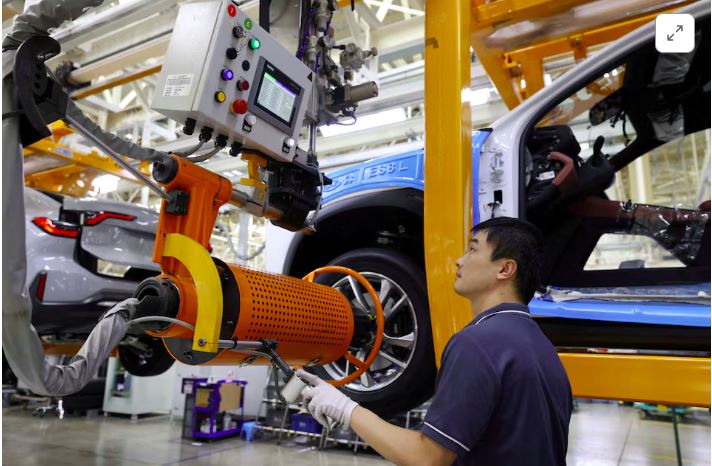

Factory activity in China expanded at its fastest pace in a year in March, offering a boost to the বিশ্বের দ্বিতীয় বৃহত্তম অর্থনীতি amid ongoing global uncertainty and energy market volatility.
According to data released by the National Bureau of Statistics, China’s official manufacturing Purchasing Managers’ Index (PMI) rose to 50.4 from 49.0 in February—crossing the critical 50 mark that separates growth from contraction. The figure also exceeded analysts’ expectations and marked the strongest reading in 12 months.
The improvement comes after a prolonged slowdown, with factory activity remaining in contraction for most of 2025 and early 2026.
The মার্চ rebound was largely driven by stronger demand and a post-holiday production recovery following the Lunar New Year. Businesses resumed operations more quickly than expected, helping lift output and new orders above the expansion threshold.
China’s exports also remained a key growth engine, supported by robust global demand for electronics, particularly semiconductors. The country posted a record $1.2 trillion trade surplus last year, and officials say momentum has continued into 2026.
Despite the positive data, economists warn that the outlook remains uncertain due to escalating geopolitical tensions, especially the ongoing conflict in the Middle East.
“The outlook for the second quarter is unclear due to high energy prices,” said Zhiwei Zhang, chief economist at Pinpoint Asset Management. He added that markets are increasingly concerned about a global growth slowdown and supply chain disruptions.
The survey showed mounting cost pressures, with the raw materials price index jumping sharply to 63.9 in March from 54.8 in February. Rising commodity prices and faster procurement have squeezed manufacturers already operating on thin margins, while output prices rose only modestly—indicating limited pricing power.
While production and new orders improved, domestic demand continues to lag. Higher input costs could affect wages and job stability, potentially weakening consumer spending further.
The non-manufacturing PMI, which covers services and construction, also edged up to 50.1, signaling modest expansion across the broader economy.
Analysts from ANZ estimate that China’s GDP growth in the first quarter could exceed 4.5%, aligning with the government’s annual target range of 4.5%–5%.
Industry groups, including the China Association of Automobile Manufacturers, have warned that the Middle East conflict could impact exports, particularly vehicles, as the region accounts for a significant share of China’s overseas shipments.
Experts also caution that if global conditions worsen, particularly in key markets like the European Union, China’s export-driven recovery could face setbacks later in the year.
“Global uncertainty increases reliance on China’s industrial supply chain,” said Dan Wang of Eurasia Group. “But risks to exports and factory activity may rise in the second half if major economies slow down.”
With growth holding steady, policymakers are now expected to prioritize structural reforms rather than aggressive monetary easing. Beijing has repeatedly emphasized shifting the economy toward domestic consumption, though such changes are likely to take time.
As geopolitical tensions deepen and energy prices remain volatile, China’s manufacturing sector may face growing challenges despite its current momentum.