

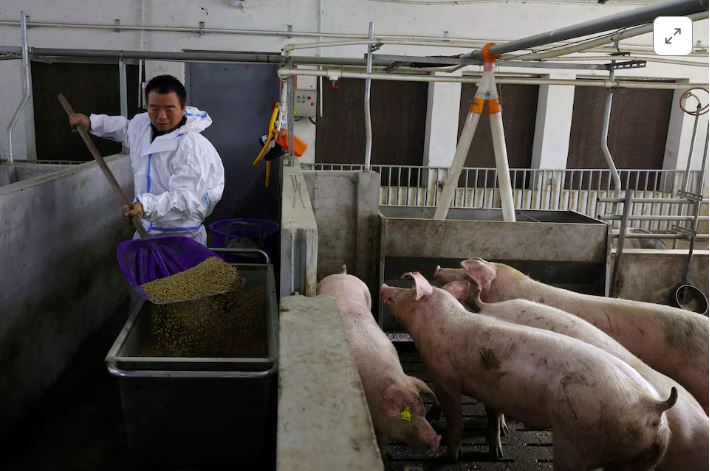

China is accelerating efforts to reduce its dependence on imported soybeans by introducing alternative livestock feed, with pig farmers increasingly adopting fermented mixtures made from locally sourced ingredients.
On farms in Taizhou, near Shanghai, producers are experimenting with fermented feed made from bran, pumpkin vines and other agricultural byproducts. The process breaks down proteins in advance—similar to yogurt fermentation—making nutrients easier for pigs to digest and reducing the need for soybean-based feed.
For farmers like Gao Qinshan, the shift is largely driven by rising costs. Feed accounts for up to 70% of pig-rearing expenses, and soybean prices have become volatile amid ongoing trade tensions between China and the United States, as well as geopolitical instability in the Middle East.
“Pig farming has become unprofitable,” Gao said, citing oversupply and weak consumer demand. “Everyone is thinking about how to cut costs.”
However, Beijing’s push goes beyond short-term savings. Officials see reducing soybean dependence as a key part of long-term food security and economic self-reliance. The strategy intensified during the trade standoff with the U.S. under Donald Trump, when soybeans emerged as a critical bargaining tool.
China remains the world’s largest soybean importer, purchasing $52.7 billion worth of the crop in 2024, including $12 billion from the U.S., according to World Bank data. Imports reached a record 111.8 million metric tons last year.
Industry analysts say fermented feed is gaining traction, rising from just 3% of China’s industrial feed market in 2022 to about 8% today, with projections of reaching 15% by 2030. This shift could cut soybean imports by more than 6%, according to estimates.
Major agribusiness players are already adapting. Muyuan Foods, the world’s largest pig producer, has reduced soymeal content in feed significantly using synthetic amino acids derived from fermented corn. Meanwhile, New Hope Liuhe is developing soy-free feed for poultry using alternative protein sources such as duckweed.
China’s leading dairy companies, Yili Group and China Mengniu Dairy, have also cut soymeal use in cattle feed by around 20%, according to industry sources.
The push has attracted international interest as well. Dutch trading giant Louis Dreyfus Company plans to build its first fermented feed production line in Tianjin, highlighting China’s growing role in feed innovation.
Despite progress, challenges remain. ферmented feed systems require significant investment and technical expertise, and many smaller farmers struggle with implementation. Concerns also persist over animal health, growth rates and meat quality.
Analysts warn that while cost-cutting is driving adoption, consumer demand for high-quality pork could limit how far the shift can go. Still, with pork a staple of the Chinese diet and the country home to half the world’s pig population, Beijing appears determined to transform the sector.
As China pushes forward with its খাদ্য নিরাপত্তা strategy, the move toward fermented feed reflects a broader effort to reshape supply chains and reduce vulnerability to global market shocks.