

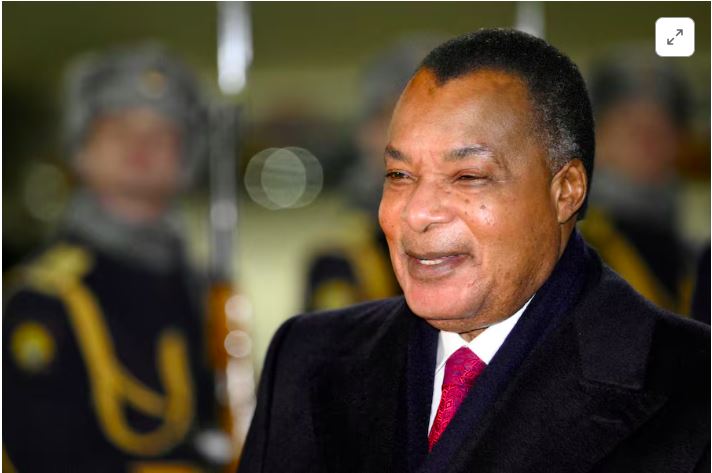

President Denis Sassou Nguesso is expected to extend his decades-long rule as voters in Republic of the Congo head to the polls on Sunday. However, growing speculation over who will eventually succeed the 82-year-old leader is increasingly shaping the country’s political debate.
Sassou Nguesso, a former paratrooper, first came to power through a coup in 1979. Although he lost the country’s first multi-party election in 1992, he returned to power in 1997 following a civil war. Since then, he has ruled the oil-rich Central African nation for a combined total of nearly 42 years.
This makes him one of Africa’s longest-serving leaders, behind Teodoro Obiang Nguema Mbasogo of Equatorial Guinea and Paul Biya of Cameroon.
Sassou is facing six challengers in the election, which is overseen by a commission largely dominated by members appointed by the ruling Congolese Labour Party.
However, two major opposition parties are boycotting the vote, arguing that the electoral process lacks transparency. Several potential rivals are either imprisoned or living in exile, raising doubts about the competitiveness of the election.
Analysts suggest the vote may largely confirm Sassou’s continued leadership rather than determine it. “This election is more of a formality,” said Remadji Hoinathy of the Pretoria-based Institute for Security Studies, noting that the real political question lies in what happens after Sassou leaves power.
A constitutional reform in 2015 reset presidential term limits and allowed Sassou to remain in office. The revised constitution limits presidents to three five-year mandates, meaning this election could be his final one unless the law is changed again.
Sassou has recently begun speaking more openly about succession. At the launch of his campaign on February 28, he told young supporters that his generation was “laying the groundwork” for them to eventually take over leadership.
One possible successor is his son, Denis-Christel Sassou Nguesso, who joined the government in 2021 as minister responsible for international cooperation and public-private partnerships. While he has gained visibility, analysts say he lacks his father’s authority within the ruling party and remains unpopular with many voters.
Other potential successors include security chief Jean-Dominique Okemba, a nephew of the president, and infrastructure minister Jean-Jacques Bouya, who is also related to Sassou.
Sassou’s campaign has focused on continuity and development. While the country’s economy has begun to recover modestly after a decade-long slowdown caused by falling global oil prices, many citizens say living conditions have not improved significantly.
Oil still accounts for roughly half of Congo’s gross domestic product and about 80% of its exports. Although the country has reduced its debt-to-GDP ratio from over 100% in 2020 to about 93.6% in 2024, financial pressures remain.
According to the World Bank, more than half of Congo’s 6.1 million people live in poverty, and youth unemployment stands at around 42%. Nearly half the population is under the age of 18.
Meanwhile, investigations by prosecutors in France and the United States into overseas assets linked to Sassou’s relatives have added to political scrutiny, though the family has denied any wrongdoing.
For many voters, the coming election raises questions about whether the next five years will bring meaningful change. “We need better healthcare and education,” said Brazzaville resident Frédéric Nkou. “But with this new term, we may see more of the same.”