


A government investigation in Nigeria has uncovered how a seemingly official presidential council, complete with government offices, civil servants, a website on a government domain and a multimillion-naira budget allocation, allegedly operated without any legal authority.
The Presidential Foreign Intervention Promotion Council (PFIPC) presented itself throughout much of 2025 as a government-backed agency designed to attract foreign investment into Nigeria, Africa’s most populous nation.
The organisation operated from an office inside the Federal Secretariat in Abuja, the main government administrative complex. It had civil servants assigned to work there, maintained an official website using Nigeria’s “.gov.ng” government domain, and reportedly received approval to recruit more than 300 employees despite a nationwide freeze on public-sector hiring.
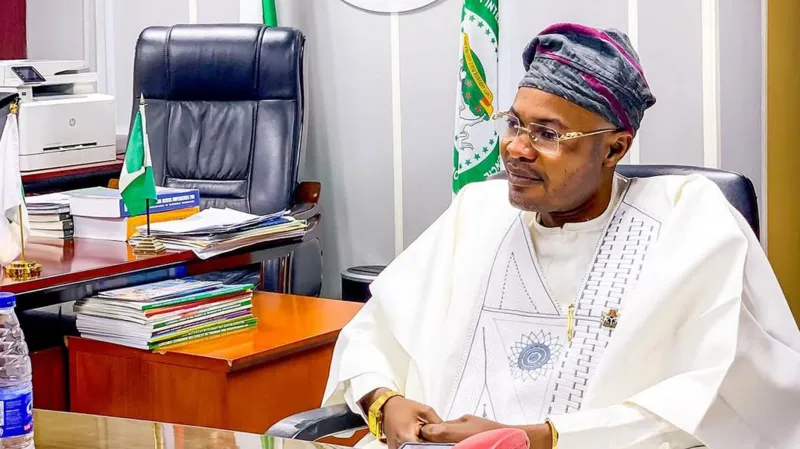
Its Director General, Prince Adeniyi Adeyemi Matthew, held meetings with senior government officials, including cabinet ministers, financial regulators, anti-corruption officials and foreign diplomats.
The council appeared to gain further legitimacy when Nigeria’s 2026 national budget included an allocation of 1.3 billion naira ($950,000) for the organisation.
However, in June, the Nigerian presidency announced that the PFIPC had never legally existed.
Officials said the council was not created through any presidential order, law or recognised government process. Investigators alleged that its legitimacy was based on a forged appointment letter claiming President Bola Tinubu had appointed Adeyemi as director general.
The document reportedly contained the forged signature of Femi Gbajabiamila, President Tinubu’s chief of staff. Adeyemi has denied the allegations, insisting that the council was legally established in 2024 and that his appointment was genuine.
Adeyemi has also accused senior officials of demanding bribes to secure his position and later attempting to take control of the council’s funds. The presidency has rejected those accusations.
The former council head has gone into hiding, claiming he fears for his safety, but has said he intends to appear in court later in July to face charges including forgery and impersonation. Nigerian police have launched a search for him.
The investigation has expanded beyond the alleged forged document, with authorities examining how the organisation managed to obtain government facilities, staff support and a budget allocation.
Experts say creating a legitimate government agency in Nigeria requires approval from several powerful institutions, including the Secretary to the Government of the Federation, the civil service leadership, the Accountant-General’s Office, the Budget Office and ultimately the National Assembly.
Former Secretary to the Government of the Federation Babachir Lawal said the council’s existence would have required cooperation from officials inside the government system.
“There is no way that office in a normal system would not know that the agency is fake,” Lawal told the BBC. “You cannot create a budget code for yourself without the budget office knowing.”
He added that officials within the system would have had to validate the organisation’s activities.
Oluseun Onigbinde, co-founder of Nigerian transparency organisation BudgIT, first highlighted the council’s appearance in the national budget.
He noted that the PFIPC was absent from Nigeria’s 2023, 2024 and 2025 budgets but appeared suddenly in the 2026 budget with its own allocation and budget code.
“This agency actually emanated and found itself in the budget from the executive,” Onigbinde said, suggesting the process originated from within the government rather than parliament.
He questioned how an organisation could pass through multiple government checks and still allegedly turn out to be fake.
“I don’t know how you go through all these tracks and you still come out at the end and this agency is fake,” he said.
The Nigerian government’s explanation has changed during the investigation.
A government spokesman initially claimed Adeyemi had fraudulently opened a bank account with the Central Bank of Nigeria. Later, the Accountant-General’s Office said no such account had been activated and that no public funds had been released.
The distinction has become central to the controversy. While officials insist that government money was not lost, critics argue that the incident exposes weaknesses in Nigeria’s administrative system.
The presidency has been asked why the council was given office space, employees and budget recognition, and why an internal investigation was chosen instead of an independent inquiry.
President Tinubu has ordered the Independent Corrupt Practices and Other Related Offences Commission (ICPC) to investigate the matter and report within 30 days, including examining the role of any public officials who may have assisted the council.
However, critics have questioned the independence of the investigation after Tinubu publicly expressed “100% confidence” in Gbajabiamila, who is listed as a witness in the case.
Nigeria has faced numerous corruption scandals over the years, but critics say many investigations have ended with few high-level convictions.
President Tinubu came to power in 2023 promising reforms and has highlighted thousands of corruption convictions and hundreds of billions of naira recovered. Opponents argue that major politically connected figures often avoid serious scrutiny.
Analysts say the PFIPC case is unusual because the alleged wrongdoing was not simply the misuse of government funds, but the creation of an entire government institution that may never have legally existed.
Onigbinde described the scandal as a symptom of Nigeria’s wider budgeting problems, pointing to the rapid expansion of government agencies despite previous recommendations to reduce their number.
“It’s a costly waste of public resources,” he said.
The investigation also affected Adeyemi’s family. Police searching for him visited his family home in Ogbomoso, Oyo State, and questioned his elderly father, Chief Adetunji Adeniyi.
Speaking to BBC News Yoruba, Adeniyi alleged that officers damaged property and searched the house.
“My son is an easy-going person, not a troublemaker,” he said. “I am really confused by all of this.”
Adeyemi’s lawyer, human rights advocate Femi Falana, said detaining relatives instead of suspects would be unlawful. Police officials denied arresting Adeniyi, saying he was only invited to assist with inquiries.
Falana said Adeyemi had promised to appear in court but repeated calls for authorities to investigate others who may have been involved.
“This guy should not just be sacrificed alone,” he said. “Those who used him to achieve their own objectives will have to be exposed.”
Adeyemi is scheduled to appear before a court in Abuja on 27 July, with Gbajabiamila and 10 others listed as prosecution witnesses.
The outcome of the investigation will likely determine whether the scandal is treated as the work of one individual accused of deception, or whether it reveals deeper failures within Nigeria’s government system that allowed a fictional agency to gain official recognition.