

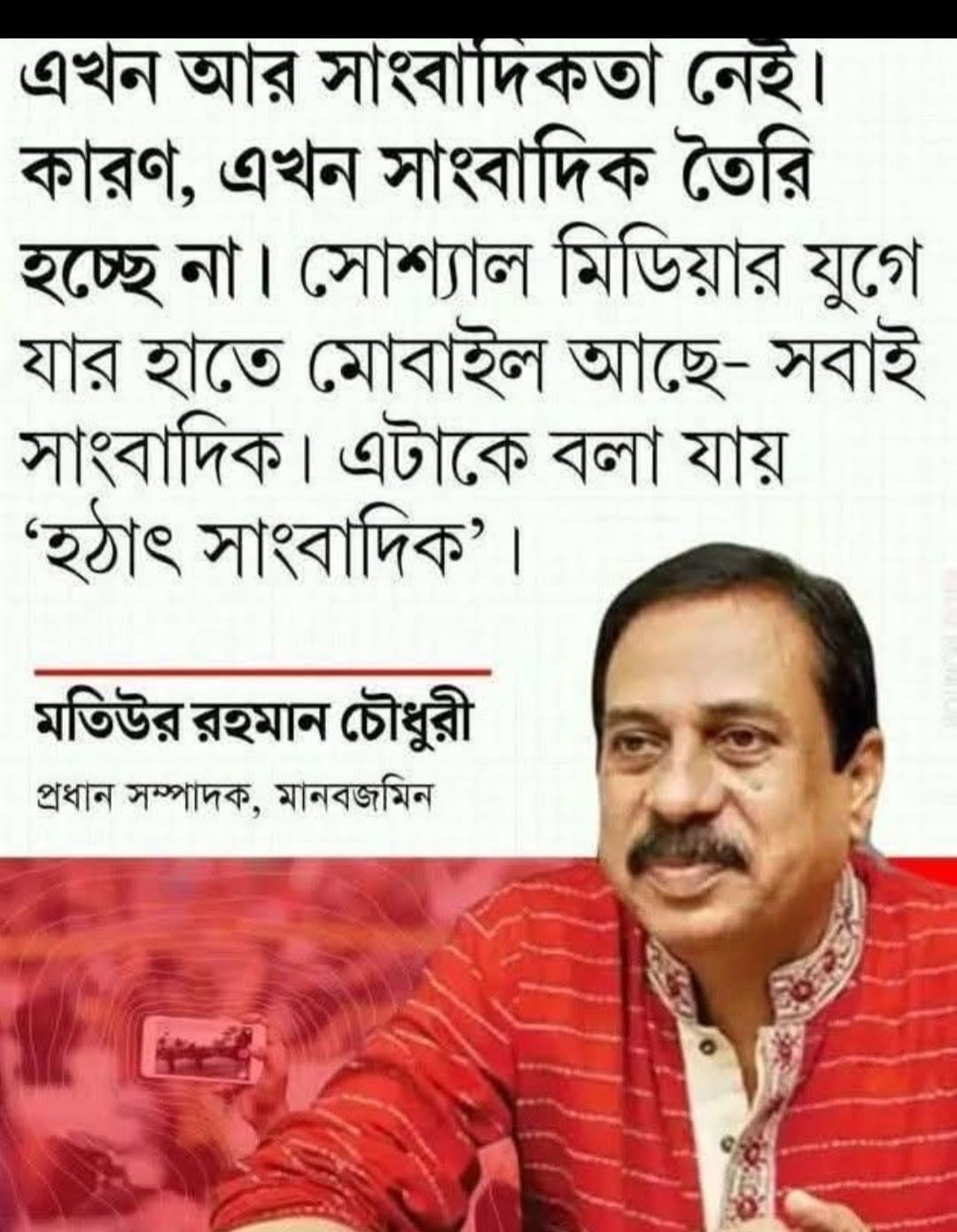

-Md. Kamal Uddin: In the modern world, journalism is no longer just a specific structure confined within professional boundaries—it is a vast information flow, a technology-based movement of public consciousness. Where once a specific institution, specific training, and long experience were required to collect and disseminate news, today a smartphone has become a powerful medium for disseminating information. Within this change, as the definition of journalism has expanded, its accuracy, ethics, and sense of responsibility have also been questioned. The current reality of our so-called journalism in Bangladesh stands in a complex position in the current of global change. As the opportunities for presenting news have increased with the ease of access to technology, so has the tendency for misreporting, rumors, unverified information, and individual-centered propaganda. As a result, the core philosophy of journalism—truth, fairness, and public interest—is being suppressed in many cases. In this context, a deeply significant comment has recently emerged in a discussion—the number of journalists in Bangladesh could reach about 50 million within the next five years. That is, whoever has a mobile phone in his hand will also become a journalist in a sense. This reality may indicate the new era of media revolution, but at the same time it also raises big questions about the standards and sense of responsibility of journalism. The direction and concerns of this change can also be seen in the recent speech of renowned journalist Matiur Rahman. His experience and observations force us to think more deeply about this transformation of modern journalism. In this article, I will try to analyze the real picture of modern journalism and our country in the light of those changes, crises and possibilities—where technology carries both opportunities and responsibilities. The revolution in information technology in the current world has radically changed the face of journalism. Once upon a time, newspapers, radio and television were the only means of disseminating information. But today, through mobile phones, Facebook, YouTube and various social media, every person has become a “news distributor”. In the midst of this reality, the speech given by veteran journalist and renowned columnist Matiur Rahman Chowdhury is not just a comment—but a deep warning about the future of journalism. He said very clearly— “There is no journalism anymore. Because journalists are not being made anymore. In the age of social media, everyone is becoming a journalist. Everyone is a journalist with a mobile phone in their hand.” Through this statement, he basically highlighted an important crisis—the boundary between professional journalism and amateur information flow is becoming blurred day by day. Journalism: Not a Profession, a Responsibility Journalism was never just a profession; it was a deep responsibility to society. A real journalist searches for the truth, verifies information, and gives the right direction to society. He stands up to power and highlights the truth, exposes the inconsistencies of society, and becomes the voice of the people. But in today’s reality, that sense of responsibility has weakened in many cases. Mobile cameras, live videos, and the tendency to quickly share are often spreading information before fact-checking. As a result, the basic foundations of journalism—truth and accuracy—are often neglected. Social media: Blessing or challenge?
Social media has undoubtedly accelerated the flow of information. News from far and wide reaches people instantly. It can also be considered a means of strengthening democracy. But at the same time, it has also created a big challenge. Today, it is seen in many cases—a video or picture is being shared without verification, which later becomes a cause of confusion, rumors and even social unrest. Being “viral” has now become the criterion for newsworthiness. But being viral does not mean that it is true—we should not forget this. The decline of professional journalism The concern expressed in Matiur Rahman Chowdhury’s speech basically indicates the decline of professional journalism. Today, it is seen in many places that the minimum training, ethics and sense of responsibility required for journalism are absent in many.
As a result, what is happening in the presentation of news— dissemination of unverified information, presentation of purposeful news, use of clickbait headlines, dissemination of personal opinions as news. These trends are questioning the credibility of journalism. Where is the real crisis of journalism? The real crisis is not technology, but the misuse of technology. Mobile or social media is not the root of the problem; the problem is the lack of morality and responsibility of the people who use it. A trained journalist knows how to verify information, how to remain impartial, and how to present a news story in a socially acceptable way. But “sudden journalists” do not go through this process. Crisis of truth in the midst of information overload
Today’s era is called the “Information Explosion Era”—that is, the era of information explosion. But truth is often lost in this information overload. The common people often cannot understand which information is true and which is rumor. This is where the role of a real journalist is very important. He does not just provide information, he analyzes the information and presents the truth separately. Therefore, journalism is not just about reporting, but rather being the guardian of truth. What should journalism of the future be like? Matiur Rahman Chowdhury’s statement poses us with an important question—is journalism ending? The answer is, no. Journalism is not ending, but rather taking a new form. However, to take that new form in the right direction, it is important to ensure certain things – making professional training mandatory, practicing ethical journalism, and giving utmost importance to fact-checking. Behaving responsibly on social media and keeping the difference between news and opinion clear is not only the responsibility of the society, but also the responsibility of every person in the society. Because in today’s era, everyone is a partner in information. Even a shared post can have a big impact on the society. Therefore, just as verification is necessary before receiving information, more caution is needed before spreading information. Matiur Rahman Chowdhury’s statement is a warning for us. It reminds us that no matter how advanced the technology is, the basic foundation of journalism never changes. That foundation is truth, morality, and responsibility. If we want to save journalism in today’s digital age, then we must strengthen not only technology, but also our own moral position. Because journalism does not end—irresponsible journalism ends. Standing on the path of truth is the greatest courage of journalism, and that courage is the foundation of a civilized society.