

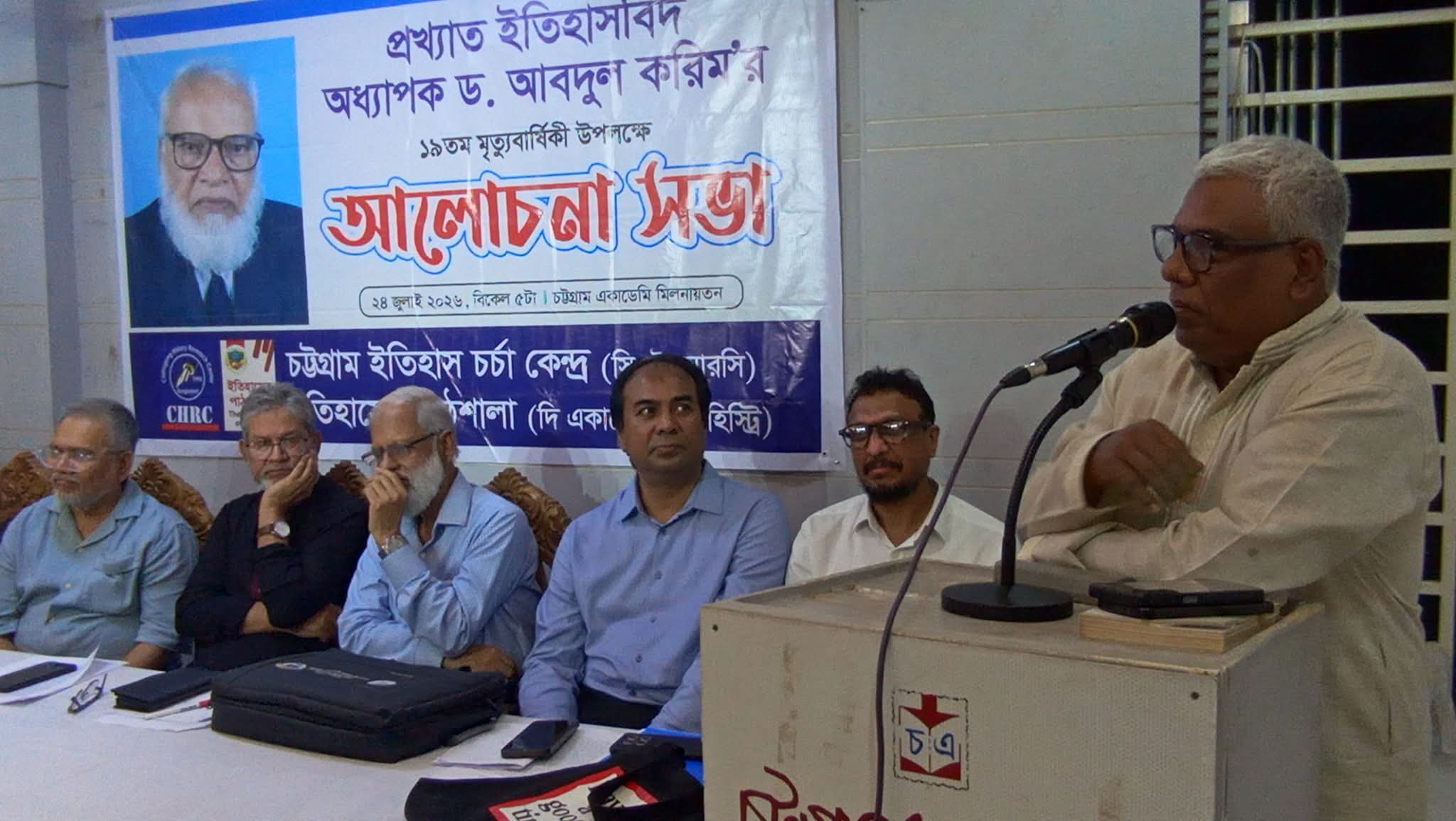

A unique event of deep respect, knowledge and historical thinking was held at the Chittagong Academy Hall on the occasion of the 17th death anniversary of the renowned historian, national professor, researcher and educationist of Bangladesh, Dr. Abdul Karim. This memorial meeting, jointly organized by the Chittagong History Study Center and History Pathshala, started at 5 pm and turned into a colorful intellectual gathering with the lively presence of history lovers, researchers, teachers, students, writers, journalists, cultural workers and conscious citizens. The main initiator of this grand event was the eminent researcher Sohel Mohammad Fakhruddin. This event was an important manifestation of his long-standing research, history study and relentless efforts to make the new generation interested in history. His well-thought-out planning, sincerity and historical consciousness elevated the event to a different level. Teachers, researchers, historians, writers, journalists, cultural figures and history-inquiring people from various universities and colleges of Chittagong were present at the event. Abdul Karim’s life, work, research, thought and method of historical research were discussed. The speakers unanimously said that Dr. Abdul Karim’s contribution to the promotion of Bangladesh’s historical research to international standards is unique and unforgettable. While speaking at this discussion meeting, I said that Dr. Abdul Karim was a historian who did not see history as just a story of the past; he saw history as a mirror of a nation’s self-identity. He believed that the more deeply a nation knows its past, the stronger its future will be. I also mention that he never gave priority to popular belief, rumors or emotions in writing history. He searched for the truth by analyzing ancient documents, inscriptions, coins, manuscripts, government documents and contemporary sources in Arabic, Persian, Bengali and English. The biggest lesson of his research is that “a researcher can never be a real historian without honesty towards history.” Dr. Abdul Karim’s life teaches us that research is not just about reading books; research means asking questions, going to the field, collecting information, verifying the truth by combining different sources and reaching conclusions based on evidence. He has shown that the pen of a historian is not accountable to any person, group or ideology; it is accountable to truth and evidence. His research on the Sultanate and Mughal eras of Bengal, social life, economy, administration, culture, religious coexistence and the history of the entire Bengal including Chittagong is still essential for researchers at home and abroad. By earning his first PhD from Dhaka University and his second PhD from the School of Oriental and African Studies (SOAS), University of London, UK, he established the history research of Bangladesh in a position of prestige worldwide. I also said in my speech—currently, various types of misleading information are rapidly spreading on social media. In this reality, Dr. Abdul Karim’s research method is even more relevant for us. He taught us—no matter how interesting a piece of information is, it cannot be called history without documents and evidence. This honesty and commitment to history is what sets him apart from others.
His life is a silent call to today’s young researchers. As if he had said – read, know, investigate, question and establish the truth. Because the richer the history of a nation, the stronger the self-esteem of that nation will be. The speakers at the discussion meeting also said that Dr. Abdul Karim’s unpublished research, manuscripts and published books should be made more accessible to the new generation. The demand for a research scholarship, memorial lecture and establishment of a history research center in his name also came up with importance in the meeting. At the end of the program, everyone present remembered this great historian with deep respect and prayed for the forgiveness of his soul. At the same time, everyone pledged – to follow the path shown by Dr. Abdul Karim and further strengthen evidence-based history practice. Although Dr. Abdul Karim is physically absent from us, his thoughts, research, books, ideals and philosophy of truthful history practice will guide researchers, teachers, students and history lovers for generations to come. He is a bright star in the sky of history, whose light will never go out. Deep respect, humble gratitude, and sincere prayers remain for his memory.