

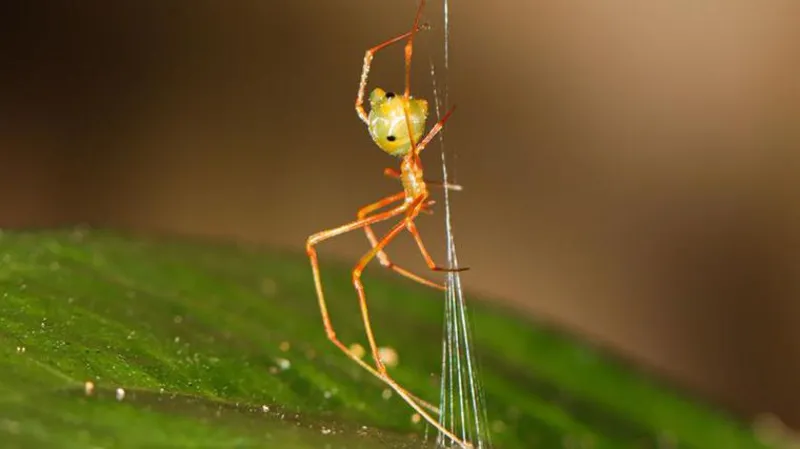

Scientists have discovered a remarkable new species of spider in the remote rainforests of northern Australia that uses a powerful spring-loaded silk trap to capture a single species of ant, revealing one of the most specialized hunting strategies ever recorded in the animal kingdom.
The tiny nocturnal spider, informally nicknamed “Ballista” after the ancient siege weapon, was found by researchers from Macquarie University in the tropical rainforests of northern Queensland. The findings were published in the scientific journal Current Biology.
According to the research team, the spider belongs to the genus Propostira and has evolved a unique catapult-like silk mechanism to hunt the aggressive green tree ant, Oecophylla smaragdina.
Lead researcher Ajay Narendra said the trap generates extraordinary force, launching prey into a larger web at acceleration levels equivalent to “15 times the most extreme g-forces experienced by jet pilots.”
Researchers believe the hunting method evolved because ants are particularly dangerous prey for spiders. Many ant species possess chemical defenses, painful bites, and the ability to rapidly summon large numbers of nestmates to overwhelm predators.
“The snare mechanism appears to have evolved as a highly specialized way of allowing the spider to capture potentially hazardous prey one at a time and transport them a safe distance away from ant trails and nests,” said researcher Jonas Wolff.
The research team spent 10 nights observing the spider’s behavior using high-speed and infrared cameras. During the day, the spider hides beneath leaves in webs built on trees inhabited by green tree ants. At night, it descends approximately 50 centimeters and constructs a cone-shaped trap made of dozens of tensioned silk lines.
Once completed, the spider retreats upward and waits. Scientists observed that when a green tree ant bites the trap, the tensioned silk structure instantly springs into action, catapulting the ant into the spider’s web at extreme speed.
Perhaps most remarkably, researchers found that the spider exclusively captured green tree ants. Even when other nocturnal ant species were placed near the trap, they were ignored. Scientists suspect the spider may use chemical signals or pheromones to specifically attract and provoke green tree ants.
“This appears to be the only known example of a spider web designed to capture a single prey species, and where the trap is triggered by the prey rather than the predator,” Narendra said.
The species was first noticed by biomedical researcher and wildlife photographer Greg Anderson, whose observations helped initiate the scientific investigation.
Researchers say the discovery provides new insights into predator-prey evolution and highlights the extraordinary biodiversity still hidden within Australia’s rainforest ecosystems.