

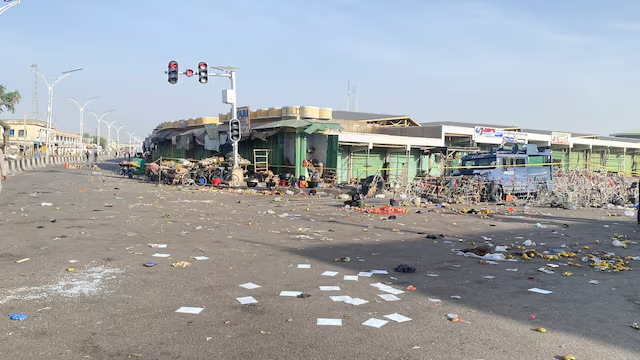

Deadly suicide bombings in northeastern Nigeria have raised fresh concerns about the strength and persistence of jihadist groups, despite years of military operations aimed at dismantling them.
Nigeria’s President, Bola Tinubu, described the coordinated attacks in Maiduguri as the “final desperate” acts of militants seeking to instill fear. However, security analysts argue the attacks suggest the opposite — that militant groups remain capable and confident.
The assault, carried out by multiple suicide bombers in the heavily fortified city of Maiduguri, points to significant intelligence lapses and highlights the ability of Islamist militants to strike urban centers. Experts say the incident underscores ongoing vulnerabilities despite sustained government offensives.
It remains unclear which group was responsible for the attack, reflecting the complexity of Nigeria’s 17-year insurgency. The conflict, primarily driven by Boko Haram and its splinter faction Islamic State West Africa Province, has killed tens of thousands and displaced millions.
Recent weeks have seen a surge in attacks by both groups, leading some analysts to suggest possible coordination between the often rival factions. Ikemesit Effiong, a partner at SBM Intelligence, warned that the bombings could signal the beginning of a broader wave of attacks across northeastern Nigeria, including less protected urban areas.
In response, President Tinubu announced additional military support and equipment, reiterating his commitment to defeating the insurgents — a pledge echoed by previous administrations.
Nigeria has been battling Islamist militancy since 2009, when Boko Haram first emerged in Maiduguri with the aim of establishing an Islamic state. Although the military has pushed militants out of major cities, they continue to control significant rural territories.
According to analysts, military gains are often short-lived. Even when strongholds are targeted, militants tend to retreat and regroup, maintaining their operational capabilities over time.
The crisis-monitoring group Armed Conflict Location & Event Data Project reported that the recent bombing was the deadliest of its kind in Nigeria in seven years.
Experts also highlighted serious intelligence failures, noting that carrying out multiple coordinated attacks in a city that hosts military headquarters raises critical questions about security preparedness.
While some believe Boko Haram — known for its use of suicide bombings — was behind the attack, others do not rule out collaboration with ISWAP.
The violence has escalated during the holy month of Ramadan, with militants targeting military personnel and infrastructure. Despite support from international partners, including the United States, analysts warn that the insurgency remains far from over.
“They are not going anywhere anytime soon,” one expert said, emphasizing that the situation resembles a “whack-a-mole” challenge, where eliminating one threat often leads to the emergence of another.
The latest attack serves as a stark reminder that, even after years of war, Nigeria’s jihadist insurgency continues to pose a serious and evolving threat.