

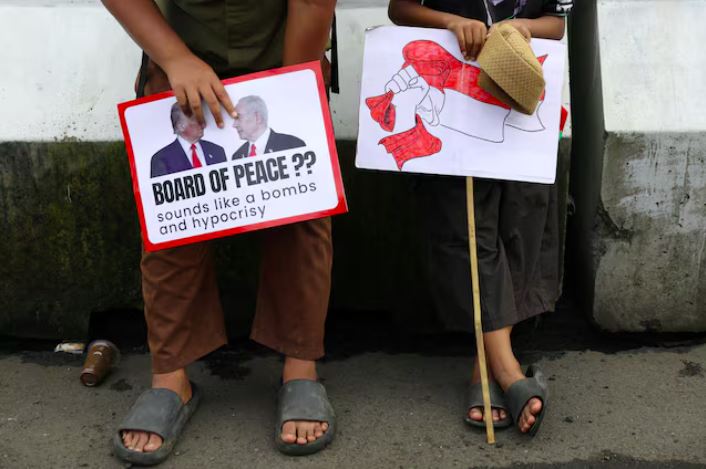

Indonesian President Prabowo Subianto has warned that his country could withdraw from U.S. President Donald Trump’s “Board of Peace” if the initiative does not serve the interests of Palestinians. The statement was released by the Indonesian government on Friday as the ongoing Iran war raises concerns about Indonesia’s role in the initiative.
Prabowo, leader of the world’s largest Muslim-majority nation, has faced criticism from several domestic Islamic groups for agreeing to join the board and for committing Indonesian troops to a Gaza stabilization force. The force was part of a ceasefire arrangement brokered by Trump that ended the two-year conflict between Israel and Hamas.
A U.S. official said on Friday that the deteriorating security situation in the Middle East could affect the timeline for deploying the international stabilization force. The mission was authorized by the United Nations Security Council, with Indonesia expected to play a major role.
“While some deployment timelines may change due to the evolving situation on the ground, discussions with our Indonesian partners are continuing,” a Trump administration official told Reuters.
Indonesia’s Foreign Minister Sugiono said earlier this week that talks related to the Board of Peace—responsible for overseeing the formation of the stabilization force—have been paused because of the escalating conflict involving Iran.
On Thursday evening, Prabowo held a meeting with leaders of several Indonesian Islamic organizations to explain the government’s decision to participate in the initiative. According to a government statement, he emphasized that Indonesia’s involvement would depend on whether it truly benefits the Palestinian people and aligns with the country’s national interests.
Hanif Alatas, a representative of the Islamic Brotherhood Front who attended the meeting, said the president made it clear that Indonesia would not remain part of the initiative if it failed to support the Palestinian cause.
“The president said that if he determines the board no longer benefits Palestine or does not align with Indonesia’s national interests, he will withdraw,” Hanif said.
Last month, the U.S. commander of the planned stabilization force—tasked with supporting reconstruction efforts in Gaza—announced that the deputy commander would be an Indonesian official.
However, Indonesia’s participation has sparked debate at home. The Indonesian Ulema Council, one of the country’s most influential Islamic clerical bodies, previously urged the government to leave the board due to Washington’s involvement in the war with Iran. Critics argue that Indonesia’s role could undermine its long-standing support for the Palestinian struggle.
Meanwhile, Nahdlatul Ulama, Indonesia’s largest Muslim organization, suggested that Jakarta could use its position on the board to encourage diplomatic efforts and reduce tensions in the region.
The group’s leader, Yahya Cholil Staquf, said Indonesia could propose temporarily suspending the board’s activities until broader talks are held on de-escalation and peace related to the U.S. and Israeli military actions against Iran.