

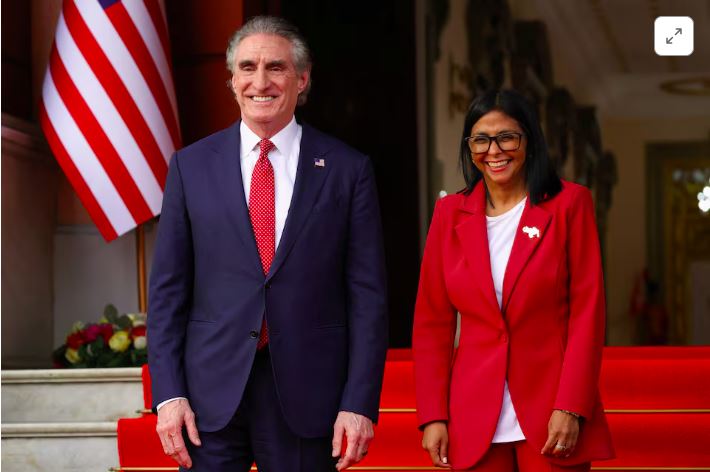

The United States has issued a license permitting certain transactions involving Venezuelan-origin gold, according to a notice published on the U.S. Treasury Department’s website. The move came shortly after U.S. Interior Secretary Doug Burgum completed a visit to Venezuela focused on expanding cooperation in the mining sector.
Burgum, who also leads the U.S. National Energy Dominance Council, praised efforts by Venezuela’s interim president, Delcy Rodriguez, to open the country’s oil and mineral sectors to foreign investment. His remarks echoed earlier support from U.S. President Donald Trump for policies aimed at attracting international companies to Venezuela’s resource industries.
During his visit, Burgum said a new mining law supported by Rodriguez could create opportunities for international firms and that licenses allowing companies to operate in Venezuela’s mining sector could soon be issued. He also said the Venezuelan government had pledged to guarantee security for foreign businesses working in the industry.
Under the new U.S. license, transactions involving the state-owned mining company Minerven and its subsidiaries are permitted if they relate to exporting, selling, purchasing, transporting or delivering Venezuelan gold to the United States. However, the contracts must be governed by U.S. law.
The authorization still includes strict conditions. Payments to sanctioned individuals — except for local taxes or permits — must go through special Foreign Government Deposit Funds accounts. The license also prohibits deals involving debt swaps or digital currencies issued by the Venezuelan government.
Additionally, transactions involving individuals or entities linked to countries allied with the Venezuelan government, including Russia, Iran, North Korea and Cuba, are banned. Joint ventures involving Chinese partners are also excluded under the terms of the license.
Despite possessing vast reserves of minerals such as gold, iron ore, bauxite and coltan, Venezuela’s mining output remains far below its potential due to aging infrastructure, sanctions and a lack of investment. Both Minerven and the state-owned metals group Corporacion Venezolana de Guayana (CVG) have been under U.S. sanctions for years, which has discouraged foreign investors since the nationalizations carried out under former president Hugo Chavez.
Analysts say gold exports could recover relatively quickly if restrictions ease, but warn that the sector will require massive investment — possibly even greater than the oil industry — along with renewed exploration efforts to fully revive production.
Burgum’s two-day visit included a delegation of more than two dozen mining and minerals companies, reflecting growing interest in Venezuela’s natural resources. Rodriguez has also signaled that a recent oil sector reform — which lowered taxes, increased the oil ministry’s authority and gave greater autonomy to private producers — could serve as a model for upcoming mining legislation expected to be presented to lawmakers soon.
According to Rodriguez, Venezuela produced about 9.5 tons of gold in 2025, highlighting the sector’s continued importance to the country’s economy despite years of sanctions and limited investment.