
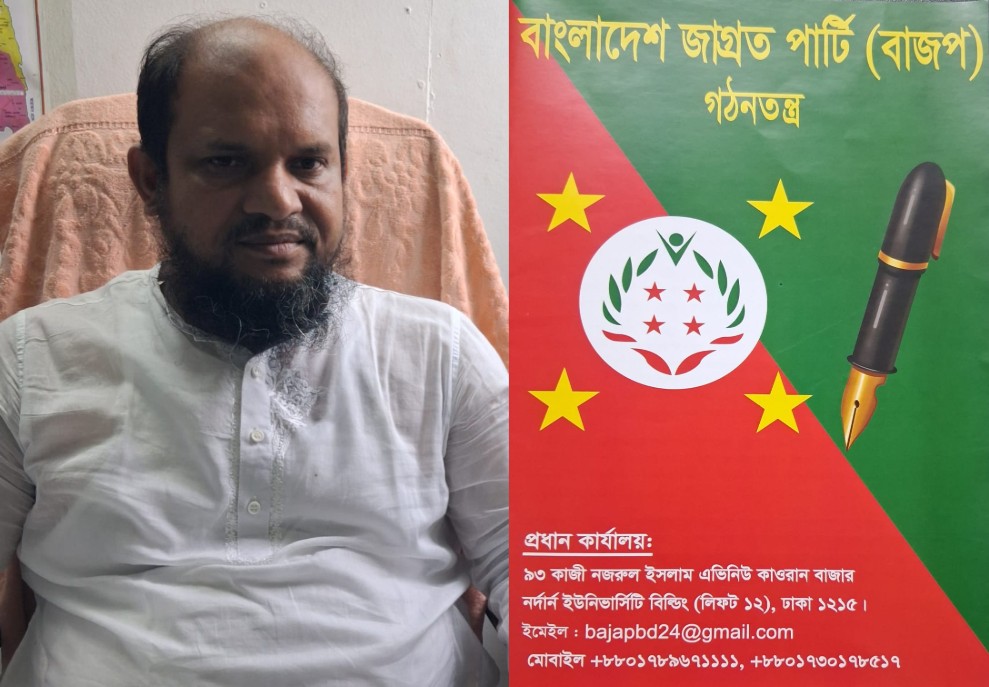


By Mohammad Kamal Uddin : At a time when public trust in politics is repeatedly being questioned and the gap between political promises and reality continues to widen, a new vision and a renewed commitment are emerging in Bangladesh’s political landscape through the Bangladesh Jagrata Party. Its founding Chairman, Engineer Ikramul Haque Khan, believes that the country’s greatest crisis is neither economic nor political—it is a crisis of morality. It is this conviction that has inspired his political journey. Recently, I had the opportunity to engage in an extensive and exclusive conversation with Engineer Ikramul Haque Khan at the central office of the Bangladesh Jagrata Party in Karwan Bazar, Dhaka. Conducted on behalf of Tourist Newspaper and Chattal Chitra Multimedia News, the interview covered a wide range of topics, including his personal philosophy, political vision, statecraft, the future of young people, education, corruption, democracy, and his blueprint for building a new Bangladesh.
What immediately stood out during our meeting was his simplicity and confidence. Although he has spent many years living in Australia, every word he spoke reflected a deep affection and commitment to Bangladesh. His observations on the country’s political, economic, and social realities were thoughtful, analytical, and remarkably clear.
At the very beginning of our discussion, he remarked: “I do not see politics as a ladder to power. To me, politics is a responsibility and a commitment. I firmly believe that the people are the true owners of the state. Politics loses its meaning if it fails to ensure the welfare of the people.” According to him, the Bangladesh Jagrata Party is not centered around any individual; rather, it is an ideology-based political platform. The party stands upon four fundamental principles: Bangladeshi nationalism, the spirit of independence, effective democracy, and religious values.
Engineer Ikramul Haque Khan believes that even after more than five decades of independence, Bangladesh has yet to establish the political culture it truly deserves. Political intolerance, corruption, administrative weaknesses, and the absence of accountability continue to hinder the nation’s progress. He stated: “The people of Bangladesh are incredibly tolerant. They can endure many hardships, but there is one thing they never accept—deception. We must stop deceiving the people. Their votes, opinions, and rights must be respected above all else.” When discussing corruption, he expressed a firm and uncompromising stance. In his view, corruption has become one of the most serious obstacles to national development. While billions are spent in the name of development, the benefits often fail to reach ordinary citizens. “Corruption is not merely the theft of money; it is the theft of people’s future. It is the theft of a nation’s dreams. Without genuine political will, no anti-corruption law can be truly effective.” Turning to education, he emphasized that the world is advancing through technology, innovation, and knowledge. Bangladesh, he argued, must undertake fundamental reforms in its education system if it wishes to remain competitive in the global arena.
“We need an education system that produces skilled individuals, not just certificates. We need education that encourages entrepreneurship and innovation rather than merely preparing people to search for jobs.” He spoke passionately about the country’s youth, describing them as Bangladesh’s greatest asset. With proper planning, leadership, and opportunities, he believes the younger generation can transform the nation. “Our young people possess technology, talent, and creativity. What they need is proper guidance. We envision a Bangladesh where every young person has the opportunity to turn their dreams into reality.”
On the subject of religious values, he emphasized that Bangladesh has a long tradition of communal harmony and coexistence. “Religion teaches humanity, compassion, and moral responsibility. It should unite people, not divide them. Muslims, Hindus, Buddhists, Christians—every citizen deserves equal dignity and equal rights under the state.”
Speaking about the Bangladeshi diaspora, he highlighted the immense contribution expatriates make to the national economy. However, he believes their expertise and experience are not sufficiently incorporated into policymaking and national development strategies. According to him, the knowledge, technological expertise, and management experience gained abroad can play a vital role in Bangladesh’s future progress.
When asked about the future of democracy, he offered a broader perspective: “Democracy is not merely about elections. It is about accountability, freedom of expression, the rule of law, and a humane system of governance. Genuine democracy cannot exist unless the people are placed at the center of power.” Toward the end of the interview, I asked him what kind of Bangladesh he hopes to see in the future. After a brief pause, he replied:”I dream of a Bangladesh where no talented young person remains u nemployed, where no mother fears for her child’s future, where no citizen is denied justice, and where no corrupt individual stands above the law. I want a Bangladesh where the state serves the people—not rules over them.” His response seemed to encapsulate the essence of the entire conversation. As our discussion concluded, there was a clear sense of determination in his words and demeanor. It became evident that he is not merely trying to build a political party; he is attempting to cultivate a new political culture—one based on integrity, patriotism, accountability, and public service. Whether the Bangladesh Jagrata Party will significantly influence the country’s political future remains to be seen. However, one thing was unmistakably clear from Engineer Ikramul Haque Khan’s remarks: he believes that meaningful change is possible through honest leadership, active citizen participation, and a nation inspired by genuine love for its country. It is from that conviction that he proclaims:
“We must awaken a sleeping nation. For it is an awakened people who possess the power to write a new chapter in Bangladesh’s history.”
Interview and Feature Written By:
Mohammad Kamal Uddin Deputy Editor, Tourist Newspaper
Chattal Chitra Multimedia News :::