

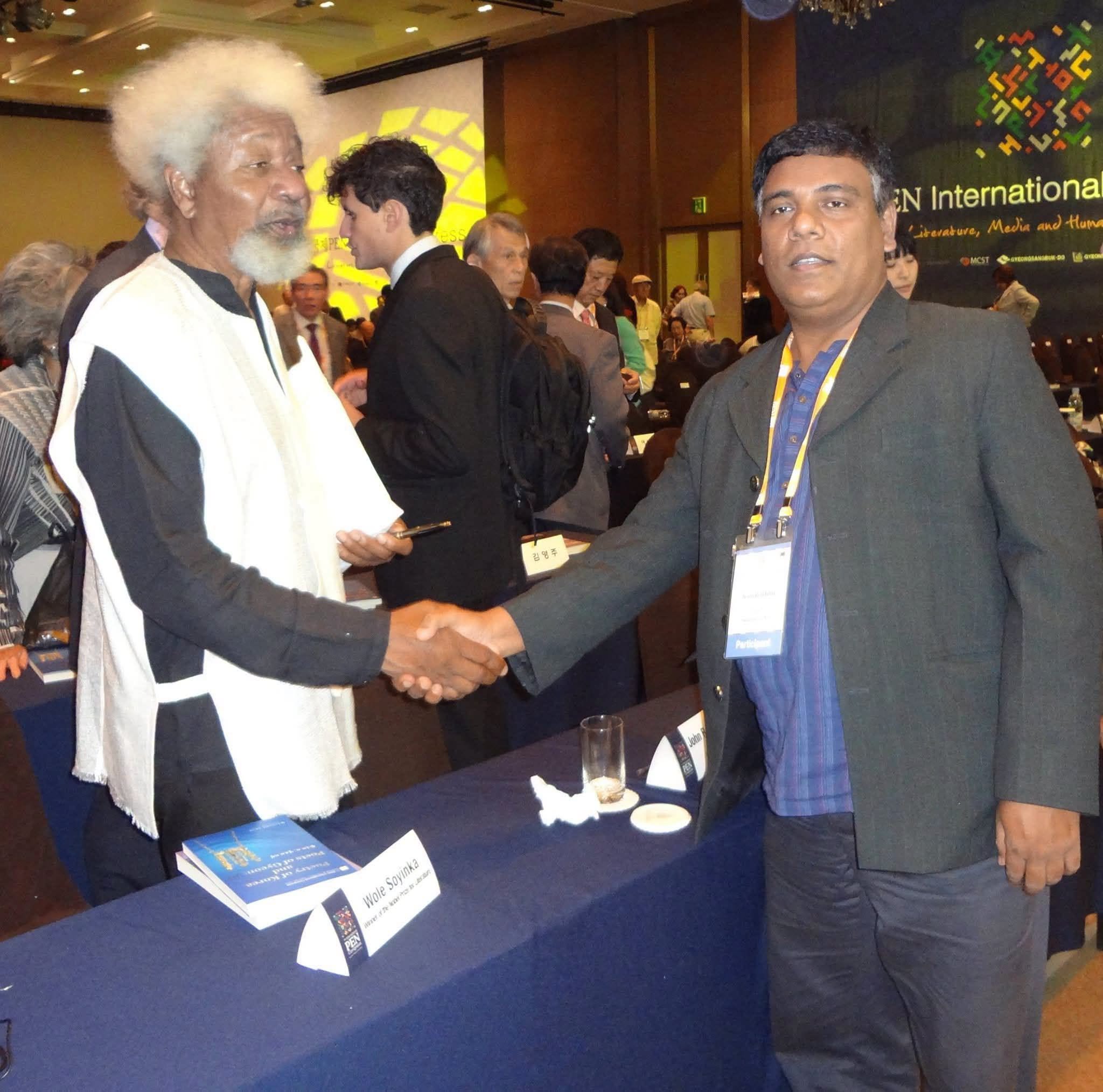

— Md. Kamal Uddin There are some moments in a writer’s life that are not just memories but an endless source of inspiration. Literature is the language of the human soul. The opportunity to participate in the global conference of that language is a rare privilege for every writer. A similar glorious chapter was added to my life in 2012, when I participated as a representative of Bangladesh in the 78th PEN International Congress (World Writers’ Conference) held in the historic city of Gwangju, South Korea. Many famous writers of the world were present at the gathering of writers, poets, researchers, translators and literary organizers from almost every continent of the world. The center of attention among them was the legendary Nigerian writer Wole Soyinka, who won the Nobel Prize in Literature in 1986. Seeing him up close for the first time, shaking hands with him, participating in conversations and spending time on the same stage was a priceless treasure in my literary life. At first glance, I felt that he was a living symbol of struggle, wisdom and humanity. With a dark complexion, white hair and beard, deep yet calm eyes, a modest smile and an unpretentious personality—all in all, he was a true cosmopolitan. There was no arrogance in him; rather, he had equal respect and sincerity for every writer. The pen of protest, the voice of humanity, Wole Soyinka was born on July 13, 1934, in a Yoruba family in Nigeria. From childhood, he grew up in an environment of education, culture and human values. Later, he studied English literature at the University of Leeds in England and became known worldwide as a playwright, poet, essayist and novelist. After Nigeria’s independence, he began to write fearlessly about the political and social realities of the country. His writings were uncompromising against the abuse of power, military rule, corruption and human rights violations. Because of this courage to speak the truth, he was arrested in 1967 and had to spend 22 months in prison. But the prison walls could not imprison his conscience. Bengali Literature in the Eyes of the Nobel Laureate At one point in the conversation, I brought up the literature and culture of Bangladesh. I noticed with surprise that his knowledge of Bengali literature is very rich. He said that Bengali language is one of the richest literary languages in the world. He is aware of Rabindranath Tagore, Kazi Nazrul Islam and many writers of Bengali literature. He also had a deep interest in the language movement and the liberation war of Bangladesh. He said very sincerely— “Bangladesh literature can create a stronger position in world literature. Writing for truth and humanity can never be stopped.”
His words still ring in my ears. He also expressed his interest in visiting Bangladesh and assured me that he would come if invited to any literary or public welfare event. World Writers’ Conference in Gwangju The World Writers’ Conference was officially inaugurated on September 10, 2012 at the Hyundai Hotel in Gwangju. There was great interest in listening to the speeches of the Nobel laureates right from the opening session. Each of their speeches raised questions about freedom of expression, human rights, peace, democracy and the social responsibility of literature. Seminars, discussions, literary readings, exchange of views and cultural events were held every day from morning to evening. Although the languages were different, the language of feelings was the same – the liberation of the people, the victory of truth and the freedom of literature. The proud delegation of Bangladesh The Bangladesh delegation was led by Ekushey Padak-winning writer Farida Hossain. She was accompanied by journalists Ershad Majumder, Dr. Syeda Irene Parvin, writer Mohiuddin, writer Ali Ahamad and many others. Farida Hossain very skillfully presented Bangladeshi literature and culture in the international arena. She invited world-renowned writers to visit Bangladesh. Journalist Ershad Majumdar’s sincere behavior played an important role in building friendly relations with foreign writers. Long lines for autographs, but no arrogance At every break, long lines formed to take pictures and autographs with Nobel laureates. Surprisingly, Wole Soyinka never got bored. He patiently talked to everyone, took pictures and greeted them with a smile. Even at the peak of his world fame, he was a very ordinary person. This humility made him even greater. Free Writing is the Strength of Civilization The most important topic of discussion at the conference was the freedom of the writer. The speakers said that if a writer cannot write the truth due to fear of the state or the ruling class, then society will be plunged into darkness. Wole Soyinka, citing his own life experience, said that to stand for the truth, one must be prepared to make sacrifices. His 22 months in prison are proof of that truth. These words have had a profound impact on my writing career. I have realized that a writer’s greatest strength is his conscience and commitment to the truth. The education I received from a world-class person taught me to recognize literature in a new way during those few days in Korea. I have learned to understand that literature is not just a practice of beauty; it is also a language of human freedom, justice, humanity and protest. Even today, when I remember those moments, it feels as if I was witnessing a brilliant chapter in the living history of world literature. That handshake, that conversation, that inspiration with Wole Soyinka still gives courage to my pen. His humility, wisdom and steadfast stand towards truth remind me again and again that a true writer is never of power, but is a man on the side of the people. This memory is not just my personal achievement; it is a monument to a bridge between Bangladeshi literary practice and world literature. This experience will also be an inspiration for future generations of writers. (The original form of this memoir was published in the book ‘Samkalin Kathar’ written by I Md. Kamal Uddin, published at the Ekushey Book Fair in 2015.