

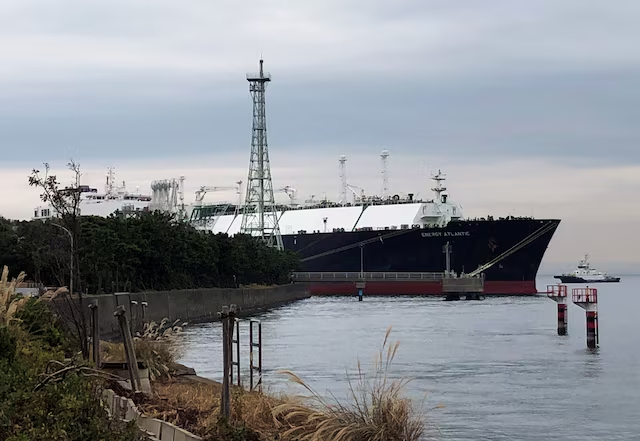

Japan’s major utilities boosted their liquefied natural gas (LNG) reserves by 10% last week, reaching 2.19 million metric tons, according to the Ministry of Economy, Trade and Industry (METI). The ministry said there have been no requests so far for emergency LNG supplies despite rising tensions in the Middle East.
The stockpile level — recorded for the week ending March 1 — represents roughly 12 days of domestic consumption. That compares with 2 million tons held during the previous week, METI data showed.
Japan, the world’s second-largest LNG importer, sources about 11% of its LNG from the Middle East, including Qatar, Oman and the United Arab Emirates. However, only around 6% of total imports pass through the Strait of Hormuz, which has been closed following U.S.-Israeli military action against Iran.
Global oil and gas prices have climbed as the conflict disrupted energy flows in the region. Tehran has reportedly targeted ships and energy infrastructure, halting exports and navigation in parts of the Gulf.
To reduce supply risks, METI has instructed JERA — Japan’s largest LNG buyer — to secure at least one LNG cargo per month, equivalent to about 70,000 tons, under the government’s Strategic Buffer LNG (SBL) scheme.
“We have not received any requests for support from electric power or gas companies for SBL usage,” a METI official said, adding that the ministry does not foresee an immediate LNG shortage.
JERA declined to comment on the SBL arrangement but confirmed that none of its LNG vessels have been affected by the conflict in the Gulf or by Qatar’s production halt.
Kansai Electric Power said about 13% of its LNG supplies come from Qatar and acknowledged that prolonged instability could affect deliveries.
Still, analysts suggest Japan remains relatively insulated. According to Kpler analyst Go Katayama, Japan holds more than 4 million tons of LNG in storage overall. With only about 0.1 million tons per week typically transiting through the Strait of Hormuz, the country is “highly insulated” from a narrow disruption of the waterway.
“In a pure Hormuz-only outage scenario and under stable demand conditions, Japan’s inventories would provide roughly 44 weeks of cover — close to a year,” Katayama said. More broadly, Japan’s LNG stocks provide around three weeks of supply coverage under normal consumption patterns.
While authorities remain on alert amid ongoing geopolitical tensions, current stock levels suggest Japan’s energy supply remains stable for now.